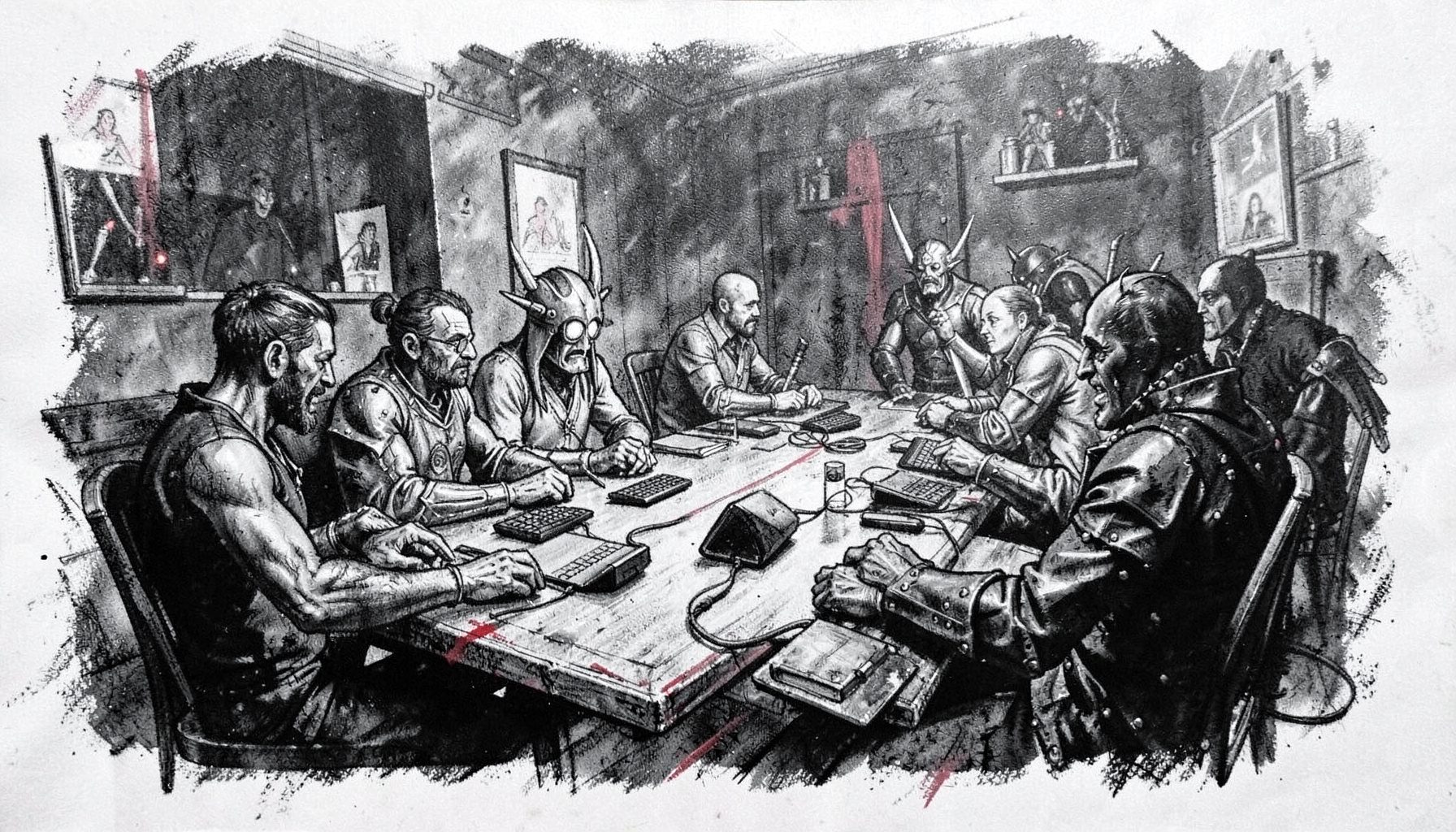
A Guide to Running a Game for Seven or More Players
A game for seven or more players can feel like organised chaos until every person has a clear job in the story. The best large-party tabletop games create shared stakes rather than assigning each character a private queue of rules. Designing around decisions, negotiation and changing circumstances gives the game master structure without taking choice away from the table. The inclusive, collaborative spirit shown at the 2018 High Level Games Convention in Atlantic City offers a useful model: every participant should have a reason to act.
This guide explains how to scale a tabletop role-playing game for seven or more players without losing the story, the pace or the people at the table. It applies to one-shots, campaign instalments and live-action adaptations, from a convention skirmish in an exhibitor hall to a multi-hour game in a community hall. The emphasis stays on collaborative storytelling, practical preparation and an inclusive session that works for a mixed group of regulars and newcomers.
Design the game around shared decisions
Start with a premise that improves when more voices enter it. A disputed inheritance, a failing station or a city preparing for a festival gives every character a reason to care. Keep the central question visible, but let players determine how they influence it.
Translate the premise into two or three connected objectives rather than a dozen disconnected errands. Give each objective at least two possible approaches, such as persuasion, infiltration, technical problem-solving or direct force. The aim is to make each choice consequential to the whole party without forcing every character into combat.
Reward cooperation without requiring constant agreement. A quiet character can spot a detail, a forceful character can hold a crowd’s attention, and a newcomer can carry the party’s token if the scene changes quickly. Rotate the spotlight deliberately and let quiet success matter as much as a dramatic speech.
Select a system that can carry a large party
Choose rules that reduce bookkeeping before adding rules for spectacle. For eight to twelve participants, a rules-light or prepared-stat system is often easier to run than one requiring extensive maths. Pre-calculate likely encounters, limit tracked resources and keep a one-page reference beside the game master.
Adapt the challenge, not the worth, of each character. If six players must confront guards, add reinforcements, terrain or competing goals instead of simply increasing hit points. Build multiple ways to succeed because a single obvious solution can leave half the table waiting. A group objective with individual contributions often scales better than one heroic finale.
Test the format before the full session. Conventions are useful for this because they gather different expectations and play styles in one place; the advice on finding playtest groups can help you recruit a focused group. If possible, run a short rehearsal with the same system, starting characters and seats you expect to use.
Give every player meaningful agency
Give each person a decision that can alter the shared story. Avoid making every character a specialisation with one permitted task, since that turns extra players into assistants. Strong roles overlap: a hacker may also negotiate, a fighter may read people, and an investigator may control a useful object.
Use a party roster or whiteboard so everyone can see current goals, known facts and unresolved risks. This reduces repeated explanations and gives late arrivals a route into play. Invite brief character-to-character exchanges, but keep them brief; a private conversation lasting too long can divide attention from the main group.
Assign small leadership jobs that rotate. A map holder, recorder, timer or rules explainer can distribute the game master’s workload without stripping characters of choice. Make these jobs clear, consensual and non-hierarchical, and ask the table which form of support it wants before the session begins.
Run turns, time and conflict with less friction
Give every character a turn without letting every turn consume the same amount of time. Time-box routine actions, combine trivial decisions and let players state simple moves together before detailed roleplay. In a busy encounter, announce the clock, spotlight one complication and pause for consequences rather than branching into every possible response.
Long sessions need deliberate pacing and breaks. The account of a twelve-hour marathon session illustrates how much can happen when a game master sustains momentum across an extended event. Save major reveals for meaningful pauses, and build in a meal or outdoor break before fatigue turns minor rules disputes into major ones.
Plan for imperfect decisions. When players disagree, clarify the intended goal, offer two plausible interpretations and move on unless the choice will cause material harm. A game master who accepts a workable solution preserves agency; one who demands the intended solution makes the group feel judged rather than engaged.
Prepare the venue for people, noise and Australian weather
Book a room that can hold the full party without forcing everyone into a cramped circle. In Melbourne, inner-suburb cafés with tram access can work well for regular sessions, while Sydney groups may need a venue close to rail or buses because distances make late finishes costly. Check step-free access, toilet timing and the maximum safe occupancy before confirming.
Control noise at the source: use headphones for solo exploration, reserve a side room for loud scenes and agree on a signal when discussion becomes private. Ask about food and drink rules well ahead. An Australian game night may finish with shared pizza or a sausage sizzle, but venues differ on outside food, BYO drinks and alcohol service, so confirm licensing and waste arrangements.
Design for local conditions rather than copying a schedule from another country. Brisbane’s summer heat and afternoon storms make an air-conditioned indoor room and reliable breaks especially valuable. If tickets or materials are sold, price them in Australian dollars, include GST where required and account for local shipping costs; Australian publishers and creators often test demand through specialist shops or campaigns such as Pozible.
Protect the social contract at the table
Agree on boundaries before play begins, using tools such as lines, veils and an open-door policy. Explain that a player may pause, skip or revise content without having to defend the decision. Keep check-ins brief and private, and treat a request as a request rather than an obstacle to debate in front of the group.
Make participation accessible. Avoid requiring constant public performance, provide readable rules and large-print or digital references, and include newcomers in decisions without forcing them to prove expertise. The 2018 High Level Games Convention’s emphasis on inclusive participation is a strong standard: no one should need special status to ask for clarification or suggest a better process.
Prepare for conflict without letting it dominate. If two players develop tension, separate personal disagreement from fictional rivalry and let the table set boundaries. If a participant becomes disruptive, use a clear pause and facilitator support. A designated co-game-master or safety-conscious player can help, though no one should police another person’s identity or motives.
A reliable run-of-show for the game master
Use this as a flexible run-of-show rather than a rigid script. Keep the planned beats visible, but allow the party’s decisions to change their order. The aim is a session that feels purposeful from the first five minutes and leaves enough energy for a shared ending, even when the group takes an unexpected route.
A useful checklist for a large-party game includes:
- Set the frame in five minutes: goals, boundaries, turn order, breaks and who controls timing. Assign a note-taker and rules helper, but explain that every decision remains with the player.
- Use three story beats with flexible triggers. For each beat, note what must happen, what players may change and which complication appears if they ignore it. Leave room for improvisation without preparing so much that every choice feels trapped.
- Keep one visible tracker for party status, key clues and time pressure. Move details into spoken narration and quick summaries rather than reading long passages aloud or demanding frequent note-taking.
- Schedule a break every 60 to 90 minutes, with water and a clear return time. For an all-day convention game, protect meal and outdoor breaks so attention does not collapse during the finale.
- End with consequences and a hook. Ask what each character gained, changed or left behind, then point toward a consequence already planted in the world rather than inventing a last-minute cliffhanger.
Keep the final ten minutes for closure: resolve outstanding risks, acknowledge quieter character contributions and record the next agreed step. If the group wants to continue, a short downtime scene can bridge sessions without repeating every consequence. The practical takeaway is to leave every participant with a visible contribution, a resolved consequence and a clear reason to remember the shared session.