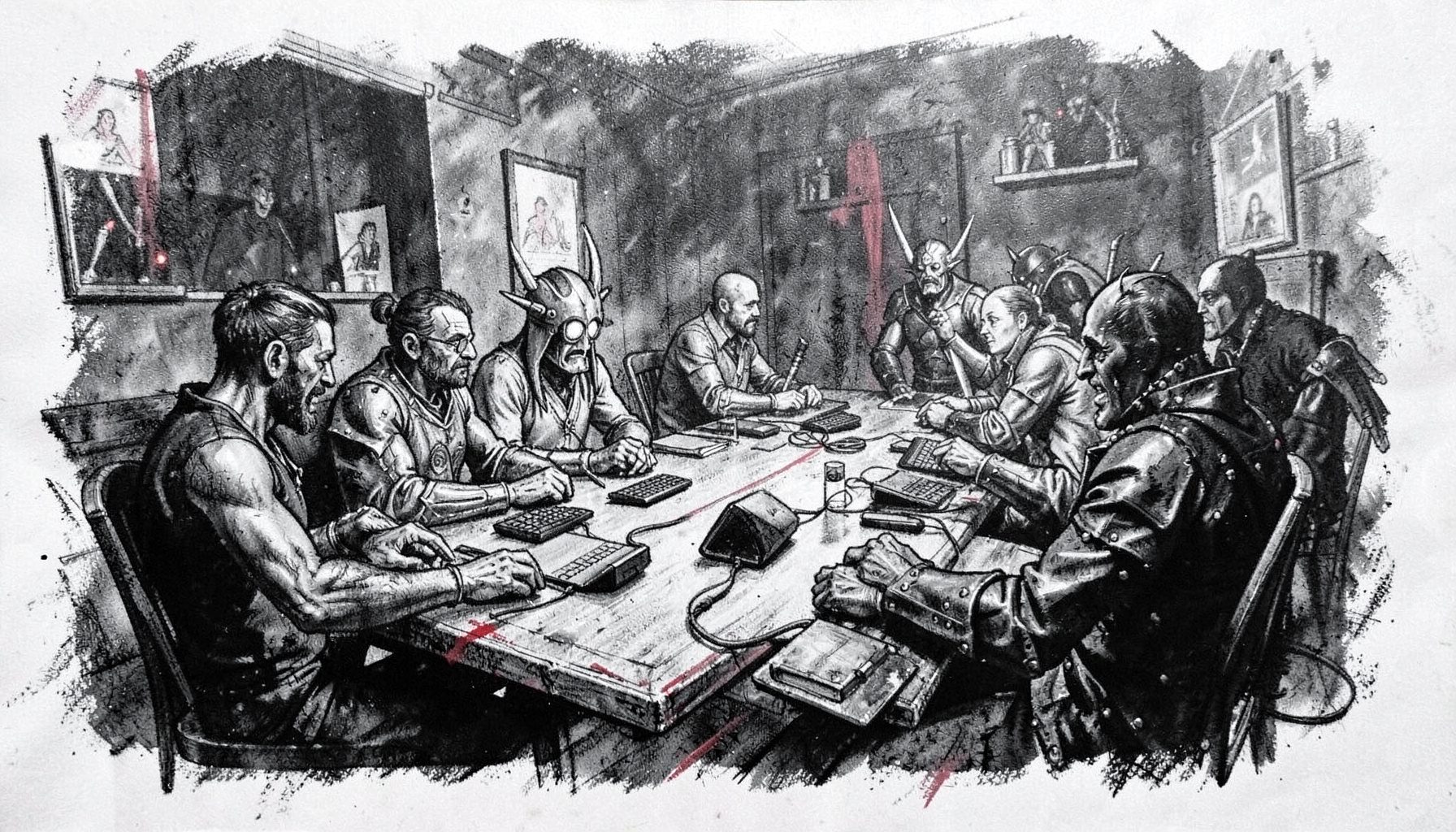
Escape Rooms and the Game Master’s Eye
Escape rooms reveal something tabletop role-playing games can conceal: players are constantly communicating, even when they are silent. A hand hovering over a drawer, a glance towards another player, or a sudden change in posture can show where attention, uncertainty, or excitement is gathering. The game master who notices these signals can shape a better session without forcing the group towards a predetermined answer.
At a convention such as High Level Games Convention at the Showboat Hotel in Atlantic City, this kind of observation became especially visible. Players arrived with different systems, expectations, and levels of experience, then had to collaborate quickly in a room full of puzzles, props, performers, and unfamiliar people. Escape rooms offered a concentrated lesson in reading behaviour under pressure.
For Australian game masters, the lesson transfers neatly to a home game in Brisbane, a club night in Melbourne, or a convention session in Perth. A group might use “keen as” to describe enthusiasm while quietly disengaging from a scene, or spend an entire arvo debating a clue because nobody wants to admit they are stuck. Careful observation helps the GM respond to what players are actually doing rather than what the adventure assumes they will do.
Reading The Room Before The Clue
An escape room is built from visible attention. Players cluster around the object that seems important, repeatedly return to a particular wall, or divide tasks according to confidence. These choices provide the facilitator with a live map of the group’s thinking. The room itself becomes a feedback system: every movement suggests a theory, a priority, or a possible misunderstanding.
Game masters can use the same approach before and during a tabletop session. Notice who opens the character sheet immediately, who waits for an invitation to speak, and who starts making jokes when the plot becomes unclear. A player looking at the dice rather than the other participants may be calculating risk, feeling anxious, or simply preparing an action. Observation does not provide a perfect diagnosis, but it offers useful evidence.
This is particularly valuable in mixed-experience groups. At an Australian games club, a veteran player may fill every silence while a newcomer from a local university group is still learning when it is acceptable to interrupt. The GM can redistribute attention by asking for a quieter character’s view, rather than assuming the loudest voice represents the whole table.
Attention Is A Limited Resource
Escape rooms teach facilitators that attention has a physical rhythm. Groups surge towards a discovery, scatter when a task becomes repetitive, then gather again when a timer or new clue restores urgency. If every puzzle demands the same level of concentration, players become tired and start overlooking details that would otherwise be obvious.
Tabletop scenes work in much the same way. A lengthy investigation may need a change in pace: a short conversation with an NPC, a physical handout, a decision with immediate consequences, or a quick character moment. These adjustments are not distractions from the story. They refresh the group’s ability to notice and interpret information.
A GM should also distinguish boredom from productive quiet. When players lean forward, compare notes, and speak in short bursts, silence may indicate deep engagement. When they check phones, look towards the snacks, or begin side conversations, the scene may have exceeded its useful length. At a Sydney apartment game, where sessions often run after work and dinner, managing energy can matter as much as managing initiative order.
The Meaning Of Hesitation
In an escape room, hesitation is often treated as a request for a hint, but it can mean several different things. Players may have found the right object and fear damaging it. They may understand the clue but doubt their interpretation. They may be waiting for permission to take an unusual action. The facilitator needs to observe the type of hesitation before deciding how much assistance to give.
The same distinction matters in role-playing. A player who pauses before speaking as their character may be searching for an emotional response, not a plot solution. Another may remain quiet because the scene has no obvious entry point. Offering a broad prompt such as “What does your character notice?” can support both players without revealing the answer or dictating the performance.
Hints are most effective when they target process rather than conclusion. An escape-room facilitator might encourage the group to organise its discovered items, revisit a neglected clue, or explain its current theory aloud. In a campaign, the GM can invite players to summarise what they know, identify a contradiction, or describe what their characters would reasonably test next. This preserves agency while making the group’s reasoning visible.
Props, Space And Player Behaviour
Physical space changes the way players think. An object placed at the centre of an escape-room table receives more attention than one tucked beneath a chair, whether or not it is important. In a tabletop game, the map, miniatures, cards, handouts, and GM screen create similar signals. Players read placement as information, sometimes more strongly than the GM intended.
That makes prop management part of game mastering. If every document is presented with theatrical emphasis, the group may assume every document is vital. If a puzzle handout is difficult to read under a dim lamp, players may interpret frustration as a challenge rather than a practical problem. A good facilitator watches whether the physical setup supports the intended focus.
Australian venue conditions can make this especially practical. A club meeting in a community hall may have harsh fluorescent lighting, limited table space, or a noisy air conditioner. A convention room in Adelaide or Canberra may require players to share crowded tables with unfamiliar groups. Moving a map into the centre, reading text aloud, or giving each player a clear copy can prevent environmental friction from being mistaken for poor engagement.
Collaboration Reveals The Real Game
Escape rooms are collaborative storytelling laboratories. Players reveal their preferred roles quickly: the organiser, the sceptic, the experimenter, the note-taker, the lateral thinker, or the person who keeps morale high. These roles are not fixed personalities, but they often emerge when the group faces uncertainty and a visible time limit.
A tabletop party also develops an informal division of labour. One player may track clues while another handles every social interaction. This can be useful until a specialist becomes the only person allowed to contribute. The GM who observes these patterns can design scenes that invite different forms of expertise, giving the mapper, actor, rules enthusiast, and quiet analyst meaningful opportunities.
The relationship between digital design and tabletop play offers another useful lens. A convention discussion of video game mechanics highlights how interfaces guide attention through feedback, rewards, and clear affordances. A tabletop GM has fewer visual controls, so player behaviour becomes the interface. Their questions and movements show whether the fiction is legible.
What Convention Play Makes Visible
Convention sessions compress the social learning that normally takes weeks. A GM may have only four hours to establish safety, explain a rules system, give everyone a spotlight, and create a satisfying ending. Observation becomes essential because there is little time to rely on assumptions about the group.
High Level Games Convention brought together tabletop players, LARPers, designers, artists, publishers, and vendors in one shared environment. That mixture demonstrated how different play cultures interpret the same invitation. Someone experienced in live-action role-play may look for embodied cues and immersive objects, while a board-game player may expect explicit procedures and a clear win condition.
Workshops also showed why facilitation is a craft rather than a script. The anatomy of a workshop offers a useful model for thinking about pacing, participation, and structured learning. A GM can apply those principles by alternating explanation with action, checking comprehension through play, and adjusting the plan when the room’s energy changes.
Habits That Sharpen Player Observation
Observation should be active without becoming intrusive. The goal is not to monitor players as if they are solving a behavioural puzzle. It is to notice enough information to make the game more welcoming, clearer, and more responsive. The following habits work across escape rooms, one-shots, campaign nights, and convention tables:
- Track who has spoken, acted, or made a meaningful decision during the last scene.
- Watch for repeated actions, such as rereading one clue or returning to one location.
- Ask whether silence reflects concentration, uncertainty, discomfort, or fatigue before intervening.
- Offer process-based hints that help players organise their thinking without removing the discovery.
- Change the sensory rhythm with a prop, NPC exchange, time pressure, or short character beat.
- Check that lighting, seating, maps, and handouts are helping players focus.
- After a session, record one moment when player behaviour contradicted your preparation.
These habits are easy to adapt to local play. In a busy Melbourne café, a GM may need to read attention through posture and eye contact over background noise. At a regional Queensland convention, where players may have travelled a long way and be ready for a big social experience, fatigue can appear as joking or restlessness. Good observation includes the setting, not just the people.
Turning Observation Into Better Sessions
The most valuable lesson from escape rooms is that player behaviour is information, not a problem to suppress. Confusion can indicate a missing connection, enthusiasm can point towards an unexpected story, and silence can signal either intense thought or a need for invitation. The GM’s task is to interpret these signals carefully, then make small adjustments that preserve player ownership.
This approach also supports inclusive play. When the facilitator notices who is being interrupted, who has not had a chance to contribute, or who is consistently asked to perform outside their comfort zone, the table can be reshaped without public embarrassment. A brief pause, a written prompt, or a turn-taking structure may be enough to restore balance.
For a practical starting point, run the next session with a small observation note beside your rulebook and record who speaks, where attention gathers, and when energy changes; review those three notes immediately after the game and use them to adjust the following scene.