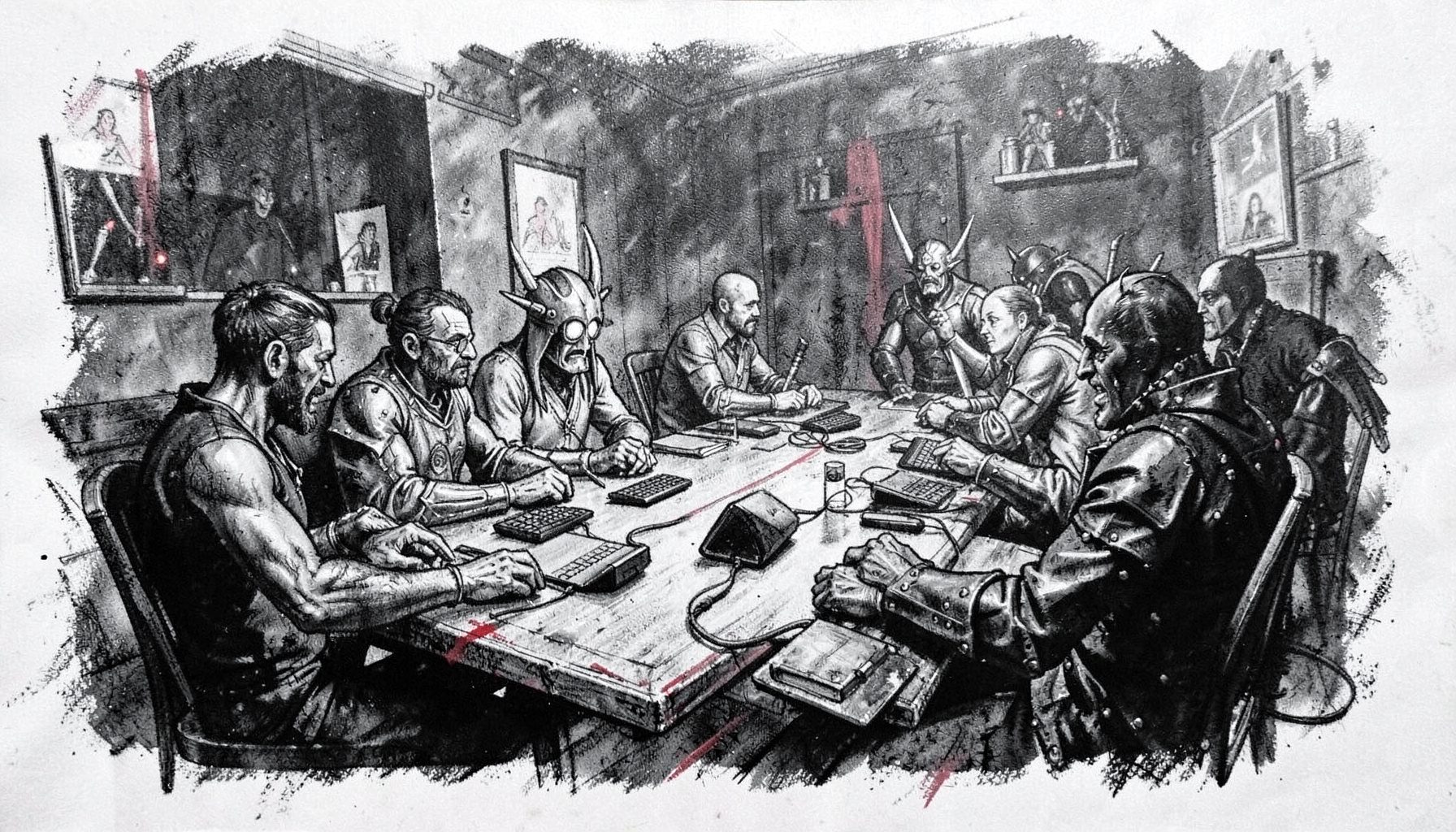
Anatomy of a great convention workshop
At the 2018 High Level Games Convention, held at the Showboat Hotel in Atlantic City, New Jersey, tabletop role-players, live-action players, designers, artists, publishers and vendors gathered in one busy community. Alongside LARP experiences, gaming sessions, panels, workshops and an exhibitor hall, immersive challenges such as escape rooms showed how a well-run activity can turn strangers into collaborators.
The anatomy of a great convention workshop begins with intent. A useful session gives participants a clear experience to attempt, practical knowledge to take away and a reason to talk to people outside their usual play group. Success may look like a playable prototype, a resolved scene, a character concept or a better grasp of running collaborative games, but it must be defined before décor, props or promotional copy are added.
Workshops at a convention have a different job from ordinary meetings. They share rooms with queues, noise, neighbouring events and short breaks, while participants may have arrived with different expectations. Great sessions protect their core purpose from that surrounding activity and create enough space for experimentation, courtesy and shared storytelling.
The inclusive spirit visible across High Level Games Convention matters here. A strong workshop does not treat accessibility, safety or belonging as final checks; it builds them into the design, casting, instructions and feedback process so that more people can contribute meaningfully.
Begin with a precise workshop promise
A workshop objective should describe a change, not a subject. “Understand character creation” is broad; “build one playable character whose motivation creates a difficult choice” can guide a 90-minute session. Pair that outcome with the expected audience, prior knowledge, group size and final artefact so participants can judge whether the session fits them.
A concept map prevents attractive but disconnected ideas. Connect the opening prompt, the activity, the facilitator’s input and the closing reflection. Every element should either move participants toward the outcome or create a welcome transition to it. This also helps a designer cut a clever feature that consumes time without strengthening the learning.
Design the experience before the details
Start with the participant’s journey. For a tabletop workshop, show how a rule produces a decision; for a LARP, stage how information, movement and character intent create tension. At High Level Games Convention, the coexistence of table games, live action and immersive rooms offered many ways to test that journey, but the best choice still depends on one memorable interaction rather than a collection of borrowed tricks.
Give the session an arc: invitation, orientation, first action, complication, collaboration, application and closure. The arc need not take equal time. A short explanation can precede a long debrief, while the central activity may consume half the session. Let participants understand the stakes early, then leave enough time to absorb what happened and decide what they will do differently.
Limit the material to what can be used well. One strong mechanic, a handful of props and a clear decision often create more excitement than a large collection of options. Rehearse transitions, identify what happens if a prop is lost and protect the ending from overrun. Afterwards, a facilitator can write a convention recap that records the actual participant experience, useful details and honest improvements rather than merely repeating the pitch.
Build participation into every segment
Facilitation is the workshop’s live design. Explain how choices will be made, make space for quieter participants and invite contribution without forcing anyone into performance. In role-play, distribute useful tasks and narrate the world so one confident actor cannot carry the scene. In tabletop work, ask for reasoning at the table and rotate who speaks for the group.
Feedback should sharpen the craft rather than flatter the creator. Give specific prompts: which moment changed your decision, which instruction felt ambiguous, where did another participant’s contribution alter the result? Observe body language and note where the group became engaged or excluded, then adjust the next run. A debrief that connects experience to technique makes the workshop educational without removing its sense of play.
Collaboration also benefits from mixed forms of expertise. The convention’s artist panel discussions illustrated how visual artists, writers and game developers can translate ideas across disciplines. A workshop can use the same principle by pairing a drawing exercise with scene design, a rules prototype with character motivation, or a performance beat with visual storytelling. The bridge should be practical, so participants leave with something they made, not just an abstract conversation.
Make access and inclusion practical
Capacity, clarity and comfort determine who can take part. Publish the session length, physical demands, required materials, age guidance and accessibility details before registration. Offer alternatives for movement, vision, hearing or sensory needs where possible, and let participants request a quieter role without explaining a diagnosis. Choose a room whose layout supports circles, tables or clear sightlines rather than relying on whatever chairs happen to be available.
Australian events add specific practical considerations. Sydney, Melbourne, Brisbane and Perth have different venue costs, transport patterns and local convention communities, while community halls, gaming stores and multipurpose rooms create their own atmosphere. Budgets are usually quoted in AUD, so state whether GST is included; for commercial support, local sponsor options can be matched to audience size, deliverables and campaign goals rather than treated as generic exposure.
Regional participants may cross thousands of kilometres or several time zones to attend a major convention. Publish times in the local timezone and the event timezone, record essential guidance, and provide a remote or on-demand route when the format allows. These details widen access without asking every Australian attendee to absorb the cost and uncertainty of interstate travel.
Cultural welcome can also shape the room. Many Australian gatherings open with an Acknowledgement of Country, and a workshop that includes one should explain its purpose briefly rather than treat it as decoration. Invite local knowledge into examples, credit participants and creators properly, and use names and pronouns consistently. These habits signal that contribution is expected, not merely permitted.
Prepare the room, people and materials
A detailed design becomes dependable through checklists, rehearsal and a shared facilitator brief. Decide what must work, what can be simplified and what must never be improvised. Assign ownership for arrivals, timing, safety, materials and questions so participants receive a coherent experience.
Session design checklist
- State one observable participant outcome.
- Match activities to the stated skill level.
- Build the session around one central decision.
- List props, printouts and digital requirements.
- Reserve time for setup, reset and overruns.
The design checklist should also be tested against the venue. Confirm that the room is available early enough for setup and that participants can return to it after a break. Where an activity depends on tables, movement or quiet concentration, the chosen layout must support that need rather than the opposite.
Facilitation checklist
- Send joining and arrival information beforehand.
- Name facilitator, support and safety roles.
- Test access, sightlines and participation options.
- Prepare prompts for quiet and first-time attendees.
- End with a tangible takeaway and structured feedback.
Rehearse the opening and the recovery plan. Invite a colleague to watch for unclear instructions, unexplained jargon and moments when participation falls unevenly. After the session, compare observations with participant feedback, then revise the activity while the experience remains fresh.
Compare the main workshop formats
No format is universally strongest. Match it to the outcome, room, group size and amount of facilitator confidence. The comparison below shows the trade-offs worth considering before promotion; a useful session needs an honest design, not the most fashionable label.
| Format | Best for | Main strength | Common risk | Design move that helps |
|---|---|---|---|---|
| Tabletop scenario | Rules and decision-making play | Strong shared information and reflection | Discussion stalls or one player dominates | Give every player a role in resolving a dilemma |
| LARP encounter | Embodied storytelling and live tension | Immediate choices and memorable presence | Performance pressure excludes quieter players | Offer expressive, technical and observer roles |
| Creator lab | Prototyping and idea development | Participants finish with a tangible artefact | Scope expands beyond the session | Set one deliverable and one decision point |
| Panel with exercise | Shared context and professional insight | Combines expertise with participation | Talk becomes lecture and dominates the time | Use short inputs followed by paired practice |
| Escape-room challenge | Team problem-solving under pressure | Clear goal and fast feedback | Puzzles fail for reasons unrelated to learning | Test each step and allow multiple solution routes |
Mixed formats work when each component has a distinct purpose. An artist demonstration can introduce visual principles, a tabletop exercise can turn those principles into decisions, and a LARP scene can test how the decisions feel in motion. The combination should feel purposeful rather than like a showcase of every activity available at the convention.
Carry the learning beyond the session
The closing minutes determine whether insight becomes memory. Ask participants to name one choice they would make differently, one technique they want to try and one question they are taking home. Capture the shared discoveries, but separate those from individual notes. A concise handout, photo or online summary can preserve the useful structure without turning the outcome into marketing copy.
Evaluation should match the promise. If the aim was a playable prototype, inspect whether it can be tested; if it was a dramatic scene, ask whether choices shaped the experience; if it was skill development, request a specific change participants can apply. Gather feedback while the session is still clear, then use it to revise the description, room setup and future run.
A great convention workshop aligns purpose, participation and preparation. It lets the convention’s energy work in service of the session while retaining clarity, care and room for surprise. The idea to remember is simple: when every design choice supports a shared outcome, attendees do not merely attend an activity—they leave with a story, a skill and a reason to return.