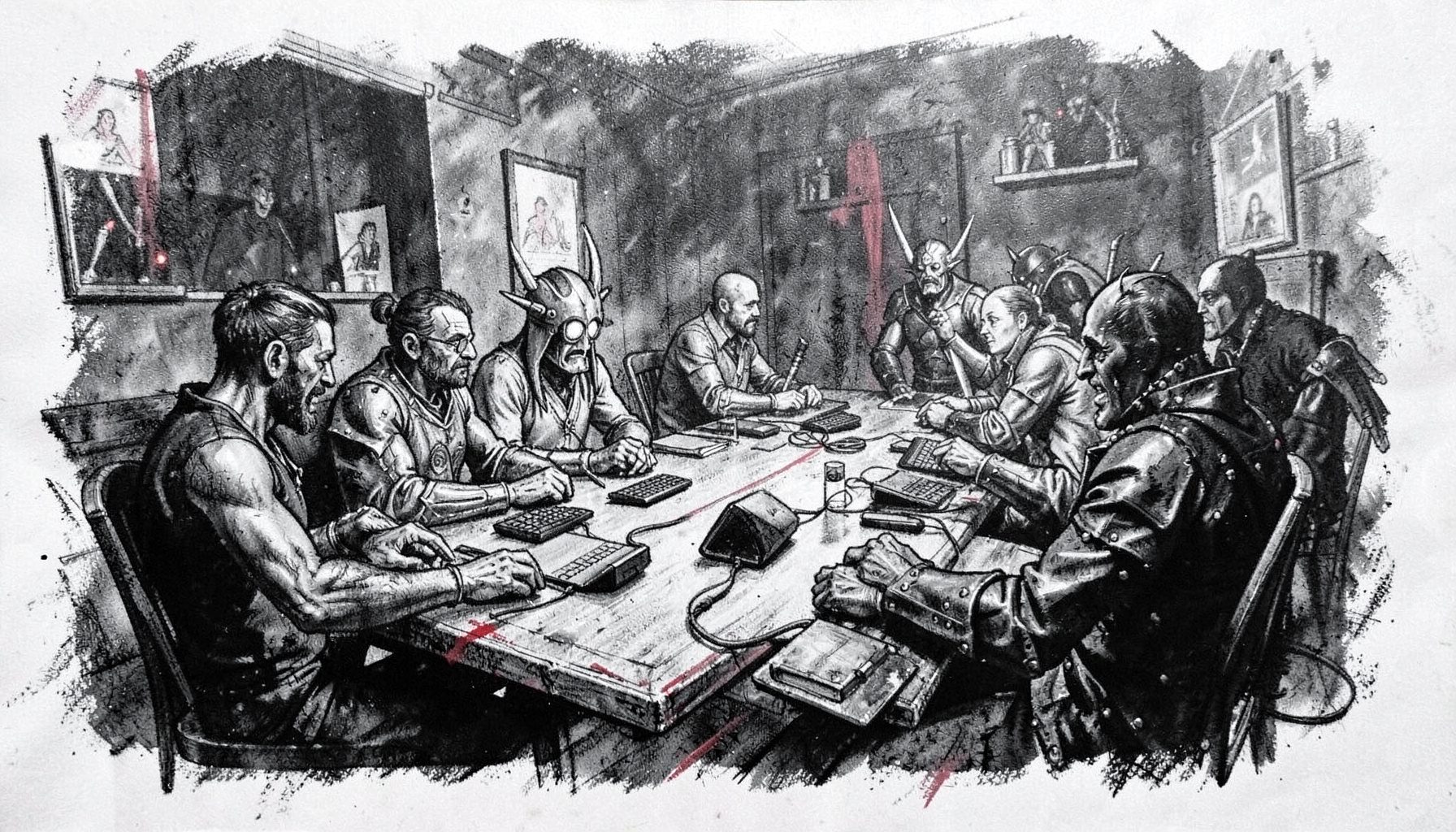
How Video Game Design Continues to Reshape Tabletop RPGs
For decades the relationship between video games and tabletop role-playing flowed in one direction, with designers borrowing ideas from pen-and-paper systems to build virtual worlds. At the High Level Games Convention panel titled "How Video Games Influence Tabletop RPG Mechanics," the conversation turned that flow back on itself, examining how interface design, progression loops and digital affordances now travel the other way. The panel brought together indie designers, convention veterans and LARP organisers who all pointed to the same trend: the boundary between the screen and the table is thinner than many players realise.
The discussion also highlighted how regional communities absorb these influences differently. In Australia, where cities like Melbourne and Brisbane host thriving meet-up cultures and where classification ratings for games sit under the watchful eye of the Australian Classification Board, designers have been quietly adapting digital mechanics for in-person play. What emerged was a snapshot of an evolving hobby that borrows from every corner of interactive storytelling.
Borrowed Interfaces and the Player Expectation Shift
One of the clearest threads in the panel was the way player expectations have been shaped by video game interfaces. Modern RPGs on consoles and PC routinely present clear feedback: a glowing quest marker, a cooldown timer beside an ability, a damage number floating above a foe's head. Designers at HLG Con noted that newer players now arrive at the tabletop expecting similar clarity, sometimes pushing back against the ambiguity that long-time grognards cherish. A simple line on a character sheet like "Sneak: Pass or Fail" has given way to layered stealth states lifted directly from stealth-action franchises.
The shift cuts both ways. Some designers welcome the precision because it speeds up table play and reduces the friction that often turns newcomers away. Others worry about an over-reliance on numeric scaffolding, arguing that too much mechanical transparency can drain the sense of improvisation that defines the medium. The consensus among the panelists was that the art lies in selecting which digital conveniences actually enhance in-person storytelling and which ones flatten it.
Dialogue Trees, Morality Systems and Social Combat
Few video game mechanics have crossed over as visibly as branching dialogue and morality systems. From early BioWare titles to contemporary narrative experiments, players have spent two decades choosing what to say, watching meters shift in response and feeling the emotional weight of consequence. Tabletop designers are increasingly codifying this into explicit social mechanics, with systems tracking allegiance, rumour and reputation across a campaign rather than leaving everything in the game master's notebook.
Australian designers working on titles inspired by the political tensions of Canberra's parliament or the rough social hierarchies of a Sydney pub have found morality tracks invaluable for grounding their settings. The mechanic gives players something to manipulate in dialogue-heavy scenes and gives game masters a quantitative scaffold when improvised rulings start to drift. Conversation at the convention repeatedly returned to Mass Effect's Paragon and Renegade bars as the reference point everyone understood, even those who had never touched the game.
Procedural Generation, Random Tables and Loot Boxes
Randomness has always lived in tabletop games, but the way it is structured owes a great deal to modern video design. Designers on the panel described how procedural generation algorithms from survival and roguelike video games inspire the kinds of multi-column tables they now write. Where a referee once drew a treasure from a flat list, contemporary random tables mimic the satisfying cascade of a loot drop, with tiered results that escalate based on campaign progression.
The loot box debate, which has featured heavily in Australian public discussion since the 2018 Senate inquiry into loot box mechanics, also came up. Several panelists argued that the controversy actually gave tabletop designers an opportunity to explain why physical random tables feel fundamentally different. A hypergeometric die roll at a table in Brunswick or Fremantle happens in front of everyone, with shared anticipation and immediate communal reaction. That moment of joint suspense is something no algorithm can replicate, yet it is something the digital side keeps trying to commodify. Designers at the panel embraced this difference as a feature rather than a limitation.
Reference Tools That Borrow From Heads-Up Displays
Game masters today increasingly rely on tools that echo video game heads-up displays. Initiative trackers built like action queues, condition trackers that mirror status effect icons, fog-of-war maps that recall real-time strategy games — these are no longer exotic conveniences. They are standard kit for a serious modern referee. The panel showcased a handful of Australian-developed apps and templates that handle these jobs, noting that mobile-friendly design has become essential because most players now manage characters on phones rather than paper binders.
The display layer even extends to custom dice and tokens at the convention itself. Players dropping from Melbourne into a Sydney game via voice chat expect a certain level of visual feedback, and table organisers at HLG Con responded by providing printed status cards for high-level play. For those curious about how much tooling actually improves play, an experienced designer shared practical perspectives in the write-up A Designer's Guide to Playtesting a New RPG at a Convention, which captured the trial-and-error attitude that now defines the hobby's tool-makers.
Live Action, Immersion and Escape Room Design
LARP at the convention pulled heavily from the escape room tradition, which itself borrowed heavily from point-and-click adventure games and from puzzle games in general. Organisers from Brisbane-based immersive theatre groups described how they now structure an evening's narrative around clear objectives, lockable skill checks and timed reveals, all concepts lifted from video design vocabulary. Puzzle-mastery feels intuitive to players who grew up navigating inventory screens, and that familiarity has lowered the barrier to entry for live-action events.
The panel also discussed how environmental storytelling, a term more often used in level design than in role-playing, has entered the LARP toolkit. Designers now think about lighting cues, the placement of non-player characters and the timing of audio interruptions as deliberate gameplay elements rather than as set dressing. One presenter noted that a well-designed convention LARP can be run twice with completely different outcomes based on a single mechanical seed borrowed from a survival game, an approach that thrills participants and stretches program budgets at the same time.
Tabletop Communities Growing Through Digital Adjacency
Across Australia, local game stores have adapted to the blend of physical and digital play in ways that reflect how the hobby now sits between mediums. Stores in the Melbourne suburb of Fitzroy and in Adelaide's Rundle Mall report strong sales of beginner-friendly tabletop starter sets alongside accessories tailored to streamed play, such as light-up dice towers and microphones. Some retailers have introduced dedicated beginner nights where newcomers learn alongside more experienced players, mirroring the way modern video games use guided tutorials to onboard players.
Australian consumer law also shapes how these products are presented at conventions and in stores. Pricing in AUD must clearly reflect inclusive GST, and warranty obligations under Australian Consumer Law affect how imported miniatures and printed materials are marketed. Designers at the panel were acutely aware that transparency around mechanics — the same transparency that video games have spent decades perfecting — also wins consumer trust in this market. For newcomers stepping into the hobby for the first time, an accessible write-up about getting started at HLG Con remains a useful primer, and convention staff were on hand throughout the weekend to point curious players toward the right beginner-friendly tables.
Designing With One Eye on the Screen and One on the Table
The practical takeaway from the panel, and from the wider convention weekend, is that borrowing from video games is no longer a controversial choice. It is simply part of the design vocabulary of modern tabletop role-playing. The most successful systems at the convention balanced digital clarity with analog soul, and the most engaged players were those who could move fluidly between a screen-heavy video session on a Tuesday and a paper-and-dice session on a Thursday. For designers, the path forward is selective borrowing: take the interface improvements that reduce friction, keep the procedural generation tricks that heighten surprise, and leave behind the loot box monetisation model entirely. The result is a tabletop scene that grows stronger each year by looking honestly at where its players actually learned to play. Readers exploring the convention floor itself can browse the smaller press standouts to see which Australian-led studios are already pushing this blended design approach.