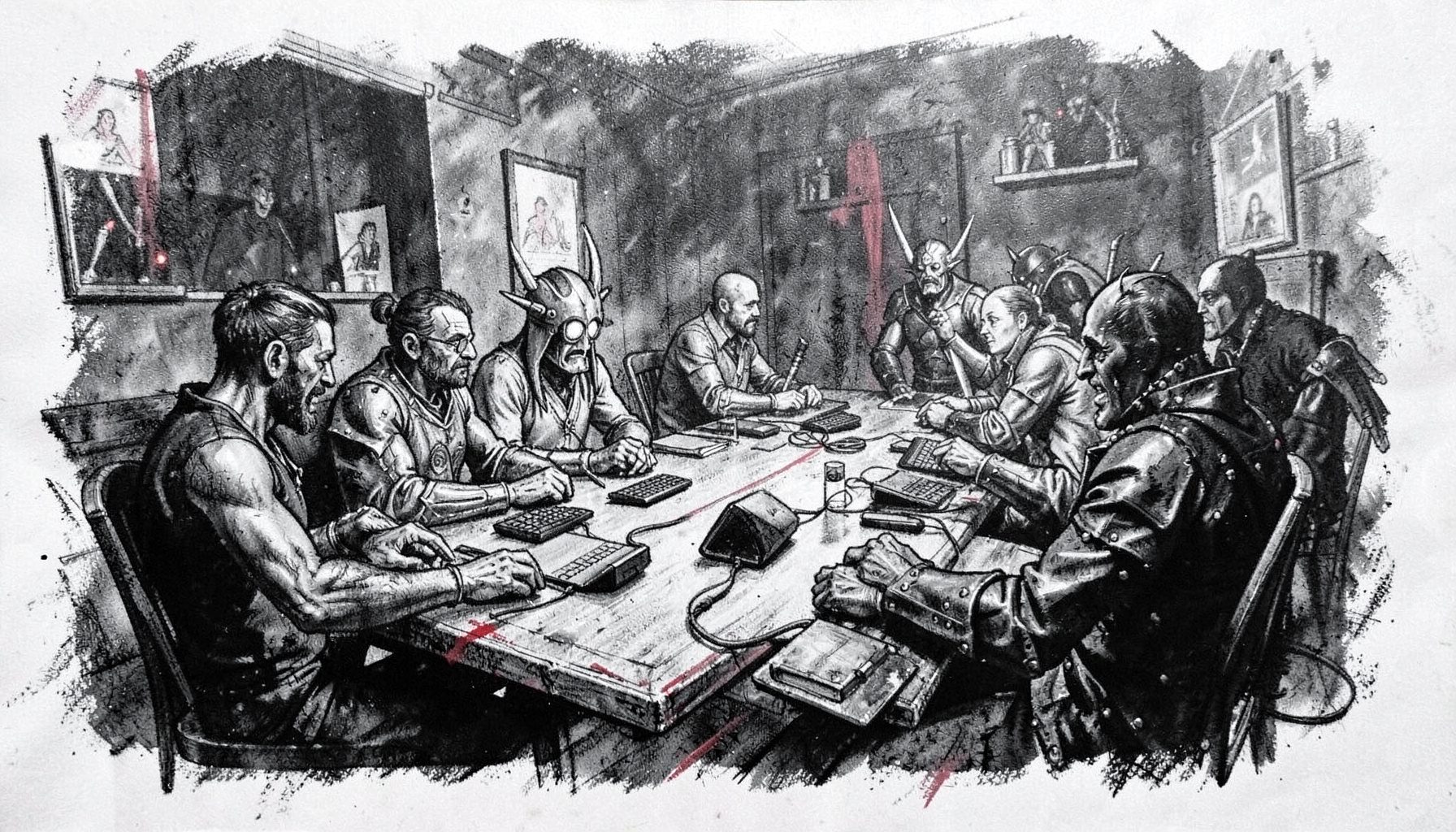
Artists Give Game Conventions a Living Presence
A game convention is never only a collection of tables, panels and exhibitors. Its appeal comes from the energy between those activities: players discovering a new system, designers explaining a world, performers embodying a character and visitors moving through a space that seems to belong to the games inside it. Art gives that energy a visible form.
Illustrators, scenic designers, prop makers, costume creators, graphic designers and community artists contribute more than decoration. They establish identity, guide movement, reveal narrative and make strangers feel that they have entered a shared world. Their role in making a convention feel alive is therefore practical, social and creative at once.
At the High Level Games Convention, held at the Showboat Hotel in Atlantic City in 2018, tabletop role-players, live-action performers, designers, publishers, artists and vendors met within one programme. LARP experiences, gaming sessions, panels, workshops, an exhibitor hall and escape rooms each required their own visual language. The convention became coherent because those languages communicated with one another.
Australian conventions face distinctive conditions, from community halls and volunteer crews to summer heat, long freight routes and audiences accustomed to travelling between major cities. Melbourne’s laneway venues, Sydney’s transport-linked halls, Brisbane’s bright subtropical daylight and Perth’s distance from eastern suppliers all shape how art can be produced and displayed. The principles are international, but their execution must feel local.
Artists shape the first impression
The entrance establishes whether a convention feels welcoming before a single game begins. Illustrated signs, bold icons, painted registration zones and distinct colour families help attendees understand where they are and what awaits them. These elements also create the first visual memory that later appears on social media, merchandise and event photographs.
Wayfinding is an inclusion tool as well as a visual exercise. Clear typography, readable maps and symbols that do not depend on colour alone help people with different language needs and neurological conditions. For Australian organisers using council facilities or repurposed hotel spaces, these details also reduce confusion when volunteers, performers and suppliers are working across several rooms.
A consistent visual identity lets attendees recognise the same world in the exhibitor hall, panel room and LARP area. It gives volunteers a practical system for badges, schedules, queue markers and emergency notices. Local printers and fabrication workshops can produce these pieces in Australian dollars, while commissioned artists can adapt the core designs for digital screens without allowing every format to look identical.
Visual storytelling makes play imaginable
Artists help participants understand a fictional setting before its rules are explained. A painted forest, a stylised faction crest or a map showing forgotten ruins can turn an abstract premise into something emotionally immediate. This matters across tabletop sessions, where terrain and character cards frame play, and live-action games, where visual cues signal alliances, dangers and changes in the story.
Experience on that scale depends on coordination rather than isolated decoration. The event’s account of convention-wide LARP planning shows how costume, scenery, storytelling and safety must operate as one system. An artist who changes a faction’s symbol may also alter how players identify that faction in the world and on a character sheet.
Concept artists can support this work through visual briefings, reference sheets and miniature mock-ups. Panels and workshops benefit from clear diagrams, while publishers can use commissioned artwork to communicate the tone of a game without revealing every mechanic. In Australia, independent creators often handle several roles at once, so a modest visual brief may produce assets that support a pitch, convention display and eventual commercial release.
Props and spaces create shared reality
The strongest convention props are not necessarily the most elaborate. They are the objects that help a participant cross the boundary between observer and character. A sealed letter, a worn travel case or a table scattered with convincing documents can contain more dramatic force than a large display that remains outside the action.
Scenic artists also control what information appears when. Signs can guide players, environmental details can provide clues, and lighting can establish tension without an actor saying a word. Escape rooms require this precision because every visual element must support interpretation. A redundant decoration creates doubt, while a carefully placed mark can make players feel clever for noticing it.
Local conditions deserve attention to these details. A Brisbane LARP may need scenery that remains readable in strong daylight, while a venue near a busy Sydney street might require acoustic and visual screening. Australian conventions based in regional cities also face shipping costs for breakaway scenery, making durable local fabrication and reusable materials especially valuable.
Artists connect people across formats
Art becomes a bridge between designers, players and exhibitors when it translates specialist ideas into accessible experiences. A panelist might describe a combat system, but a diagram can show it at a glance. A publisher might explain a campaign setting, while an illustrator demonstrates how its symbols would work across cards, books and miniature figures.
For designers testing a new system, finding RPG playtest groups creates useful feedback, and artists can make that testing more productive. Visual prompts help newcomers enter a scenario, while painted terrain and character portraits make it easier to compare reactions to particular choices. The artwork becomes part of the research method rather than a promotional layer around it.
This cross-format work also supports the Australian market. Independent illustrators can sell prints at convention stalls while building commissions through local galleries, makers’ markets and online storefronts. Australian publishers may pair local cover artists with international distribution, giving small studios access to audiences that would otherwise require expensive travel. A convention acts as both a creative meeting place and a practical marketplace.
A practical framework for convention art
Commissioning works best when visual artists are treated as collaborators with knowledge of the audience, the venue and the programme. The following measures help prevent artwork from becoming disconnected decoration:
- Map the attendee journey from arrival to departure, identifying places where signage, illustration, projection or live art can solve a practical need.
- Bring artists into planning meetings before the visual identity is locked, allowing them to understand the programme and flag conflicts between formats.
- Commission a connected family of assets, including wayfinding, room identities, schedules and digital screens, rather than asking for one attractive image that has no operational purpose.
- Support live making, costume work and interactive installations that give visitors a role in the art while preserving clear rules for safety and participation.
- Define usage rights, credits and fees in the initial agreement, with budgets in Australian dollars covering materials, local fabrication, freight, installation and removal.
- Involve Aboriginal and Torres Strait Islander artists through paid consultation, specific creative briefs and proper attribution whenever cultural knowledge is central to the work.
A convention should also retain a clear budget for contingency and accessibility. Vinyl lettering may need replacing after heavy use, an installation may require additional lighting or a commissioned image may need a text alternative. Those costs are easier to absorb when they appear in the original schedule rather than emerging as emergency expenses during the event.
Building the next creative partnership
A useful creative brief explains the problem, audience and atmosphere without prescribing every artistic decision. Organisers should identify required dimensions, formats, deadlines and installation constraints, then leave room for the artist to develop a distinctive response. References can guide the tone, but copying them too closely often produces a convention that looks polished without communicating anything genuine.
Feedback should focus on whether the work functions within the event. A panel illustration is successful when attendees can understand it from a distance; an LARP prop succeeds when it supports the story; a wayfinding system succeeds when people reach the correct room with less assistance. The artist remains responsible for craft, while the organiser remains responsible for operational fit.
Partnerships also work best when credits, payment and future permissions are agreed at the outset. That clarity gives Australian artists room to build sustainable practices and gives conventions a dependable pool of experienced collaborators. The concrete next step is to place a 60-minute site walk-through on the production calendar, with the organiser, lead artist and venue coordinator attending and leaving with a dated list of required assets.