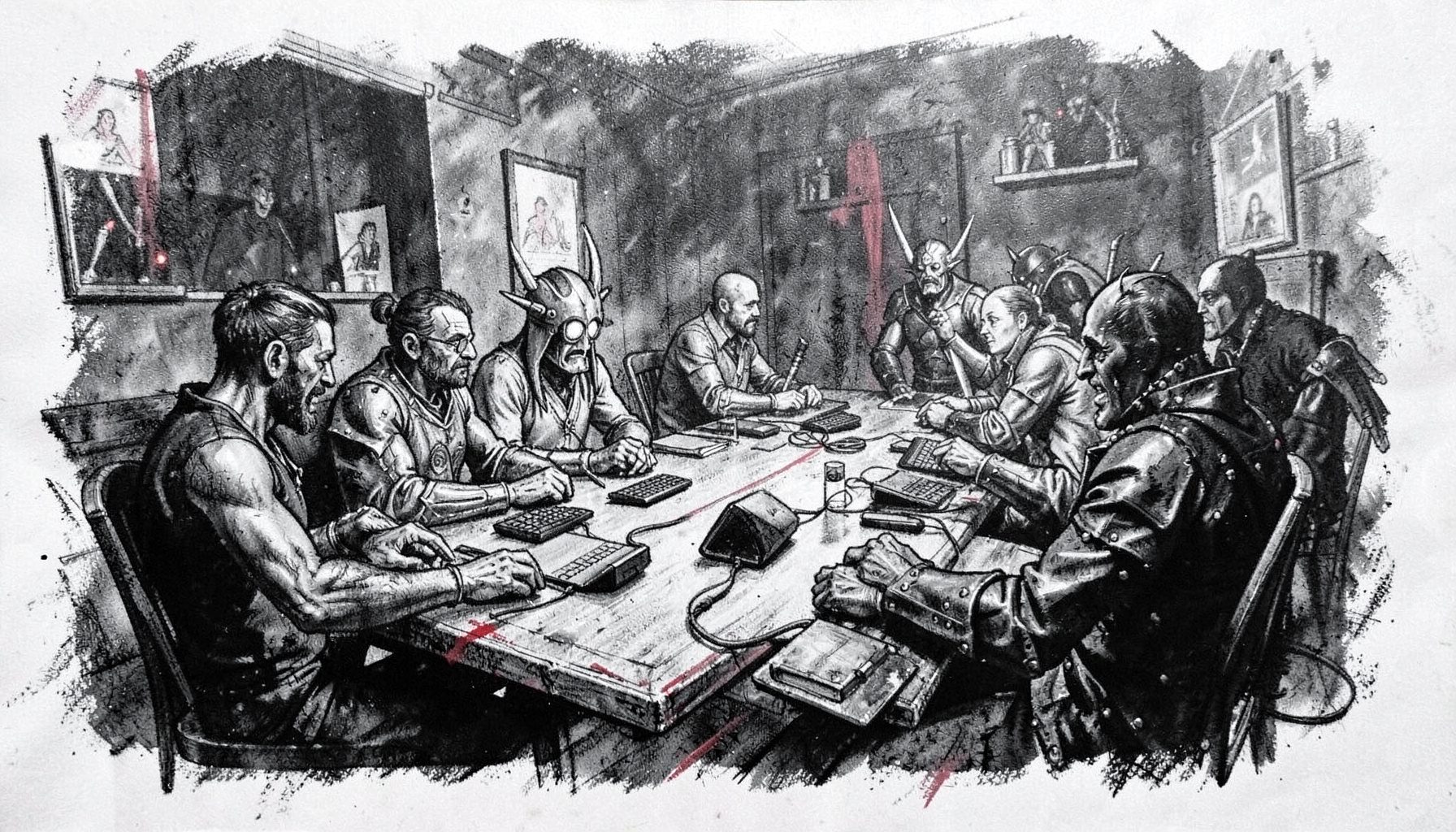
What it takes to organise a convention-wide LARP
A convention-wide LARP is a live-action role-playing event where several scenarios run across one venue and feed a larger story. Players may move between linked encounters, carry outcomes into tabletop role-playing sessions, or act within a shared festival setting. High Level Games Convention at the Showboat Hotel in Atlantic City, New Jersey, in 2018 showed the potential of this mix, bringing together LARP, tabletop games, panels, workshops, vendors and escape rooms.
Scale changes the challenge. A single scenario can hide weak links in a friendly volunteer team; a convention-wide production exposes every handover, bottleneck and blind corner. Success depends less on a huge cast than on a clear playable premise, disciplined live operations, safe boundaries and a schedule players can understand without needing a tour guide.
Australian organisers also have to plan around large distances, variable weather, volunteer availability and venue costs. Sydney, Melbourne and Brisbane each reward different production choices, while regional clubs often anchor the community scene. Those conditions encourage direct communication, portable kit and realistic staffing rather than an imported model based on a dense city centre.
A workable convention plan connects narrative design to floor management, welfare, local compliance and event logistics. It also decides what must be shared: the cause, the timeline, the consequences of failure and the locations where the story changes. Everything else—props, costumes, rules, radio calls and downtime—should support those promises.
A shared story players can enter
A convention-wide production needs one playable ecology, not a bundle of unrelated demonstrations. Set a shared spine: a central conflict, competing factions, a visible clock and consequences that carry from one scenario into another. A story bible should name the timeline, fixed facts, decision points and authorised changes so plot runners can improvise without rewriting the core premise.
Assume players arrive with different levels of theatre experience and knowledge of the setting. Give each a concise pre-game brief covering their role, objective, boundaries and the consequences of missing an encounter. Colour-coded credentials and simple progression routes help people find the next beat, while plot runners explain live developments and prevent contradictory rulings.
Tabletop role-playing sessions can reveal a clue, establish a rumour or send a character into the field. Treat those exchanges as optional feeds rather than compulsory homework, and publish a plain schedule showing when linked content unlocks. Protect downtime for costume changes, prop resets, rest and unscripted player interaction; those pauses often carry more character than another scripted fight.
An operational backbone for live play
Treat the venue as a live control system. Mark every playing zone, queue, backstage area, vendor stall, accessible route, power point, toilet and emergency exit on a master map. Use a separate flow plan for audience movement and player movement, then test capacities during a full-dress rehearsal. Colour-coded lanyards, floor markers and a published schedule reduce dependence on volunteers improvising directions.
Props need an owner, storage point and reset method. The creativity visible in HLGCon's cardboard and foam builds shows what small teams can achieve with inexpensive materials, but every prop also needs edge checks, safe coatings, fire-safety clearance and a backup if it breaks. Store oversized scenery away from exits, label boxes for rapid changes and keep a repair kit with each plot team.
Build a staffing ladder that separates narrative decisions from safety decisions. Each zone needs a plot runner and lead marshal; central control handles timing, missing players and venue calls, while first aid, accessibility support and technical repairs have named leads. Give volunteers one radio channel for routine requests, one for incidents and a clear escalation script. Pay for roles that cannot safely depend on volunteers, including event medical coverage and overnight security.
Safety, consent and accessibility
Complete a risk assessment for every zone and activity under the applicable state or territory work health and safety rules. Cover script combat, running, climbing, confined spaces, electrical work, food, alcohol, severe weather and crowd bottlenecks. A public liability policy is only one layer: organisers also need incident reporting, venue procedures, qualified first aid and a documented process for suspending play.
Consent must be active and revocable. Publish rules for touch, weapons, photography, hugs and participation without using a visible costume as implied permission. Offer opt-out alternatives that remain narratively useful, provide a quiet room, accessible toilets and seating, and make dietary, sensory and medical needs visible to the crew without exposing private details. Safeguarding checks and guardian rules should apply whenever players under eighteen attend.
Rehearse the moments nobody wants to imagine: a missed radio call, a player leaving a scene, a lost child, severe weather or an evacuation. Agree on plain phrases such as “stop the scene” and “all clear”, assign who contacts the venue and medical team, and make announcements understandable over costuming noise. After each session, record near misses as well as rule breaks so operational weaknesses can be addressed.
Making the event work in Australia
Melbourne’s South Wharf and the Melbourne Convention and Exhibition Centre offer plenary theatres, breakout rooms and heavy exhibition traffic, making them practical for linked programme strands. Local game clubs often supply dependable volunteers and designers, while costume competitions add visual energy without replacing live play. The standard visible in the 2018 costume gallery illustrates how presentation can strengthen the shared world, provided characters remain legible in movement and safe close contact.
At ICC Sydney in Darling Harbour, transport links and nearby hotels simplify late finishes, but wind, rain and hotel-room capacity shape scheduling. Brisbane’s South Bank convention precinct brings a different issue: heat, humidity and sudden summer storms can interrupt outdoor scenes. Cover both cases with indoor alternatives, water access, shelter routes and permission to pause narrative time rather than forcing actors to perform through dangerous weather.
Australian community gaming runs through volunteer-led clubs, independent designers, publishers, cosplayers, stallholders and sponsors, with conventions in Sydney and Melbourne frequently feeding regional tournaments and smaller one-day events. Many organisers coordinate crews interstate, so budgets must allow travel, breaks, GST and contingency cover, not just venue hire and materials. Communication can remain friendly and direct without becoming vague: an “arvo” start time is exact, “no dramas” never means ignoring a safety report, and every radio instruction uses a fixed vocabulary.
A practical delivery checklist
The best operating model depends on how players move, how many spaces the crew can supervise and how tightly the story must connect.
| Model | Player experience | Best fit | Main pressure |
|---|---|---|---|
| Hub-and-spoke | Fixed teams rotate through prepared scenario stations | Short modules and large casts | Queue timing and resetting props between groups |
| Continuous city | Players move through a persistent story district | Immersive weekends with trained marshals | Staffing every zone and keeping routes clear |
| Layered programme | Timed encounters sit between talks, workshops and tabletop sessions | Mixed-format conventions | Helping players find linked content and recover between sessions |
Whichever model is chosen, these controls keep a multi-zone event coherent:
- Approve a one-page story spine, timeline and canon in one version-controlled document.
- Map zones, capacities, accessible routes, emergency exits, power, toilets and radio coverage with the venue.
- Give every module a plot lead, marshal, reset plan and realistic recovery window.
- Rehearse medical, severe-weather, missing-player and evacuation procedures with venue and crew.
- Publish a plain-English player guide with the schedule, boundaries, photo rules, opt-outs and help points.
A useful after-action review tests whether players understood the story, moved safely, received the promised participation and still wanted to return. It tracks queue times, no-shows, radio traffic, safety reports and debrief themes alongside attendance and revenue. The practical takeaway is simple: a successful convention-wide LARP comes from one shared story backed by visible commands, realistic staffing and rehearsed safety, with every operational choice made to protect the player experience.