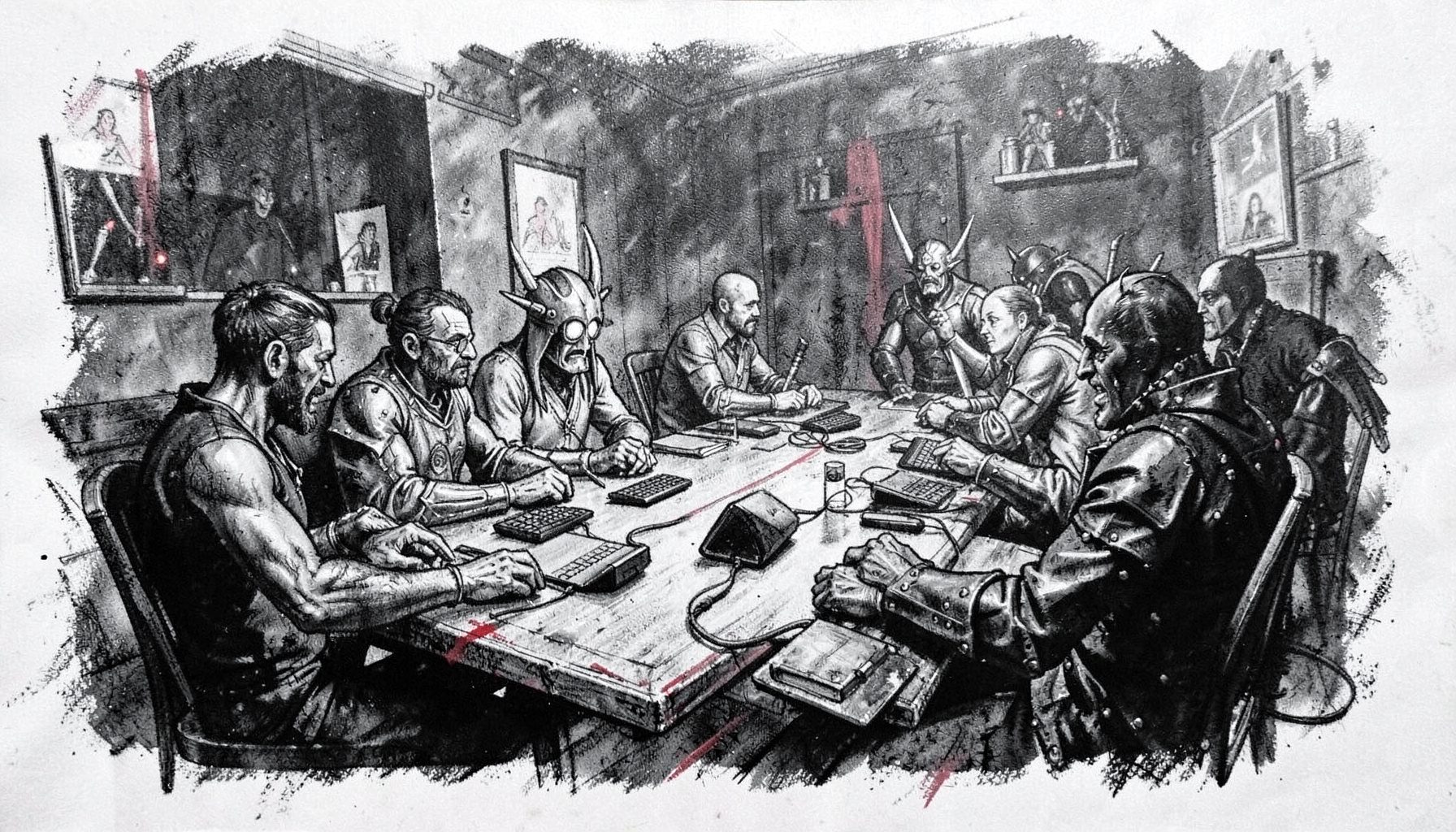
Inside the Convention’s Escape Room Set
High Level Games Convention 2018 filled Atlantic City’s Showboat Hotel with tabletop campaigns, live-action role-play (LARP) games, panels, workshops and an exhibitor hall. Within that busy mix, an escape-room set offered a different kind of participation: players moved through a physical scenario, interpreted clues and made decisions together rather than receiving direction from a single game master. Its appeal came from the moment fictional rules became tangible.
The set was also a compact piece of theatre. A corridor, locked case or flickering light carried meaning because each object had been placed to support a shared story. The convention’s larger culture of collaborative storytelling mattered here; success depended on players trusting one another, noticing details and accepting that the solution belonged to the whole group.
Behind the scenes, the experience depended on dozens of less theatrical tasks: measuring corridors, duplicating keys, testing locks, resetting props and learning how quickly a room could recover from confusion. Those practical choices are just as relevant to Australian organisers working in cities such as Melbourne and Sydney, where venues, budgets and audience expectations differ from Atlantic City.
Designing the room around a shared story
A useful room begins with a playable question rather than an elaborate backstory. Designers need to know what players are trying to recover, avert or expose, and which actions reveal progress. Backstory can enrich the scenario, but it should appear through clues, objects and character behaviour. If it cannot be touched, heard or used, it usually belongs in the design brief rather than the set itself.
The social structure should be deliberate. One player may be good at patterns, another at reading text, and a third at connecting clues. The scenario can make those strengths matter without assigning rigid roles, allowing personalities to surface naturally. A review of collaborative storytelling captures this principle well: participants contribute meaning, while the facilitator protects the shared objective rather than steering every decision.
The room also has to admit different ways of playing. Coloured light, timed speech, physical movement and hidden information can create barriers for some guests. A safer version uses clear visual cues, adjustable volume, written alternatives and pauses that do not punish discussion. The inclusivity shown across the wider convention becomes a design standard: every player should have a plausible route into the puzzle.
Turning a floor plan into a playable set
Once the story is mapped, the floor plan shows where tension rises and where breathing room belongs. Set designers check sightlines so players cannot see every answer at once, preserve routes for staff and emergency access, and place doors or thresholds to make each discovery feel earned. Measurements on paper become marked walls, furniture footprints and safe walking lanes on the hotel floor.
Temporary convention construction favours modular pieces. Lightweight timber, foam board, painted plywood and fabric scenery can be assembled quickly, repaired between sessions and removed without damaging the Showboat venue. Hardware stores become useful when a lock needs a hidden panel; scenic paint and printed textures turn ordinary boxes into convincing evidence. Set dressing should create atmosphere without disguising essential information or creating trip hazards.
Clues need physical logic as well as narrative logic. A code makes sense if players can trace it to a source, while an electronic lock only adds drama when the room also offers fair alternatives. Good builds conceal answers in plain sight, use colour and shape consistently and provide redundant ways to proceed. A facilitator can then diagnose a failed method rather than simply declaring it wrong.
The people and materials behind the scenes
The visible mystery rested on an unglamorous production system. Cases of props and scenic panels had to arrive, pass hotel loading rules and fit the convention’s narrow installation window. A scenic team fabricated scenery, a props lead assembled each puzzle item, and technicians tested locks, lights and timers. A show runner kept the scenario, solution and reset instructions aligned. On event day, floor staff briefed groups, watched for safety issues and restored every movable element before the next team entered.
Props carried several jobs at once. A battered case might conceal a clue, establish period or reveal character status, but it also had to open reliably, survive handling and reset without specialist tools. Teams often chose lightweight duplicates so a damaged object could be swapped quickly. Recording the intended solution at each stage reduced memory errors during long convention hours.
Budgeting shaped the atmosphere. Expensive theatrical effects rarely compensate for unclear rules, while a few well-made details can anchor the entire scenario. Local sourcing matters in Australia: builders can compare quotes in Australian dollars, confirm whether the 10% GST is included and account for freight between cities. Repurposed materials can preserve the visual concept while leaving room for locks, staffing and accessible design.
Safety, rules and an Australian event context
Every session began with rules that protected both the story and the participants. Staff explained boundaries for live role-play, identified emergency exits and checked whether tasks required climbing, darkness, sound or close contact. Requests for step-free access, seating, low-sensory conditions or extra processing time need to be handled before arrival where possible, not improvised after a group enters.
Australian Consumer Law requires commercial services to meet applicable guarantees and be performed with reasonable care and skill. Escape-room operators should state session lengths, difficulty, physical demands and age guidance clearly, and provide a fair process for cancelled or private bookings. Prices quoted to Australian customers should show whether GST is included, while ticketing terms should distinguish minor changes from failures in the promised service.
Privacy and state and territory work health and safety duties add another layer. Contact details collected through bookings may fall under the Privacy Act 1988 and the Australian Privacy Principles, especially when a form requests identification or accessibility information. Venues and organisers also need suitable insurance, incident procedures and staff training. These obligations need not make the game clinical; they create dependable conditions for imaginative play.
The cultural fit matters as much. Australian cities offer distinctive spaces, from Melbourne’s converted laneway workshops to Sydney’s waterfront venues, and weekend groups often plan an escape alongside dinner or public transport. Set choices should respect local venues and avoid treating First Nations cultures as generic decoration; relevant Traditional Owners should be consulted where a scenario uses Indigenous material.
Testing the set before the doors opened
Testing began with the mechanics, long before the room looked convincing. Staff timed a clean run, then gave the scenario to colleagues who had never seen it. Their hesitations revealed missing context: a symbol without a legend, a clue placed too low or a note that could be read in two contradictory ways. The best fix was often a small visual or verbal change rather than a more elaborate prop.
Puzzle chains also need resilience. If one key can be carried to any zone, players have more freedom; if it must be found in a precise location, the set needs scenery that directs attention without feeling coercive. Facilitators should watch for teams solving through accidental means and record those routes because they may become deliberate alternatives.
Smaller productions can preserve the same rhythm. A miniature escape room design shows how a compact scenario can use household objects, a short chain of deductions and a clear reset procedure. Such a setup works well for a home game or community meet-up, provided the host explains the goal, limits interruptions and tests the full sequence before relying on it.
The finished experience and its lasting design lessons
A successful set left players describing their own choices as the story’s turning point. The physical room delivered atmosphere, but the strongest payoff came from cooperation: a theory voiced quietly, an object passed across the table or a contradiction noticed by the person who had been studying the timeline. That is where the escape-room set met the convention’s wider appetite for participation.
The same principles can travel to a different scale without copying the Atlantic City build. What changes is the number of zones, the complexity of technology and the amount of staff available, not the need for a coherent mystery or a reliable reset.
| Element | Full convention set | Compact Australian adaptation |
|---|---|---|
| Narrative | Multi-zone mystery with a shared objective | One-room problem with a visible goal |
| Clues | Mixed tactile, visual and coded prompts | Reusable objects with clear relationships |
| Technology | Electronic locks, lighting and optional timers | Manual locks, cards or a basic phone timer |
| Reset | Dedicated staff and organised storage | Labelled reset tray and a ten-minute check |
| Access | Wide routes, seating and planned low-sensory options | Clear walking space, readable text and adjustable sound |
The practical takeaway is a small production test: choose one story beat, make three clues that demand different kinds of observation, and time a complete attempt. The next concrete step is to place one prop, one clue and one timed decision on a table and test them with three players.