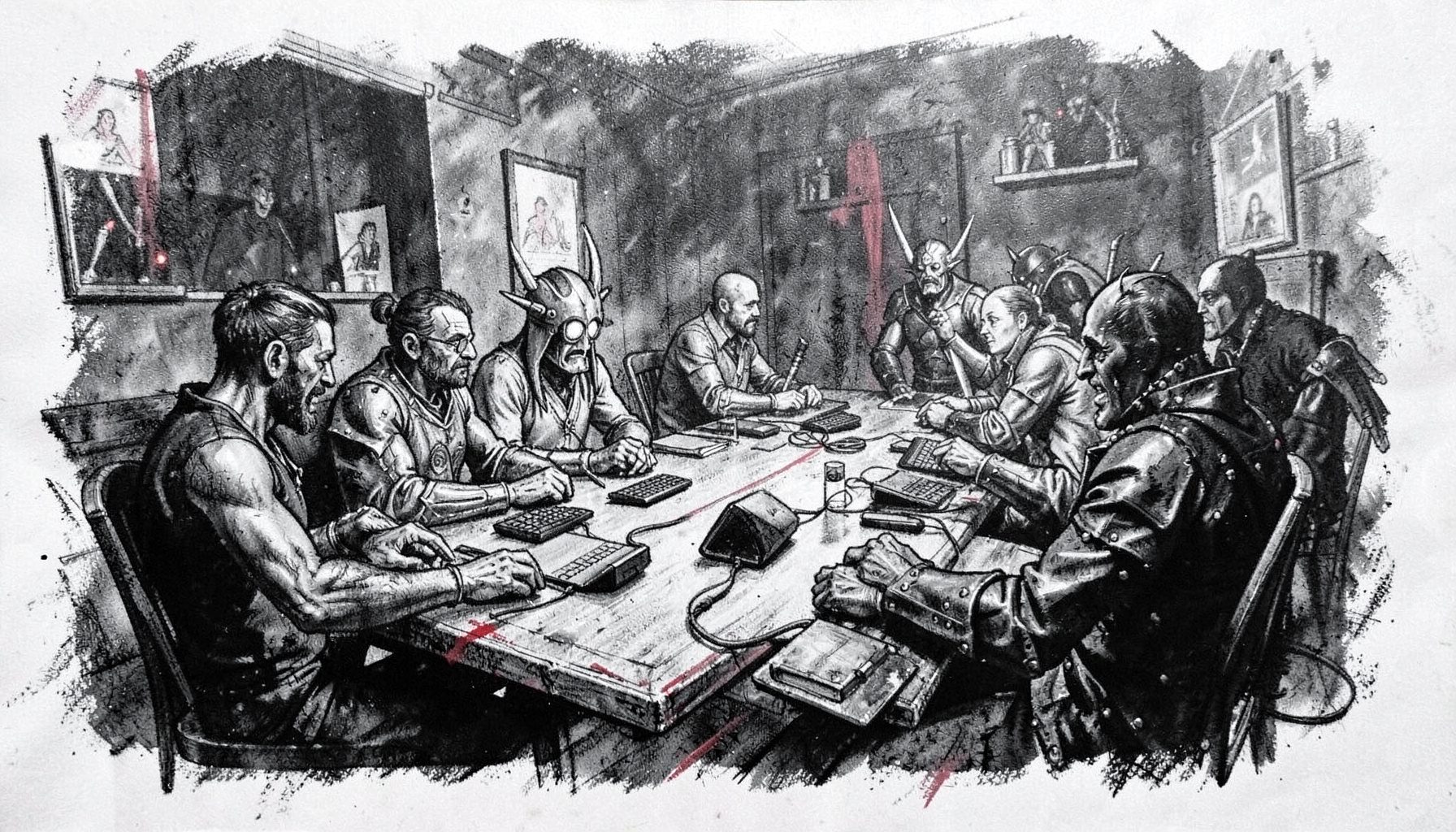
Building a Multi-Faction LARP Plot in 48 Hours
A live-action role-playing plot can feel enormous before the first participant arrives. Several factions need distinct motives, players need clear reasons to act, and the organisers must prepare handouts, locations, props, safety procedures and contingency plans. With only 48 hours, the answer is not to write more lore. It is to create a compact pressure system that turns every choice into movement.
The best convention LARP stories are collaborative rather than tightly scripted. Players should understand what their characters want, what stands in the way and which other people can help or interfere. That approach suits the spirit of High Level Games Convention, where tabletop players, LARPers, designers, artists and vendors shared a space built around imaginative participation.
Start with a Pressure Cooker Premise
Choose one urgent event that makes neutrality impossible. A disputed succession, missing magical artefact, collapsing treaty or supernatural outbreak can pull several groups into the same room. The event should have a visible deadline: the vote at midnight, the ritual at sunset or the final train leaving in two hours. A clock gives players direction when they are still learning the setting.
Keep the setting small enough to perform. A harbour office, remote research station, royal archive or community hall can contain a surprising amount of drama. For an Australian convention audience, a coastal quarantine station or drought-stricken inland township may feel immediately legible without requiring a page of exposition. A few recognisable details—gum leaves on a noticeboard, a battered esky, a council permit—can ground an otherwise fantastic world.
Write the premise in three sentences. State what has happened, why it matters now and what will happen if nobody intervenes. This becomes the organiser’s anchor when late arrivals, noisy rooms or an unexpected player decision changes the timetable.
Give Every Faction a Reason to Move
A faction is more useful when it has a practical objective rather than a broad identity such as “the rebels” or “the nobles”. Give each group something it can gain, something it fears losing and something it refuses to admit. The resulting contradictions produce role-play without requiring a predetermined storyline.
Build relationships between factions before designing individual character sheets. A mining syndicate might need a local clan’s maps, while publicly denying the clan’s land rights. A government envoy may want peace but secretly need a scandal to remove a rival. These overlapping dependencies ensure that no group can solve the plot alone.
Use a simple framework while drafting:
- Public goal: what the faction says it wants
- Private goal: what its leaders are really pursuing
- Leverage: the resource, secret or relationship it can use
- Vulnerability: the fact that could split or discredit it
- Red line: the action that makes compromise impossible
Give each group two or three named members with different opinions. If an entire faction agrees about everything, players will quickly run out of meaningful internal choices. A cautious negotiator, an impatient idealist and a compromised veteran create tension before the first cross-faction scene begins.
Turn Secrets into Playable Information
Secrets only matter when players can discover, trade or weaponise them. Avoid background revelations that require an organiser to deliver a speech. Instead, attach each important fact to an object, rumour, overheard conversation, coded message or character confession. Players should be able to act on incomplete information and still make a fair decision.
Prepare information in layers. Public facts explain the situation. Faction knowledge reveals a useful advantage. Personal secrets create emotional stakes. A final revelation should change the meaning of earlier events, not simply announce that one side was evil all along. Ambiguity gives players room to argue about what justice looks like.
Make every clue point towards a choice. A forged letter might expose a conspiracy, but it should also identify someone who can be pressured, protected or recruited. A damaged artefact may prove that the ritual is unsafe while offering three possible methods of repair. When a clue creates an action, the LARP keeps moving.
Use physical materials sparingly and clearly. Colour-coded folders, stamped documents and simple tokens can help participants navigate a busy room. Test every handout by giving it to someone unfamiliar with the setting. If they cannot tell whether it is a clue, prop or decorative item, revise it before game day.
Schedule Scenes for a Convention Floor
A 48-hour build needs a run sheet as much as it needs a plot. Divide the session into phases: arrival and briefing, early negotiations, a public disruption, private bargaining, a crisis and the final decision. The phases should be flexible, but the organisers need a shared sense of when to introduce pressure.
Plan at least one cross-faction event in every phase. A public accusation, emergency vote or sudden power failure prevents groups from becoming isolated. Alongside these events, allow quiet scenes where two or three characters can negotiate. Loud spectacles create energy; private conversations create allegiance.
Convention spaces can be unpredictable. At a hotel event in Sydney, Melbourne or Brisbane, another programme may be running nearby, furniture may need to stay in place and the foyer can become busy between sessions. Keep important dialogue portable, write instructions that work in a corridor or breakout room, and avoid making the climax dependent on a single prop or exact piece of furniture.
Safety and accessibility belong in the schedule. Explain boundaries, opt-out signals, physical contact rules and content warnings during the briefing. Offer non-physical ways to represent combat, intimidation and pursuit. A player who can pause safely is more likely to take creative risks, while an organiser who notices discomfort early can redirect a scene before it damages the table’s trust.
Prepare Tools That Help Players Create
Character sheets should be short enough to read in two minutes. Include a goal, a relationship, a secret, one useful resource and one difficult choice. Replace paragraphs of history with prompts such as “Who do you blame for the treaty?” or “What would you trade to save your sibling?” These questions create playable behaviour immediately.
Provide a shared faction sheet with names, symbols and current objectives. A small map can show routes, restricted spaces and contested sites. If the LARP includes artists or makers, props should support the fiction without becoming precious objects that participants are afraid to touch. The convention’s exhibitor culture is a useful reminder that visual design can invite engagement when it is functional as well as attractive.
For independent creators, the event also offers a practical lesson in presentation. Advice collected in selling convention art applies to LARP materials: make the purpose clear, keep the display approachable and help people understand how they can participate. A beautifully designed faction badge is stronger when players know whether it grants authority, identifies allegiance or unlocks a scene.
Create a compact organiser kit with the essentials:
- Printed faction and character briefs
- Spare name tags, pens, tape and tokens
- A visible clock or phase card
- Safety information and private check-in notes
- Alternate clues for lost or damaged props
- A one-page emergency plot summary
The kit should let a facilitator recover from ordinary convention mishaps. If a player arrives late, hand them a character whose information connects two existing factions. If a clue disappears, the same fact should exist in a spoken rumour or duplicate document. Resilience matters more than polish when the build window is short.
Run, Record and Repair the Story
Before players arrive, run a thirty-minute test with the organisers. Read every faction goal aloud and identify places where nobody has a reason to act. Check that each major secret can be found through at least two routes. Time the opening explanation, because a long briefing steals energy from the actual game.
During play, facilitators should watch for stalled groups and overpowered individuals. A quiet faction may need a new rumour, a visitor or a deadline rather than a lecture from the organiser. Someone dominating every negotiation can be redirected by giving another character private authority or a piece of information they lack. The aim is to restore choices, not force a particular ending.
Accept that the finished story may differ from the planned one. One faction may form an alliance the writer never expected; another may abandon its stated objective after a powerful conversation. Record major turning points with brief notes so the organiser team can keep later scenes consistent. Guidance on writing a convention recap can also help capture those emergent moments without pretending the event followed a fixed script.
After the final scene, hold a short debrief. Invite players to share a favourite decision, a confusing moment and an unanswered question. Do not use the debrief to defend the plot. Use it to identify which clues worked, which safety tools helped and where the schedule became crowded. Those observations are more valuable than another ten pages of setting history.
A strong LARP built in 48 hours is a playable network of motives, secrets and deadlines. Start with one urgent crisis, give each faction a conflicting reason to act, attach every clue to a decision, and prepare flexible tools for the realities of a convention venue. If the organisers can keep information moving and choices visible, the final story will belong to everyone in the room.