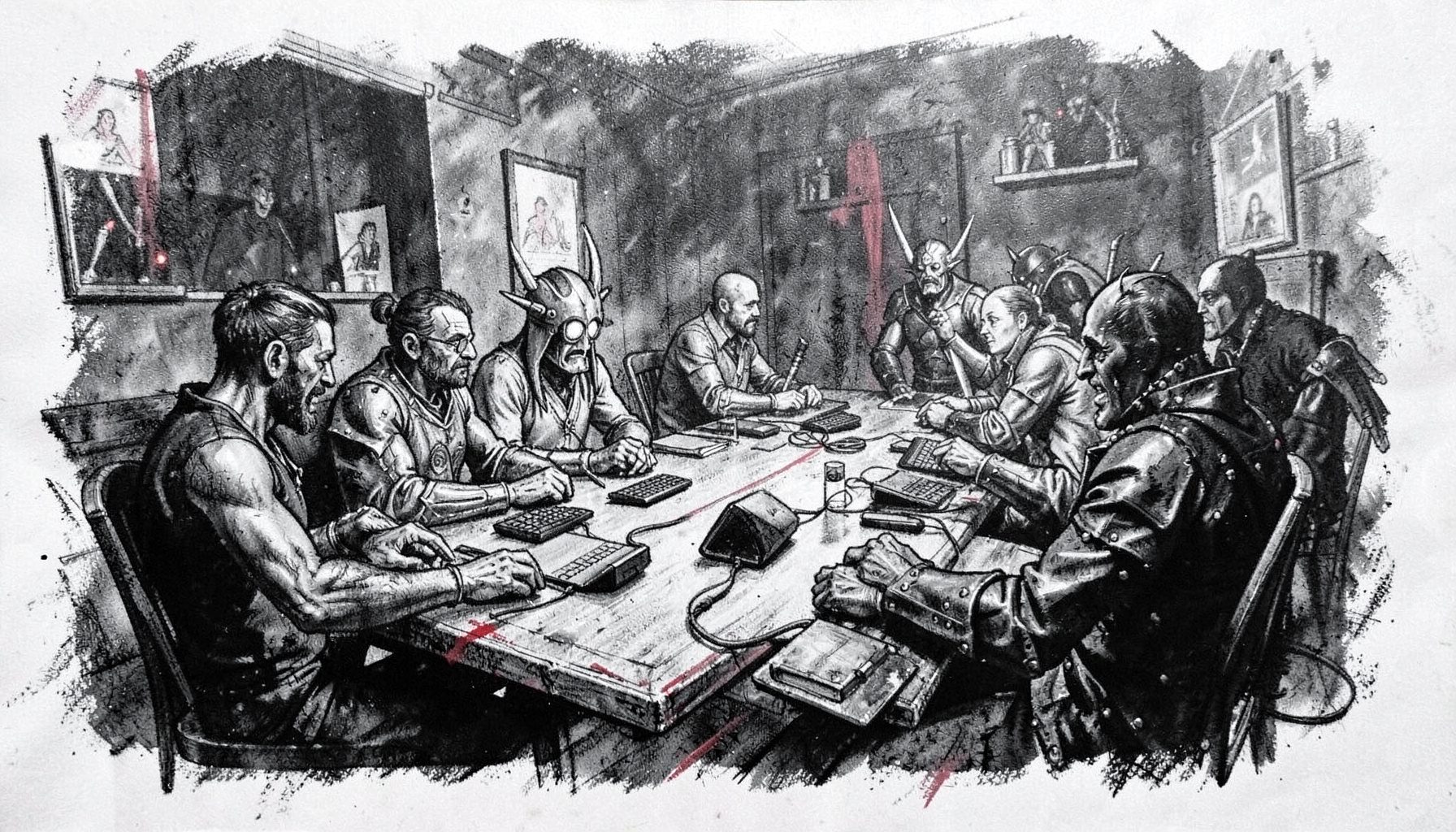
When story and mechanics stop competing
At the 2018 High Level Games Convention at the Showboat Hotel in Atlantic City, the Balancing Story and Mechanics in RPG Design panel brought together the point where narrative intention meets the procedures a table actually uses. Surrounded by LARP experiences, game sessions, artist showcases and an exhibitor hall, the discussion reflected HLGcon’s wider focus on collaborative play.
A useful design lesson is that story and mechanics work as different layers of the same experience. Story supplies motive, context and emotional consequence; mechanics provide repeatable decisions, uncertainty and feedback. When narrative carries everything, players may admire a premise but have little to decide. When rules carry everything, choices can generate activity without producing meaning. Balance means letting each layer do the work it is best suited to do.
In Australia, those questions sit against a distinctive local scene. Tables meet in converted warehouses in Melbourne’s inner north, suburban hobby shops or volunteer-run community halls. Shelf space is shared by local distributors, international publishers, specialist retailers and crowdfunded games, with Australian consumer prices generally including 10 per cent GST. Casual Australian speech—“fair enough”, “have a go” and “no worries”—can also shape how role-play sounds at the table.
Mechanics give the story a grammar
Mechanics are more than numbers attached to narrative. They tell players which actions the game recognises, how success is judged and what kind of consequence follows. A rule that rewards clever negotiation gives every fictional bargain a practical texture. The narrative then explains why that tactic fits the character, faction or moment.
This is where careful balance becomes visible. A heroic scene may call for sacrifice, but if the dice system makes sacrifice almost free, the claimed tension disappears. Conversely, a punishing cost can make a generous act feel arbitrary unless the fiction clearly explains what is at stake. The mechanic earns narrative trust when players understand the action it invites and the meaning of its result.
That relationship also depends on the setting in which a game is presented. Convention travel, shared accommodation and busy social schedules affect how much explanation a system can absorb. The practical advice in packing for a convention is useful beside this design point: short rules references, familiar accessories and quick briefing material can protect the story from being buried beneath administration.
Choice must carry consequence
Branching dialogue creates the appearance of agency, but meaningful choice needs competing values, visible cost and a changed situation afterwards. If every option succeeds and the world reacts identically, the menu is cosmetic. If every decision dooms the group without warning, freedom becomes another word for helplessness.
RPG systems can support agency by making resources, time and relationships part of the decision. A player who spends an hour persuading a guard has spent an hour the patrol may need elsewhere. The fiction gives those hours significance; the clock, roster or shared danger makes the trade-off legible. The strongest designs allow the table to discuss the trade-off before the mechanics settle it.
Uncertainty helps, provided it serves the theme. Dice create suspense when players know their options and care about the outcome. Randomness without readable stakes simply interrupts the story. A failed roll should open a new dramatic situation or force a cost, rather than erase every chance of success. Likewise, a critical success may solve a problem, but it should create the next complication instead of closing the scene completely.
Rules set the pace of play
Narrative says what matters; procedures determine when the group can act on it. A conversation-heavy sequence, a dungeon crawl, a chase and a mass battle create different rhythms. Round systems, free-form narration, timed challenges and scene-based play give those rhythms different structures. Ignoring that difference can produce a compelling story that feels slow or a brisk session with no room for character.
Pacing is not merely the number of scenes per hour. It also concerns the distribution of attention. A mechanic that gives every player frequent decisions can keep a quiet character involved, while a long procedure requiring one specialist can strand everyone else. The design should account for table talk, transitions and the energy needed to understand a new situation.
Balance often emerges from adjusting those rhythms. If combat consumes the session, the quieter story goals may need a clearer trigger. If players spend most of their time preparing to act, the fiction may need simpler prompts and more direct agency. A rule cannot create every possible interesting moment, but it can make space for them by distributing initiative, information and consequences across the party.
Prototypes turn claims into evidence
A pitch can make story and mechanics sound harmonious while the table exposes the seam between them. A scripted scene may look elegant in a design document and still fail when initiative order creates long waits. Conversely, a plain rules challenge may become dramatic once the players attach motives to it. Prototype quickly, with the smallest version that preserves the intended choice.
Different formats reveal different faults. A card exercise can test information flow; a miniature encounter can show whether terrain and positioning matter; a role-play exercise can reveal whether the rules reward the tone of the fiction. The escape-room design lessons offer a useful parallel because immersive play depends on puzzles, escalation and feedback working as one sequence rather than as isolated features.
Feedback should focus on observable behaviour. Watching players negotiate, misread a prompt or celebrate a small victory tells a designer more than asking whether the session was fun. The prototype’s purpose is to locate mismatch: a mechanic that takes too long, a clue that lacks a narrative reason or an outcome that leaves no story behind. That mismatch is not a failure of the concept; it is precise information for revision.
New players reveal hidden friction
Experienced groups often carry unwritten rules about who speaks, when to roll and what “proper” role-play sounds like. A clear onboarding process benefits the whole table because it exposes assumptions the veterans no longer notice. New players need to know what their character wants, which choices are available, how uncertainty works and what happens when they make a mistake.
The practical guide to running games for newcomers captures the value of a gentle on-ramp. Start with a small objective, explain one core procedure at a time and let players see a worked example before asking them to perform it. Provide useful choices rather than a large sheet of options, and make clear that asking for clarification is part of good play.
Onboarding is also a design test. If only the rules editor understands the treasure door, the system is carrying too much hidden weight. If safety tools and character boundaries are explained through action, inclusion becomes part of the rules language. A welcoming first session is not a simplified substitute for the full game; it is evidence that the game can teach itself without gatekeeping or correction from confident players.
Inclusive play reshapes both sides
Inclusion changes more than the cast of characters. It affects which actions are legible, how communication is valued and whose interests the mechanics centre. A system built around speed and direct confrontation may exclude players who excel at careful support unless it provides another equally valid route. A narrative that treats one culture as a set of stereotypes will fail the same way, whether the stereotypes are spoken aloud or embedded in treasure and villain descriptions.
The 2018 HLGcon mix of tabletop sessions and live role-play made this especially concrete. Immersive storytelling requires rules for pacing, safety and physical participation, while tabletop systems require equivalent care around character agency and social assumptions. Designers, artists, facilitators and players each notice different barriers. Collaboration broadens the design vocabulary.
This matters in Australian groups, where character voices often draw on casual speech and strong regional differences without requiring every person to mimic the same caricature. “No worries” can signal ease in one scene and evasion in another; context should come from the character, not a stereotype. The same principle applies across city and country tables: a mechanic should not assume every group has the same confidence, table time or access to specialist materials.
The most reliable way to judge a design is to watch the fiction and the procedures at the same moment. Players should understand what the character wants, the system should make the meaningful options clear, and success should produce both a practical result and something the group can build upon. When these conditions align, story and mechanics no longer feel like separate layers competing for control.
The practical takeaway is a dual test for every scene: the character needs a motive, and the table needs a consequence that matters. A scene that passes both tests lets story and mechanics support each other.