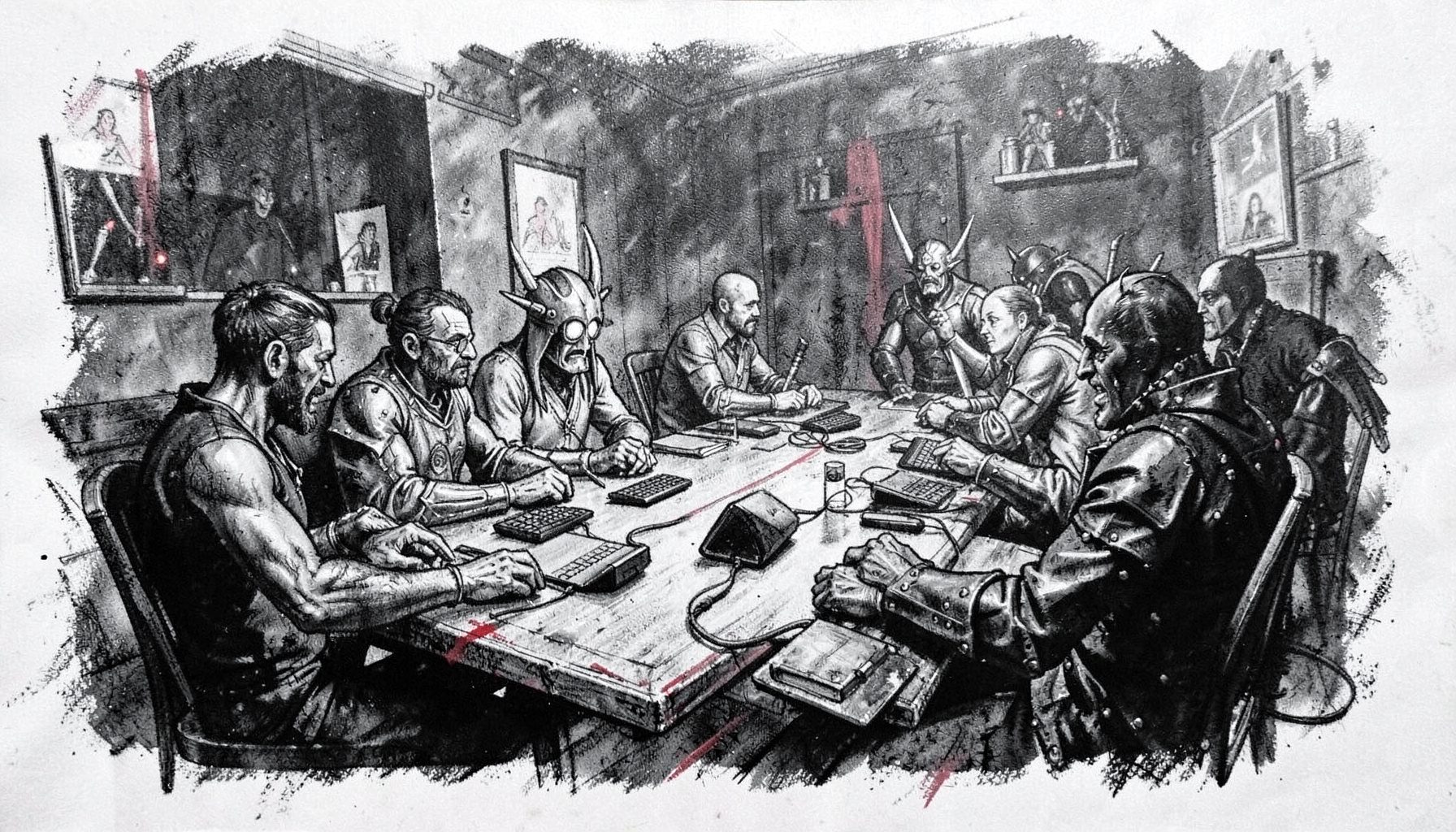
The science of puzzle design in escape rooms used at HLGCon
High Level Games Convention 2018 brought tabletop role-players, live-action players, designers, artists, publishers and vendors together at Atlantic City’s Showboat Hotel. Alongside LARP, game tables, panels, workshops and an exhibitor hall, escape-room experiences compressed collaborative storytelling into a limited span. Their success depended on more than concealed answers: every prop, instruction and social cue had to guide a group toward a shared solution.
For Australian players, the mix of mechanics and community is especially relevant. Melbourne and Sydney have busy conventions, pub-based meet-ups and commercial escape-room markets, while groups in Brisbane, Perth and regional towns often assemble through Discord, libraries and community Facebook pages. The psychology behind the puzzles can help organisers create demanding experiences that remain welcoming.
Cognitive foundations of an escape room
Puzzle design begins with attention. Players scan a scene, separate useful evidence from decoration and retain instructions in working memory. A strong room establishes a hierarchy: the crucial object need not be the loudest, but its placement, contrast or use should become meaningful as the group’s mental model improves. Ambiguity works when players can test interpretations rather than guess blindly.
| Puzzle approach | What players do | Cognitive pressure | Typical failure |
|---|---|---|---|
| Deductive | Combine evidence to confirm an answer | Sustained reasoning and memory | An arbitrary deduction |
| Lateral | Reinterpret an object or situation | Sudden insight and reframing | A culturally narrow reference |
| Physical | Manipulate, combine or move components | Spatial reasoning and coordination | Unclear affordances |
| Hybrid | Switch between clue types | Flexible thinking and communication | Inconsistent rules |
These approaches create different kinds of pressure. Deductive chains reward patience, lateral puzzles reward reframing, and physical actions turn the room into a tool. Mixing them prevents a competent strategy from solving every stage. It also lets players contribute different strengths: one person may notice a colour relationship while another remembers where a key was first seen.
Flow depends on a balance between challenge and skill. If every puzzle demands the same form of reasoning, fatigue arrives quickly; if each step is trivial, the group never develops a satisfying model of the scenario. Designers should introduce enough friction to make discovery feel earned, then provide a clear signal that progress has occurred. A changed prop, opened compartment or newly revealed instruction confirms that the group’s shared hypothesis is working.
Sequencing difficulty and the player journey
The best sequences resemble a rising curve rather than a staircase of arbitrary locks. An opening task should establish the rules, identify available interactions and produce an early win. This can be observed in the broader HLGCon programme, where participants moved between social play, instruction and performance: each mode offered a different way to learn the event’s language.
Middle puzzles can introduce one new variable at a time. A coded note may matter only after players learn how symbols work elsewhere, while a physical mechanism adds complexity to an already understood goal. Layering should remain legible. If two new rules appear together, the team may spend longer discussing instructions than experiencing the story, and the apparent sophistication of the puzzle becomes delay.
A final challenge can demand synthesis by combining earlier insights, yet it should feel like a consequence of the established world rather than a separate exam. The surrounding escape-room culture also benefits from generous reset times and visible staff cues. Those breaks lower performance pressure, let players reorganise their notes and make the eventual resolution feel collaborative instead of dependent on one unusually fast solver.
Space, objects and embodied clues
Physical space carries meaning through Gestalt principles: nearby objects are read as related, unusual shapes attract attention, and repeated patterns suggest categories. Designers can exploit these tendencies without making every answer obvious. Colour, sound, texture and scale provide redundant channels, which helps when players have different reading preferences or when ageing eyes and low light make fine print difficult.
Objects also need plausible affordances. A drawer suggests storage, a heavy box suggests lifting, and a fabric panel suggests concealment, even before a sign explains anything. Accounts of memorable panel stories from game masters with two decades of experience show the same principle in tabletop practice: a clue becomes stronger when its material form supports the fiction and invites action.
Production value should therefore serve comprehension. Elaborate set dressing can enrich a scenario, but excess visual noise makes search slower and creates false leads. At a convention venue, safety and access constraints matter too. Australian operators commonly assess props for sharp edges, unstable fixtures and restricted movement under state work-health-and-safety rules; lightweight replicas can preserve drama without creating preventable risks.
Narrative, collaboration and the social puzzle
Many escape-room puzzles are genuinely social. One player must describe an object, another recall a symbol and a third connect both to the scenario. HLGCon’s emphasis on inclusive participation fits this design: collaboration lets people contribute observation, deduction, language or physical skill without assigning fixed roles according to gender or gaming stereotypes.
Role assignment should remain flexible. A confident theatre performer may freeze at a mechanical lock, while a quiet tabletop strategist may spot a social contradiction. Good facilitation avoids declaring who is good at puzzles. It offers choices, models calm retrieval of rules and normalises asking another player to check an interpretation. The group then learns that success comes from shared information, not individual dominance.
A debrief completes the learning loop. Ask what the group believed, which clue changed the shared model and what cultural assumptions shaped the first reading. This is particularly useful in Australian conventions attended by international visitors, because a solution that relies on one narrow local reference may puzzle everyone else. Ambiguity can be intentional, but it should arise from the fiction rather than accidental exclusion.
Prototyping puzzles through playtesting
Playtesting turns intuition into evidence. A useful session gives three to five target players the same starting point, observes behaviour and asks only neutral questions. Record time to first purposeful action, points where explanations are repeated, moments when a clue is ignored and reasons for wrong guesses. Watching hands and conversation often reveals friction that the designer no longer notices.
Revision should target the earliest costly ambiguity. If players spend eight minutes interpreting one label, clearer staging may solve the problem; if everyone ignores a clue, its salience or narrative relevance needs work. Keep versions of major puzzles and compare the same measures after changes. This method suits the Australian market’s mixture of polished commercial rooms, volunteer convention sets and informal pub events, where budgets differ but testing costs little.
Paid experiences also carry legal and commercial obligations. Under the Australian Consumer Law, advertised duration, inclusions, refund terms and claims must not mislead buyers, even when an event sells through an unfamiliar marketplace. The convention-scenario challenge is closely related to designing an escape-room arc: compelling convention scenarios show how deadlines can sharpen choices without flattening character or theme. Clear premises, achievable objectives and visible consequences help both formats.
A practical blueprint for Australian game-makers
A practical design process joins cognitive, spatial, social and narrative checks. Begin with the intended player feeling—curiosity, tension, fellowship or relief—then define one behaviour that must occur. Choose a mechanic that produces that behaviour, stage the smallest possible version and test it before adding art, lore or complexity. Every later addition should strengthen the intended feeling or remove a measured obstacle.
Accessibility and local context should be designed in, not appended. Australian venues range from Sydney CBD entertainment strips and Melbourne laneway studios to council halls, suburban libraries and air-conditioned meeting rooms in Brisbane’s humid summers. Seating, readable type, captioned instructions, alternative physical interactions and adjustable difficulty widen participation. The Disability Discrimination Act 1992 and applicable building-access rules can also influence public-facing modifications.
At the next Australian meet-up, run one untested puzzle with three newcomers, time their first purposeful action, and note every hesitation before they begin.