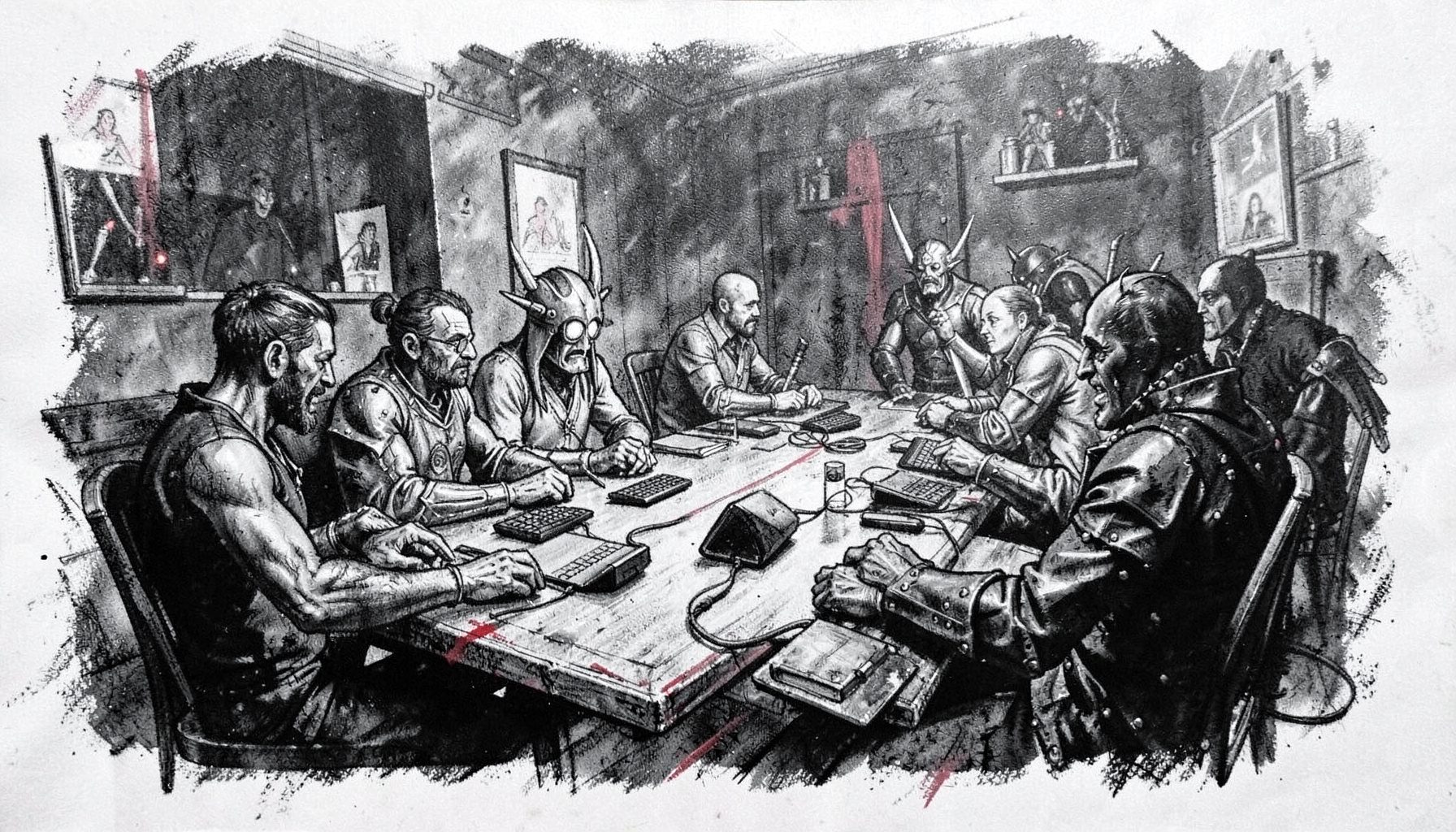
How to Write a Compelling Convention Scenario in Under a Week
A convention scenario has a difficult job. It must be easy for strangers to join, engaging enough to sustain attention, flexible enough for different play styles, and structured so a facilitator can run it with minimal preparation. A brilliant premise can still fail if players do not know what to do during the first ten minutes.
The fastest method is to design for the actual event rather than for an imaginary campaign. A convention session may run for two, four, or six hours, with players arriving from different cities and bringing varied experience. Someone from Sydney may sit beside a first-time player from Adelaide, while a group from Melbourne may expect a more theatrical experience than a regular tabletop audience.
High Level Games Convention demonstrated how tabletop play, LARP, workshops, escape rooms, and collaborative storytelling can share the same community space. That mix offers a useful model: build a clear situation, give every participant a meaningful role, and create opportunities for decisions that change what happens next. With disciplined choices, a complete convention-ready scenario is achievable in under a week.
Start With A Playable Promise
Begin with one sentence that explains the experience in practical terms. “The players are investigators trapped inside a flooded coastal observatory while a signal awakens something beneath the reef” is more useful than “This is a story about fear and isolation.” The first version gives you a location, a problem, a mood, and an immediate reason for the group to act.
Your central promise should support the session length and the venue. An escape-room-style mystery may work well in a noisy exhibitor hall if its clues are physical and its objectives are visible. A tense political drama may need a quieter room. For a convention audience, choose a premise that can be understood without a long setting lecture and that leaves room for players to add their own ideas.
Decide these elements before writing scenes:
- The immediate crisis that demands action
- The outcome that becomes possible if the group succeeds
- The consequence of delay, disagreement, or failure
- The tone, such as comic adventure, horror, investigation, or high fantasy
- The player-facing question that drives each major decision
A strong scenario does not require a complicated plot. It needs a pressure system. A missing person, collapsing treaty, dangerous experiment, or approaching storm gives players something concrete to pursue. Limit the number of factions, locations, and secrets so the facilitator can remember them without searching through pages during play.
Design Characters Around Friction And Choice
Pregenerated characters are often the quickest way to make a convention game accessible. Give each character a reason to care about the central crisis, a useful capability, and a personal complication. These details should create interaction rather than produce isolated mini-stories. A medic who wants to save everyone may clash productively with a security officer who believes one person must be sacrificed.
Write short character briefs using plain language. Include what the character knows, what they want, what they fear, and one fact they can reveal early. Avoid hiding all useful information behind a successful skill roll. Players should have enough material to act confidently from the beginning, while deeper clues can reward investigation.
Aim for complementary abilities rather than rigid roles. A group might include a negotiator, a practical problem-solver, a local expert, a sceptic, and a person connected to the threat. Give each character at least one moment when their knowledge or relationship matters. This helps quieter participants contribute without forcing everyone to compete for the same spotlight.
For an Australian convention, account for the way people travel and play. A session beginning at 9 am may include attendees adjusting from different time zones, particularly at a large event drawing players from Perth, Brisbane, Melbourne, and Auckland. Use a quick opening prompt and visible objectives rather than assuming everyone will arrive mentally settled and ready for a long rules explanation.
Build A Reliable Session Clock
A convention scenario needs a timetable, even if the players never see it. Divide the adventure into phases such as arrival, discovery, escalation, confrontation, and aftermath. Each phase should contain one essential revelation and one decision. If the table spends too long investigating a minor clue, the facilitator can move the next revelation into another scene without breaking the story.
A useful structure for a three-hour session might reserve twenty minutes for introductions and rules, forty minutes for the first problem, fifty minutes for investigation or travel, forty minutes for a major choice, and thirty minutes for the final sequence. Keep a small buffer for late arrivals, accessibility needs, rules questions, and the inevitable moment when players pursue an unexpected theory.
Use the following checks when shaping each scene:
- Can players identify the immediate objective within five minutes?
- Does the scene offer at least two possible approaches?
- Is there a clue, cost, or consequence that moves play forward?
- Can the scene end cleanly if time is running short?
- Does the scene give a different character a chance to matter?
Write “cut points” into your notes. If the schedule slips, combine two locations, reveal a clue through an NPC, or begin the final confrontation earlier. Avoid cutting the ending entirely; players remember the final decision more strongly than a detailed middle section. A compact scenario with a satisfying resolution feels more complete than an ambitious one that stops when the session bell rings.
Write For Safety, Access, And The Real Venue
Convention play involves strangers, shared spaces, and different comfort levels. State the tone and content boundaries before the game begins. If the scenario includes confinement, violence, discrimination, grief, or body horror, describe those elements clearly in the event listing and opening briefing. Offer simple safety tools such as an open-door policy, a pause signal, or a way to fade out a scene without requiring a player to explain themselves publicly.
Think about physical and sensory access while writing. Important information should not depend entirely on tiny handouts, dim lighting, fast speech, or a player being able to move around the room. If the session includes props, provide verbal descriptions and alternatives. For LARP elements, make costume and movement optional, and ensure that play does not require touching another participant.
Practical convention planning also includes local obligations. If you use recorded music, artwork, maps, or published text, check permission and licensing requirements rather than assuming online material is free to reuse. If the event involves alcohol service, minors, or a public venue, organisers may need to follow relevant state or territory rules, venue policies, and liquor-licensing conditions. Child-safety requirements can also vary, and a Working with Children Check may be relevant to some organised activities. The facilitator should confirm details with the event organiser, not improvise legal policy at the table.
Prepare these materials before the event:
- A one-page facilitator brief with the premise, tone, safety notes, and timetable
- Character sheets with large text, clear goals, and starting relationships
- A clue list showing where each essential fact can be found
- A simple map or scene card that can be understood at a glance
- Spare pencils, dice, tokens, name tags, and printed backups
- A short accessibility and content note for the event listing
Australian conditions may also affect the physical setup. A summer convention in Sydney or Perth can make crowded rooms uncomfortable, while air conditioning can make long sessions surprisingly cold. Build in water breaks, keep walkways clear, and avoid relying on fragile props that cannot survive transport between venues. If you are selling a scenario or related product, price in Australian dollars and account for GST, printing, payment fees, and shipping before setting a retail figure.
Test The Scenario Before You Polish It
Do not wait until every paragraph is elegant before testing the adventure. Run a compressed version with two or three people, or ask trusted players to read the character sheets and explain what they think the opening situation is. You are checking whether the scenario communicates its purpose, not whether the test group produces the intended story.
Watch for stalled decisions, repeated questions, unused abilities, and moments where players assume they are waiting for permission. These are design signals. If nobody knows why an NPC matters, strengthen the NPC’s goal. If every solution depends on one particular skill, add social, physical, and investigative alternatives. If a twist makes earlier choices meaningless, replace it with a revelation that changes the stakes while preserving player agency.
Keep revision focused during the final days. On the first day, define the promise and characters. On the second, outline the scenes and clock. On the third, draft handouts and facilitator notes. On the fourth, test the opening and central decision. On the fifth, revise pacing and safety details. Use the remaining time for proofreading, printing, and a short rehearsal rather than adding another subplot.
A scenario is ready when a facilitator can answer five questions without searching: what is happening, what do the players want, what happens if they do nothing, where is the next useful clue, and how can the ending be reached on time? Everything else should support those answers. Extra lore, elaborate mythology, and decorative prose can be removed if they slow down play.
Finish With Consequences Players Can Own
The final scene should make the group’s decisions visible. The settlement may be signed, but at a cost. The monster may be defeated, but the town must decide what to do with the truth. The escape may succeed, while one character chooses whether to expose the organisation responsible. These outcomes give the session emotional weight without requiring a sequel.
Prepare two or three ending variations instead of one fixed finale. A clean success, a costly success, and a failure with a meaningful consequence are usually enough. Let the final state reflect the players’ choices, alliances, and willingness to take risks. In a collaborative convention environment, the aim is not to force a predetermined plot; it is to create a strong framework in which the table produces a memorable shared story.
Before packing the scenario, read the opening aloud, time the first decision, and place every essential item in the order it will be used. Mark the non-negotiable clues, trim anything that does not serve play, and bring a printed backup. The practical test is simple: if a facilitator can start confidently, every player can make a meaningful choice, and the group can reach an earned ending before the session finishes, the scenario is ready.