Build a character from random rolls: an HLGCon workshop recap
At the 2018 High Level Games Convention at the Showboat Hotel in Atlantic City, players gathered for a workshop called Build a Character From Random Rolls. Its premise was simple: sit down, roll, and create a role-playing character without settling the backstory first. Around the session were panels, workshops, an exhibitor hall, LARP experiences and escape rooms, so the exercise offered a focused creative break from the convention’s larger programme.
Dice supplied the starting point, not the final verdict. Participants generated strengths, vulnerabilities and fragments of history, then interrogated them until they felt like a person rather than a stat block. An awkward roll could create tension, while a strong result prompted choices about desire, obligation and risk.
For Australian players, this was a portable alternative to building a character entirely from scratch. It also connected naturally with local game cafés, convention culture and collaborative play. The central lesson was that random information becomes dramatic when a group treats uncertainty as material rather than a problem to erase.
The premise in the room
The wider mix advertised through the official HLGCon site included tabletop sessions, live play, panels and vendors, all under one roof. Inside the character workshop, the emphasis was not on perfect optimisation. Players were encouraged to commit early, then discover the character’s purpose by testing the random results against other people at the table.
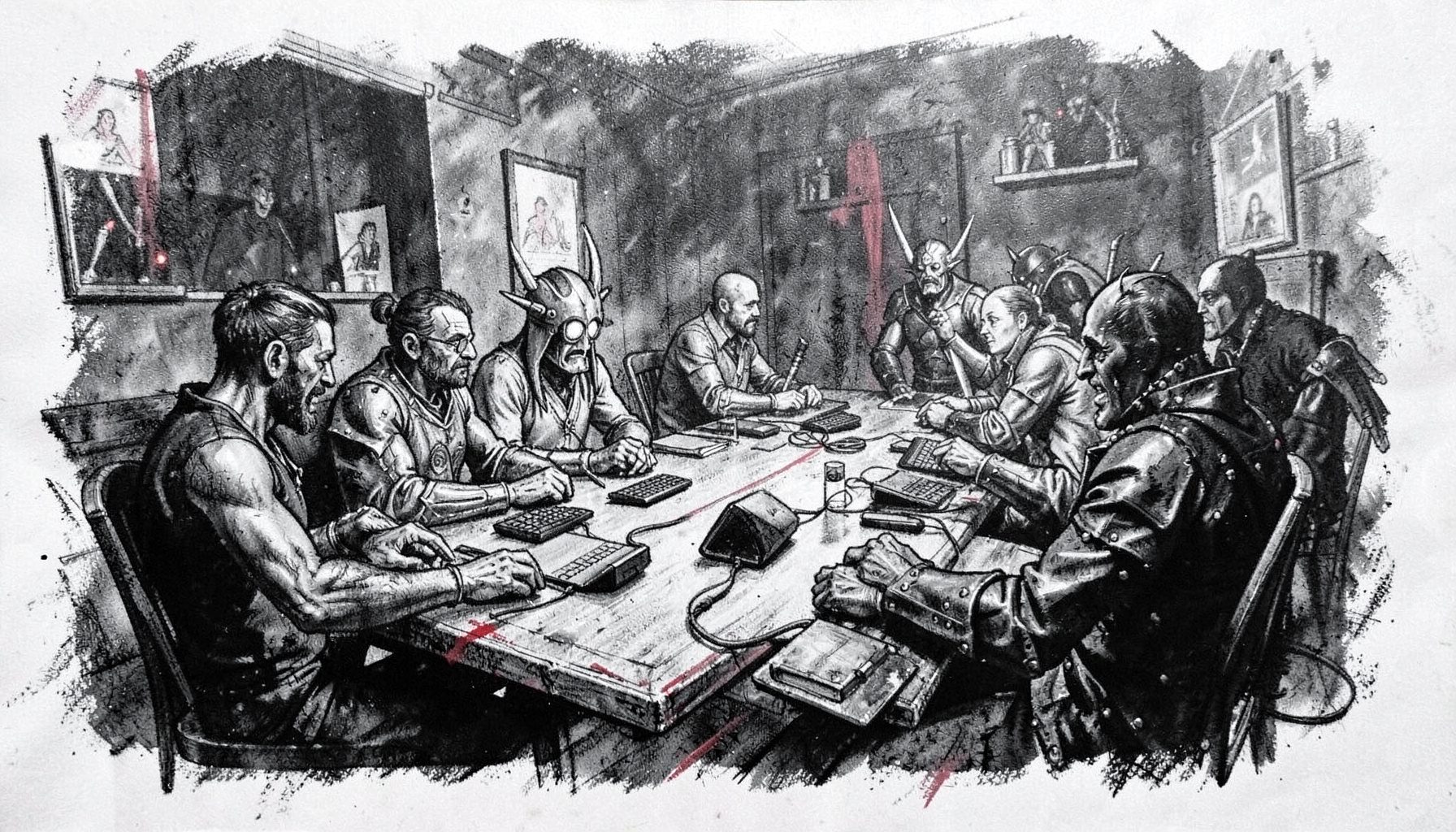
Each table began with dice and a spare character sheet. A facilitator asked players to assign the strongest results to useful qualities, the weakest to limitations, and the odd or contradictory numbers to hooks for interaction. The order mattered: a low value was not treated as dead time but as an opening for a difficult relationship, duty or mistake.
What the rolls brought out
The first round produced recognisable role-playing archetypes, but the details quickly complicated them. A nimble courier with poor physical power became someone whose survival depended on planning and allies. A stubborn investigator with an excellent memory carried evidence that other characters might want. Every apparent advantage created a reason for somebody else to approach them.
One table turned a disappointing social roll into a former apprentice who had been publicly dismissed. Another used a strong survival result for a rural guide who knew how to stretch limited supplies but disliked cities. These examples showed that the dice were not inventing complete people; they were giving each group a specific point of disagreement.
The facilitator’s questions mattered as much as the totals. Instead of asking whether a character was effective, the group asked what they would tolerate, who they trusted and which ordinary task suddenly became impossible. That shifted the conversation from optimisation to motive, making mechanical randomness useful to role-players, live-action players and character artists alike.
Turning chance into motive
A high score should not dictate a character’s personality. It might influence training, reputation or the expectations placed on someone, but the players still had to decide whether the character welcomed that reputation or resisted it. This small distinction gave the exercise its depth: numbers opened possibilities, while the group supplied intention.
Shared interpretation also gave the table an ownership that a privately generated character often lacks. Two players might use the same result differently, and the better answer was the one that produced a playable scene. The character gained friction through contact with goals, setting and other players rather than through extra lore added in isolation.
This compact workshop also depended on good scheduling, a concern examined in a review of balancing the convention programme. A hands-on session needs enough time to create, but it must also fit around panels, rest and informal play. The best slot for this exercise was therefore part of the programme’s rhythm, not simply another isolated talk.
Collaboration changed the result
Collaboration changed the result because the table supplied voices beyond the person who rolled. One player could recognise a useful instinct, another could challenge it, and a third could connect it to a running scene. The exercise therefore modelled the social nature of role-playing: a character exists in the responses they provoke as much as in the backstory they declare.
That connection between generated identity and live interaction was visible across the convention, as a review of the HLGCon LARP track shows. A character rolled in a quiet workshop could become more vivid when carried into a shared scene, provided the transition respected consent, boundaries and the agreed tone. Randomness started the process; collaboration made it safe and meaningful.
Inclusive participation was part of that process rather than an afterthought. Players could change a name, pronouns or background, decline ideas involving physical contact, and pass on any prompt. Those choices did not remove agency; they made the shared story safer and allowed the table to treat identity as something a person directs.
The exercise on Australian terms
Australian players quickly supplied familiar geography. A Sydney courier used an Opal card to cross the harbour, a Melbourne nurse missed a Myki connection while following a clue, and a mechanic outside Brisbane dealt with heat, mud and an unreliable ute. Such details are more than colour: transport, weather and work routines create credible motives, deadlines and places where a character can act.
The local market makes this easy to test. Independent hobby shops, game cafés and convention groups across Australia provide places to practise, and many clubs schedule recurring role-playing nights in Australian dollars. Australian-made games also offer familiar settings, from coastal fantasy to suburban horror, without requiring the exercise to imitate an American default.
Public play in Australia adds legal and safety responsibilities. State and territory work health and safety laws, venue licences and duty-of-care requirements shape event planning, while a pub-based LARP must observe house rules and responsible-service-of-alcohol procedures. Australian Classification Board labels such as MA15+ and R18+ apply to material it classifies, but an improvised character sheet is not rated like a video game, leaving age guidance and content warnings to the organiser.
Lessons for game makers and facilitators
For game designers, the workshop demonstrated how a random generator can serve character creation without overwhelming it. Dice can establish unusual combinations quickly, but human judgement decides which details matter. A useful tool leaves interpretive space, and a useful convention session lets that interpretation happen through conversation rather than through one facilitator’s preferred answer.
For facilitators, the practical lesson was to protect that space. Give players time to read results, let several voices respond, and stop while an idea still has energy. In the recap, the most memorable characters were not the mechanically strongest ones; they were the figures whose contradictions could immediately affect another person at the table.
The next character at your table
The workshop’s lasting appeal is its balance of speed and surprise. It removes the blank-page problem, supplies playable complications and leaves enough room for a group to make the result meaningful. It also reinforces a broader convention value: creative play works best when nobody has to surrender ownership of the story.
The next session’s concrete step is to place one set of dice in the centre, share one blank character sheet, and build the first character together.