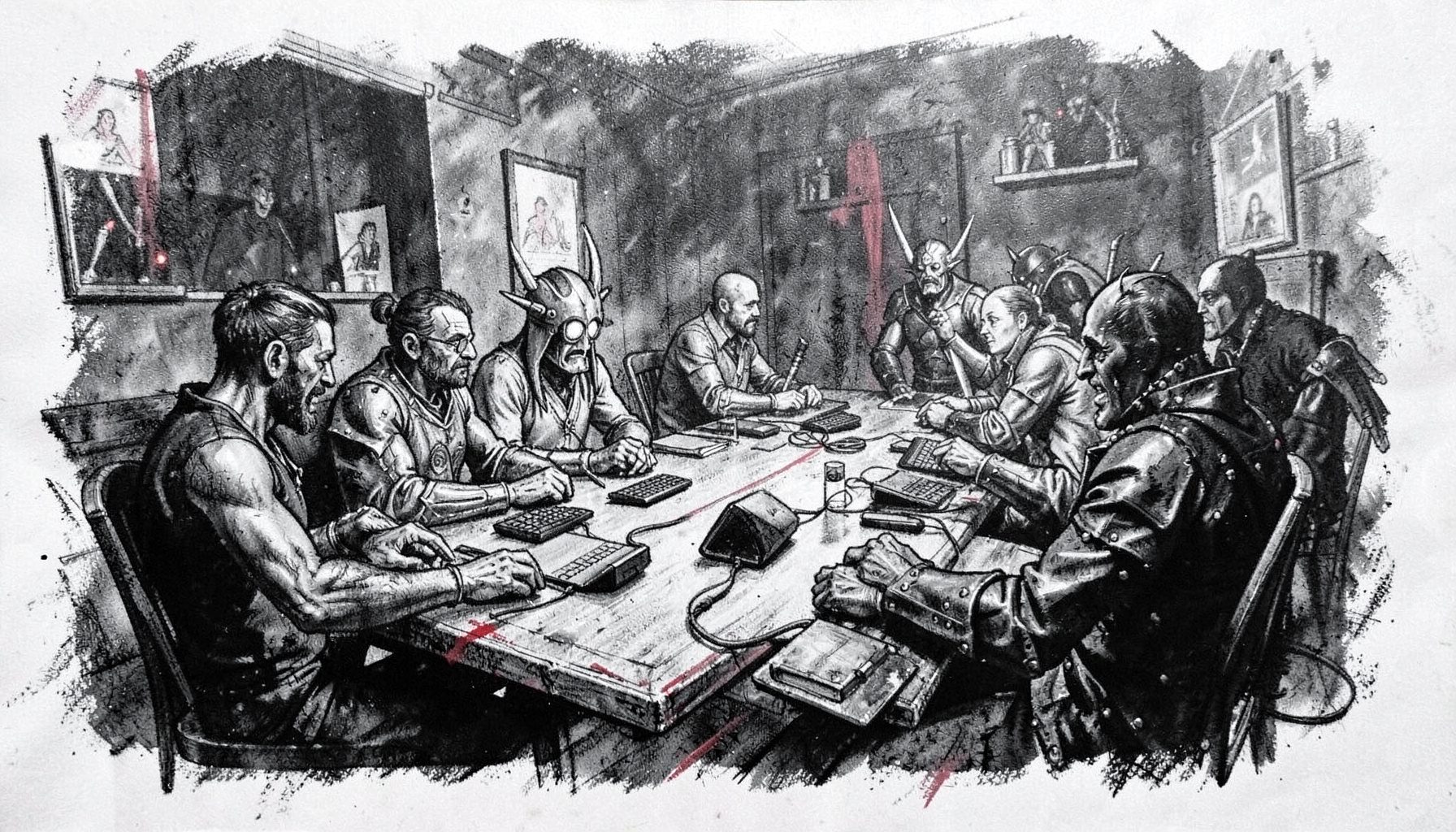
The stories held inside a handmade gaming journal
At a busy table in the exhibitor hall, handmade journals offered a quieter kind of immersion. While gamers compared dice, artists displayed character portraits and LARP participants moved between activities, one vendor invited visitors to handle stitched covers, deckled pages and brass fastenings. These were gaming accessories, certainly, but they were also props, archives and personal artefacts.
The vendor’s work suited the spirit of High Level Games Convention, held at the Showboat Hotel in Atlantic City, New Jersey, in 2018. The convention gathered tabletop role-players, live-action gamers, designers, publishers and artists around collaborative storytelling. Its High Level Games site gives a sense of the wider event, while the journals on the vendor’s table showed how a campaign can continue long after the session ends.
Meeting the maker in Atlantic City
The vendor, Rowan Vale, worked from a compact display of leather-bound notebooks, cloth-covered field books and smaller pamphlets designed for one-shot adventures. Each cover carried small signs of handwork: uneven stitching, burnished edges and stamped symbols that looked as though they belonged to a fictional guild.
“I like objects that become more personal through use,” Rowan explained. “A blank journal begins as a beautiful thing, but the real character appears when someone fills it with maps, failed dice rolls, overheard tavern rumours and notes about a party member’s strange decisions.”
That approach made the stall feel connected to the convention floor. A player could buy a campaign journal before a session and begin recording a new world that same afternoon. A LARP participant might use a weathered notebook as an in-character prop, while a game master could turn a larger volume into a campaign bible.
Why paper still matters to role-players
Digital tools make it easy to store character sheets, rules references and session summaries. Handmade paper offers a different pace. Writing by hand encourages players to pause, sketch a location or add a personal note that would never make it into a spreadsheet. The journal becomes a physical record of the group’s shared history.
Rowan designed pages with use in mind. Some books contained broad ruled lines for prose, while others included blank spreads for dungeon maps and dotted pages for diagrams. A few had removable inserts, pockets for handouts and ribbon markers in several colours.
“The best format depends on the player,” Rowan said. “A game master may need sections for non-player characters, clues and encounter ideas. Someone playing a bard may want space for lyrics. A LARP player may care more about letters, seals and objects that look believable in a medieval setting.”
The tactile quality also suited the social nature of conventions. Visitors passed journals around, compared paper weights and discussed how a book might fit a particular character. The product created conversation before a game had even begun.
Building a journal by hand
Handmade gaming journals begin with practical decisions that are easy to overlook. Paper must be thick enough for fountain pens, markers or ink washes without becoming too heavy to carry. The binding needs to open comfortably on a table. Covers need to withstand being pushed into a backpack alongside dice bags, rulebooks and snacks.
Rowan used a range of binding methods, including exposed stitching and folded signatures sewn around cords. Exposed thread gave some books a visibly crafted appearance, while concealed bindings created a cleaner silhouette. Leather covers were softened and conditioned before being wrapped around the text block, and fabric versions were reinforced to reduce fraying.
Personalisation came through small details rather than excessive decoration. A customer could choose a cover colour, paper style, closure, symbol or interior layout. “I try to leave room for the owner’s imagination,” Rowan said. “If I make every decision, the journal can feel finished before it has a story.”
This restraint was especially useful for campaign play. A neutral brown cover could belong to a ranger, scholar or smuggler, depending on what the owner added. The journal’s design established a mood without dictating the character.
Where roleplay becomes a keepsake
The strongest journals worked across several kinds of play. At a tabletop session, they held initiative notes, spell references and sketches of a ruined temple. At a LARP event, they became a diary, military ledger or coded correspondence. Between games, they preserved the small moments that players often remember more clearly than the official plot.
Rowan noticed that buyers frequently described their journals as future keepsakes. A campaign might end, but its book could remain on a shelf with ticket stubs, printed character portraits and photographs from convention weekends. The object gave a physical shape to a temporary community.
That sense of immersion also appeared elsewhere at the convention. Visitors interested in environmental storytelling could read about escape room challenges and see how clues, props and setting encouraged participants to think as a group. A well-made journal works in a similar way: its material details help players believe in the world they are entering.
For Australian gamers, this idea has familiar parallels. A notebook can travel from a Melbourne game night to a convention in Sydney, then return home carrying a record of new friendships. It fits easily into the everyday habit of keeping practical items close, whether that means a work backpack, a tote bag or a weekend gear box.
The craft behind the price
Handmade stationery can look expensive beside mass-produced notebooks, but the price reflects labour that is usually invisible. Cutting paper, folding signatures, sewing sections, preparing covers and checking the finished binding all take time. Small batches also make material costs harder to spread across many units.
Rowan said customers often asked whether a handmade book was “too good to write in”. The answer was simple: a gaming journal is made to be used. Scratched margins, ink stains and bent corners are signs that it has served its purpose.
Australian buyers may also need to consider practical costs beyond the listed price. Imported craft goods can involve international postage, currency conversion and delivery delays. A local seller generally includes Australia’s 10% GST in the advertised price, and purchases from Australian businesses are covered by the Australian Consumer Law, including protections when a product is faulty or significantly different from its description.
Shipping matters as well. Australia Post can make a sturdy journal cost more to send from Perth to Brisbane than between nearby American cities, particularly when packaging is needed to protect corners and closures. Sellers who offer tracked postage, clear measurements and an accurate weight make the buying decision easier.
A practical guide to choosing one
The right journal depends on the game, the writing tools and the habits of the person carrying it. Someone who mainly records short notes may prefer a compact softcover book. A game master managing a long-running fantasy campaign may need an A5 or larger volume with dividers and room for loose pages.
Rowan recommended testing the opening action before buying. “A journal should lie flat enough that you can write in it during a session,” the vendor said. “If the cover fights you, or the pages are too narrow for your handwriting, the beautiful binding will become a frustration.”
Useful points to consider include:
- Choose paper weight according to whether you use pencil, gel ink, fountain pen or markers.
- Look for sewn or reinforced binding if the journal will travel regularly.
- Select a size that fits your gaming table, satchel or convention backpack.
- Check whether pockets, dividers and elastic closures support your actual routine.
- Ask about care requirements for leather, cloth, metal fittings and decorated paper.
- Confirm postage, currency, GST treatment and return terms before buying from overseas.
A journal should feel inviting rather than precious. The best purchase is one that encourages regular use, whether that means writing a campaign recap after each Thursday night session or sketching a character during a train ride.
Comparing journal styles for gaming
Different formats suit different kinds of play. A rugged leather book can enhance a character concept, while a light stitched notebook may be better for a player who travels between venues. Australian shoppers may also find that locally made stationery is easier to replace or customise, even if an imported convention piece has a distinctive finish.
The comparison below focuses on function rather than status. A higher price does not automatically make a journal better; the useful question is whether its construction matches the way it will be handled.
| Journal style | Best use | Strengths | Points to check |
|---|---|---|---|
| Leather-bound campaign book | Long campaigns and keepsakes | Durable cover, strong visual identity, generous writing space | Weight, leather care and international postage |
| Cloth-covered notebook | Weekly tabletop sessions | Light, comfortable to carry and easy to personalise | Fabric durability and page thickness |
| Pocket field journal | LARP, travel and quick notes | Compact, discreet and convenient during play | Limited space for maps and long entries |
| Refillable binder journal | Game masters and organised players | Sections can be rearranged or replaced | Ring size, loose pages and closure security |
| Handmade pamphlet notebook | One-shots, conventions and sketches | Affordable, flexible and easy to share | Less protection for pages and covers |
What the convention leaves behind
A vendor specialising in handmade gaming journals contributed something important to the convention’s larger atmosphere: a reminder that games are built from objects as much as rules. Dice, miniatures, costumes, maps, tokens and books all help players cross from ordinary conversation into shared fiction.
Rowan’s journals also reflected the design thinking behind immersive play. The convention’s escape room design lessons show how physical details can guide attention, establish mood and reward collaboration. A journal applies those principles on a smaller, more intimate scale. Its texture, shape and marks invite the owner to participate in the story.
Years after the 2018 event, that quality still feels relevant. A handmade journal does not replace a digital character sheet or a campaign platform. It gives the game a memory that can be held, opened and revisited. For Australian players, it may begin at a local club in Adelaide, continue through a convention trip to Sydney or Melbourne, and eventually sit beside other objects from a life of shared play.
The key detail to remember is simple: a gaming journal becomes valuable through the stories written into it. Its handmade cover may attract attention, but its lasting worth comes from the characters, discoveries, arguments and friendships that fill its pages.