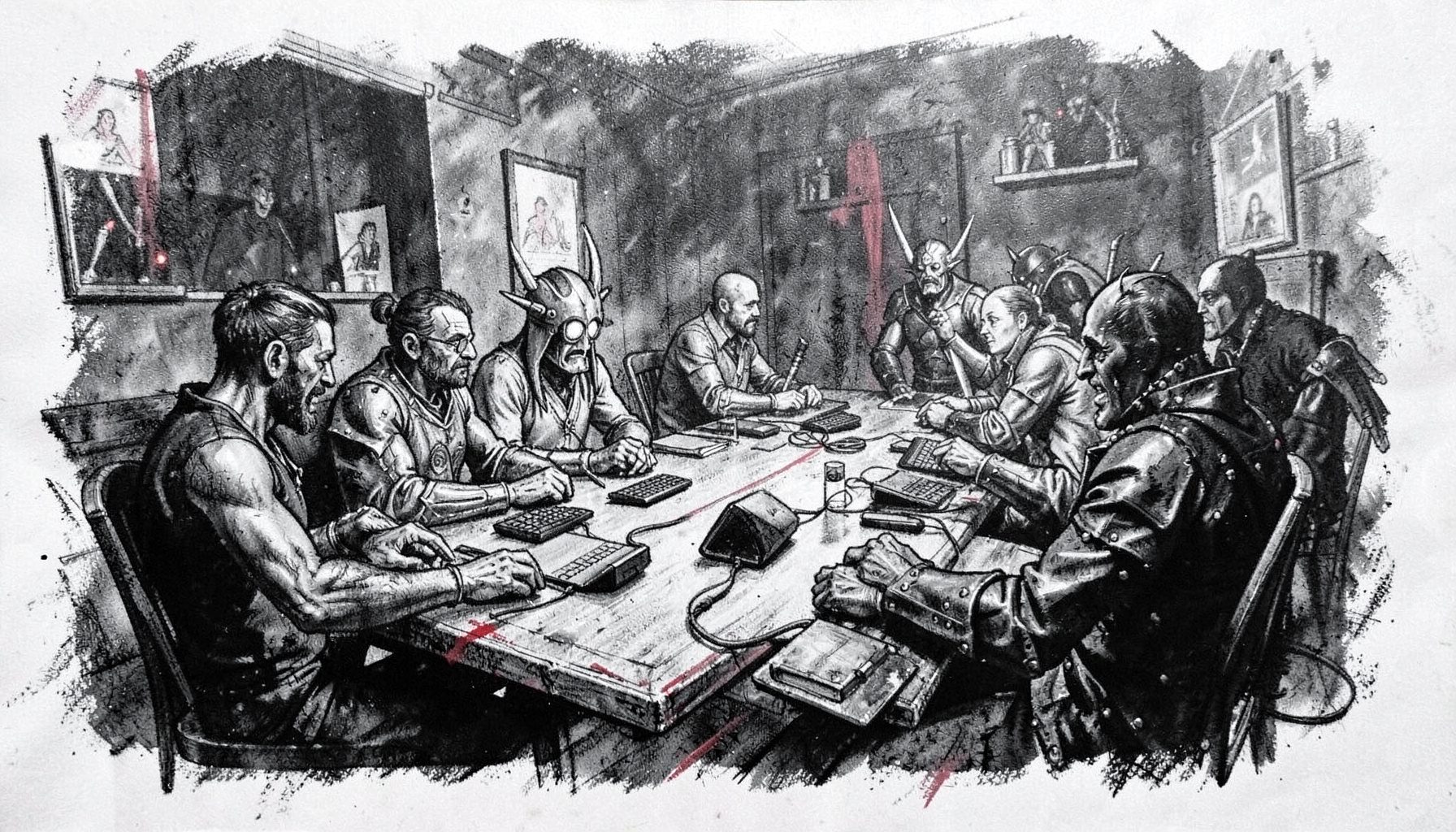
Improvising when the players ruin your plans
Every game master knows the moment when a player ignores the clue, kills the NPC they were supposed to meet, or wanders into the abandoned tower three sessions early. The carefully prepared plan may collapse, but the session does not have to. Improvisation is not the absence of preparation; it is the ability to redirect intention when the group takes an unexpected path.
That spirit of collaborative storytelling shaped High Level Games Convention at the Showboat Hotel in Atlantic City in 2018. Its LARP experiences, tabletop sessions, panels, workshops, escape rooms and exhibitor hall brought different kinds of players into the same creative space. The strongest moments often emerged when participants stopped treating the published material as a script to be performed and started treating it as a world waiting for their decisions.
A useful improvised scene still has purpose, stakes and momentum. The aim is not to control every outcome or react without limits. It is to recognise what the players want, preserve the promises of the scenario and turn interference into something that belongs to the group. Even a major detour can strengthen the story when everyone understands why it matters.
Australian groups commonly meet in community halls, libraries, suburban lounge rooms and licensed pubs rather than purpose-built studios. Their play often reflects local conversational habits: good-humoured banter, direct requests and phrases such as “have a go”, “no worries” and “fair go”. With long travel distances, changing weather and strong local convention scenes around Melbourne, Sydney and Brisbane, flexible plans are especially valuable.
| Planned element | Player disruption | Better live response | Keep intact |
|---|---|---|---|
| Fixed scene | Players arrive somewhere unexpected | Shift the location and connect it to their route | The central tension |
| Timed clue | Players ignore or misunderstand it | Let them encounter it differently later | The reason the clue matters |
| Confident NPC | Players challenge or replace them | Let the NPC respond to the challenge | Their motivation and secret |
| Planned tone | Players introduce a darker turn | Acknowledge it and establish boundaries | Mutual respect and safety |
Treat derailment as player intent
Distinguish between a player ruining an objective and a player pursuing the objective in a way you did not anticipate. If the group wants to interrogate the suspect rather than rescue them, they are not ignoring the story. They are changing what success means. The live response is to uncover the need beneath the action: do they want information, revenge, justice, or merely permission to take control?
A useful question is, “What would make this choice worth the risk to your character?” The answer may reveal a neglected hook in the scenario. A player who suddenly wants to bargain with the villain might be trying to make the villain personal. One who refuses to leave a cursed location might be searching for a sacrifice the game master forgot to include. Treating disruption as a request makes the improvisation easier to manage.
For groups still finding their feet, the archive’s tips for novice groups offer a useful reminder that uncertainty is especially common when nobody yet trusts the shared fiction. Explain what you can change, keep decisions reversible and make player goals more important than procedural fidelity. A session that visibly responds to the group teaches more about improvisation than a flawless delivery of the original plan.
Read the mood before changing the fiction
Watch for signals that the current approach is not working. Players may repeatedly look elsewhere, ask the same disruptive question or make jokes unrelated to the fiction. They may also be enjoying the disorder, in which case adding solemn narration will only flatten the energy. The group’s level of investment is often clearer than any individual complaint.
When tension is failing, change the pressure rather than the objective. Open an escape route, introduce a deadline or let an NPC make an aggressive move. If the group is bored, give their choice a consequence and reveal what it costs. This resembles the mechanics of an escape room: the players may ignore the intended sequence, but every action still changes the state of the environment and creates a new possibility.
Local conversational style can make this adjustment easier. Australian players may signal discomfort with directness, such as “Let’s park that for a sec”, while others express enthusiasm by immediately pushing the premise to its limit. Do not overinterpret a single expression, but do acknowledge a repeated signal. “You seem more interested in the rival than the mayor” is better than silently forcing the mayor back into the story.
Keep objectives flexible
A plan should provide direction, not demand obedience. Separate the objective from its exact method: the heroes need to stop the ritual, but they can sabotage it, redirect it, steal its components or expose it publicly. Each alternative changes the obstacles without erasing the purpose. When players make the journey stranger than expected, decide whether the destination still works before deciding whether the route is allowed.
Premises with several possible solutions provide the safest material for spontaneous changes. A mystery can be solved through confession, evidence or deception. A rescue can begin with negotiation, disguise or force. If a player neutralises the main antagonist early, move the consequence into the wider system. The ritual continues, the political consequences spread, or another character attempts to claim credit for the result.
The convention’s Pandaemonium event listing illustrates why a distinctive premise can anchor an improvised session. A strong central idea gives players something recognisable to pursue even when they ignore the planned sequence. It also gives the game master permission to ask what the group is actually trying to achieve, then build the next complication around that answer.
Carry a contingency spine
Before play, prepare three anchors rather than a rigid chain. Choose a location that can be reached from several directions, an NPC who wants something the players already need and a consequence that remains relevant no matter how they arrive. These anchors act as flexible hinges. When the expected route disappears, move the players towards one of them and let the current detour alter why it matters.
Keep consequences available in several intensities. A failed negotiation can cost time, damage trust, reveal a secret or hand an advantage to an enemy. Choose the smallest consequence that preserves the action, then escalate if the players continue pursuing the same approach. This prevents an improvised setback from becoming an arbitrary punishment while ensuring that their actions still affect the fiction.
Remoteness and unreliable transport make spare options particularly useful at Australian conventions. Rain can interrupt outdoor encounters, regional groups may face lengthy journeys and venue schedules rarely permit every theory to be tested. Carry a few neutral props, keep essential handouts digital and design at least one major beat that can occur in a corridor, side room or voice channel. Flexibility should protect the shared story from logistical reality, not the other way around.
Protect consent and preserve surprise
Improvisation still operates within agreed boundaries. Distinguish between a fictional surprise and an unwanted surprise, and check before making a character’s history, trauma or relationship part of the action. If someone hesitates, offer a private pause rather than demanding an immediate answer. This protects trust without removing meaningful consequences from the wider group.
The no-spoilers approach is equally useful for narrative reveals. A secret can create dramatic tension when it overturns expectations, but it should not depend on a player being trapped into an uncomfortable response. Explain the difference between fictional danger and personal limits, then let the group know which choices remain available. Clear boundaries often give players more freedom to commit once those limits are understood.
The HLG archive’s no-spoilers style guide provides a strong basis for handling that balance. Secrets can still be discovered in the right order, withheld from players without hidden manipulation and revealed when the group has earned the context. Good improvisation preserves surprise while making sure nobody feels ambushed outside the fiction.
Remember the story, not the script
After the session, notice which decisions produced the strongest reactions. Did the group care more about the discarded magistrate than the planned ritual? Did one detour create an unexpected bargain that now deserves a consequence? Record those developments and carry them forward. An improvised element becomes part of the campaign when the game master treats it as canon rather than an error awaiting correction.
The plan worth preserving is the reason the story mattered, not the exact route it took. When players ruin your plans, find the intent behind their disruption, redirect the pressure and give their choice a consequence. What they should remember is not that the scenario survived, but that the game became theirs.