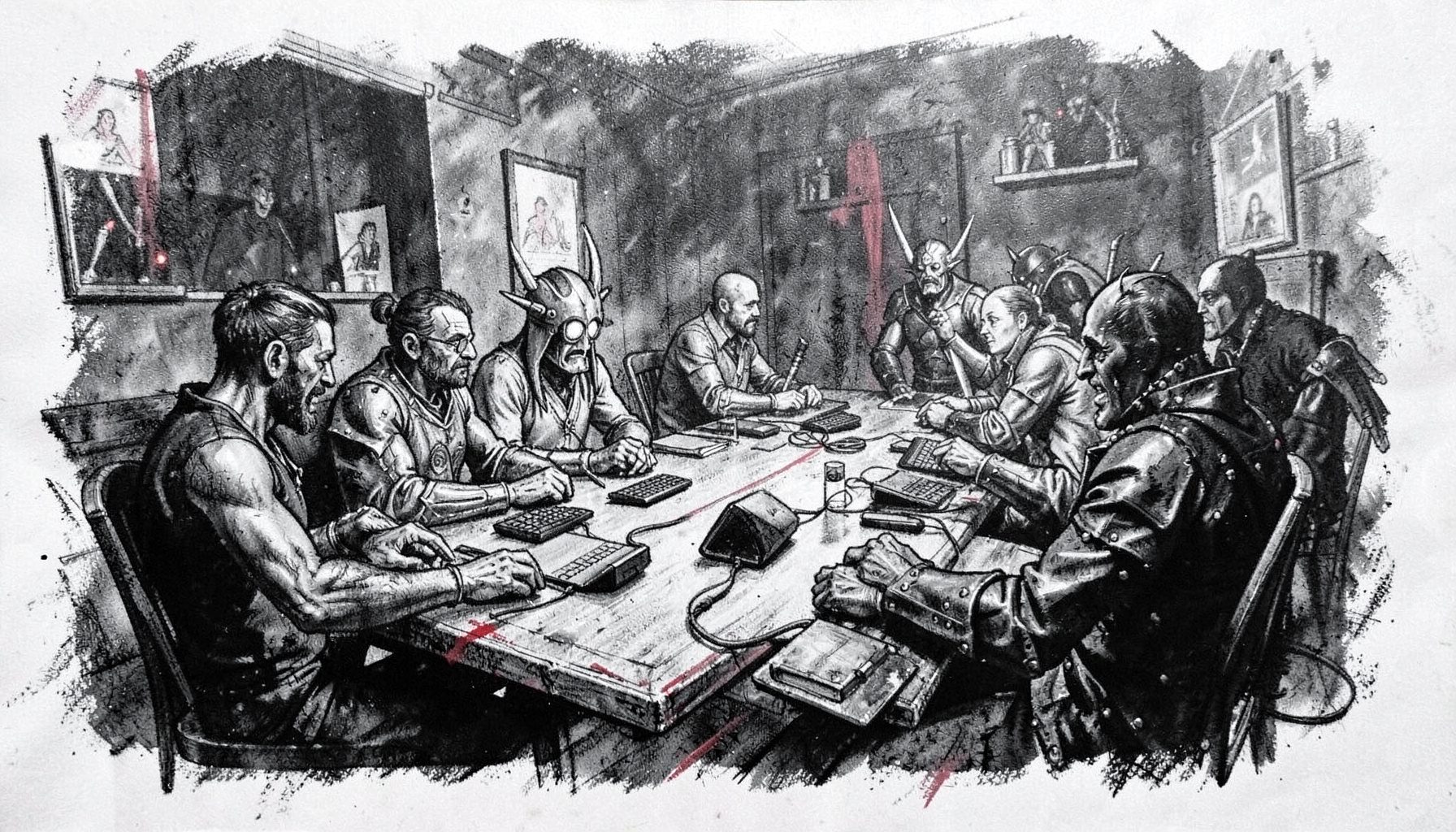
Why Live Playtesting Changes the Game
The value of playtesting at a live event becomes clearest when a design leaves the creator’s lounge and meets strangers. A familiar group can smooth over confusion and protect the designer. A convention removes those buffers, exposing unfamiliar rules, different expectations and the ordinary distractions of a busy shared venue.
High Level Games Convention, held at the Showboat Hotel in Atlantic City, New Jersey, in 2018, offered a useful example. Its tabletop sessions, LARP experiences, panels, workshops, exhibitor hall and escape rooms placed creators and players in the same energetic setting. Live play revealed how an experiment worked and how people made meaning from it.
From Private Draft to Public Experience
A home test usually answers a narrow question: can this group finish the scenario, and does the intended turn happen? At a convention, the design must survive more varied entrances. Some players know the genre; others meet the setting for the first time. Some enjoy optimisation, while others want a memorable character arc. Observing those differences helps distinguish a broken rule from one hobbyist’s preference.
Live event playtesting earns its value here. Feedback becomes more specific than “it worked” or “that puzzle was hard”: the clue appeared too late, a character lacked a reason to cooperate, or the reward came before the choice felt meaningful.
Convention culture also makes collaboration visible. Artists, designers, publishers, vendors and players contribute different lenses, revealing production issues as well as design ones. Paper stock, component readability, timing, table space and accessibility may matter as much as the rule text. An encounter may depend on a volunteer in costume, improvising voices or solving a puzzle in real time.
Designing Tests Around Real Decisions
Good live testing starts with a question, not an invitation to play. Is the investigation mechanic understandable? Does the party lose the thread when combat begins? Will a newcomer recognise a fair warning? A focused question lets facilitators record evidence without treating every preference as a demand. It also lets the designer leave one feature unchanged while testing another.
For a practical framework, designers can consult a designer’s guide that covers recruiting suitable participants and separating the creator from the table facilitator. The creator should not dominate by explaining intended solutions. A neutral facilitator can preserve the mystery and show whether players can progress from the material provided.
Scenarios need deliberate pressure. If a test asks whether diplomacy works, ignoring it should have consequences. If it examines resource scarcity, supplies must be limited. Otherwise, players may choose the obvious path because nothing rewards another approach. For that purpose, the scenario polishing guide connects small revisions to the experience players encounter rather than treating a scenario as a fixed script.
What Convention Tables Reveal
Live tables expose behaviour that design notes often miss. Players may talk among themselves, bypass the intended clue or hand control to the loudest participant. None of this is automatically a flaw. It may show that rules support flexible collaboration, or that an optional detail is doing essential work. The facilitator should describe the behaviour before diagnosing it.
Timing is particularly revealing. A short demonstration can seem brisk in a quiet room yet feel hurried when people are waiting for a turn, carrying equipment or moving between activities. A forty-minute scenario may absorb ninety minutes in a crowded hall because players debate every decision. Comparing planned and actual duration helps identify complexity, uncertainty, table management or mismatched expectations.
The wider convention offers comparative settings. LARP participants may emphasise embodied storytelling, while escape-room teams interpret clues under time pressure. They should not be treated as interchangeable, but their differences can expose assumptions in an RPG about what counts as a clue, how choices are communicated and how failure creates another story. The result is a map of audiences a design can serve, not a claim of one universal player.
Safety, Consent, and Event Logistics
Public playtesting adds responsibilities absent from a private lounge. Facilitators need escalation procedures, boundaries around physical contact, accessible materials and a way to pause. Participants should know what is observed, why notes are taken and how contributions may be used. Feedback improves only when players can speak candidly without fear of embarrassment or unwanted publicity.
Event policies should answer practical questions before doors open. The published event policies should spell out who owns feedback, how recordings are handled, what follows a serious disclosure and who can stop a session. Good policy gives volunteers a shared response when a situation exceeds a game sheet.
Run times, noise levels, age suitability and physical demands affect participation. A table relying on whispering may fail beside amplified panels and music; an activity requiring running around may need more space and first-aid planning. Accessibility includes readable fonts, alternatives to colour-coded information and advance notice of intense themes. Inclusive participation depends on removing barriers, not merely inviting a wider range of people.
Australian Communities and Commercial Context
Australian organisers face distinctive conditions. Melbourne and Sydney have dense networks of gaming cafés, specialist stores and transit-connected venues, making frequent in-person tests practical. In regional Queensland, Tasmania or Western Australia, distance may make a convention table a rare opportunity and encourage hybrid sessions through community platforms. Local clubs often rely on volunteers, borrowed spaces and homebrew groups formed through online gatherings.
The local market matters too. Australian publishers balance imported games and components against local print runs, distribution networks and GST. Where classification applies, Australian Classification Board ratings and content labels shape what retailers and families can accept. Designers testing here should check age guidance, theme warnings and release assumptions rather than importing expectations from an overseas con.
Data handling is another responsibility. For organisations covered by relevant privacy rules, identifiable attendee information can engage the Privacy Act 1988 and the Australian Privacy Principles. Sign-up sheets should need no more personal information than the event requires, while photographs, feedback forms and contact lists need clear consent and withdrawal options. Even when a small club may fall outside those provisions, careful handling builds trust.
Venue choice also intersects with state and territory requirements. Licensed pubs, community centres and council rooms have different rules for alcohol, insurance, minors, noise and accessibility. Organisers negotiate these details around common habits, including after-work gatherings, daytime family events and shared public spaces. Respecting venue rules and building access into the design protects participants and the event’s ability to return.
Recommendations for a Useful Playtest
A live test becomes valuable when its purpose, boundaries and evidence are clear. The following approach works for an RPG pitch, a homebrew scenario or an activity being polished for a convention floor.
- Set one learning question. State what the session must reveal and what is out of scope, so feedback stays focused.
- Recruit for relevant experience. Include target players and newcomers, and give genre, tone and content warnings before registration.
- Assign separate roles. Let the designer observe, a facilitator run the table and a note-taker record behaviour, quotes and timing.
- Protect consent and privacy. Explain observation, recording and feedback use; allow withdrawal and collect only essential personal details.
- Capture friction in context. Note lost time, missed information and unclear choices, separating rules problems from personal preference.
- Debrief and version the content. Compare expected and observed play, document changes and label findings that still need testing.
Keep the test playable. Clear materials, a stated duration and one facilitator script usually produce better evidence than an elaborate setup that consumes the session. Afterwards, the team should be able to say what it learned, which change follows and what remains uncertain.
The Lesson That Should Remain
The greatest gain from live event playtesting is not free validation. It is exposure to the distance between intention and encounter: the clue the designer thought was obvious but the player never saw, the conflict they expected but the table rushed through, the rule they saw as flexible but the group treated as absolute. Live play makes that distance observable while there is still time to respond.
The people around the table matter equally. Players volunteer attention, facilitators manage complexity, artists make cues legible and venues enable cooperation. When roles are respected and boundaries clear, a convention becomes a collaborative workshop as well as a showcase. The lesson to remember is simple: the most useful playtest is not the one with the most praise, but the one that turns honest human experience into a wiser next version of the game.