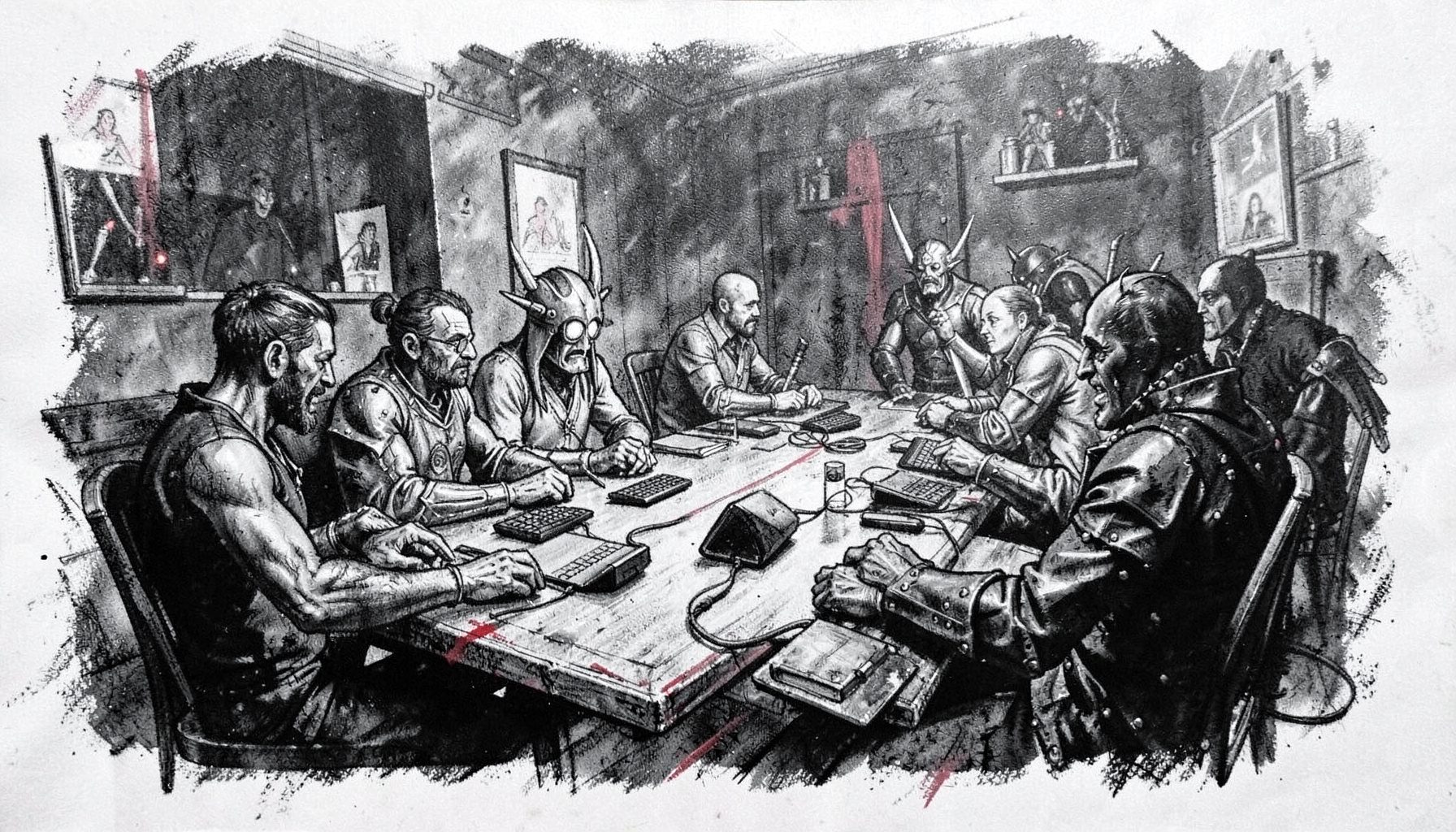
From homebrew to convention game: the polish that matters
A homebrew scenario often succeeds because its creator can explain every odd detail, pause whenever the group loses the thread, and quietly replace a poorly balanced encounter. A convention slot removes those safety nets. At the 2018 High Level Games Convention in the Showboat Hotel, Atlantic City, designers and players met across tabletop, live-action, art and publishing spaces, united by collaborative storytelling. A game presented there had to welcome unfamiliar players, establish its tone quickly, survive a fixed running time, and give its facilitator enough control to keep everyone engaged.
For Australian creators, that polish is also a logistics exercise. Conventions around Sydney, Melbourne, Brisbane and Perth often use hotels, community halls, libraries or RSL clubs, with travel shaped by rail timetables, hot weather and limited public transport. Local hire fees, Australian-dollar printing budgets and GST on commercial sales can alter what a scenario can support. The aim is not to flatten the homebrew’s personality; it is to preserve the central fantasy while making the rules of play visible, safe and achievable in a busy convention room.
Define the player-facing contract
Begin with the player-facing contract rather than a count of lore. In a short brief, state the genre, setting, player roles, tone, duration and intended ending. For a four-hour slot with five players, decide whether mystery, tactics, role-playing or character drama leads, and what each participant should be doing in the final fifteen minutes. This contract stops an elaborate premise from demanding more attention than the group can give.
Next, identify the three load-bearing choices that drive the scenario. Every supporting location, faction and complication should reinforce at least one of them; anything that does not can wait for another edition. Write the intended emotional progression from uncertainty to commitment, then test whether the encounters actually produce it. A successful playtest with unfamiliar players is more valuable than another revision made in the creator’s head.
Build an enterable world
Give players three anchors: a place they can picture, a pressure they can feel and a conflict they can influence. Exposition becomes easier to absorb when each revelation changes what the group believes about the situation. A practical location description also establishes boundaries, so nobody has to guess whether exploration, negotiation or combat is appropriate.
Information should arrive in layers rather than through a long briefing. Let environment, witnesses and physical clues carry the initial mystery, then use direct instruction when delay would frustrate the players. The convention resource on handouts and maps is a useful reminder that these materials work best when they answer immediate questions without solving the scenario for the group.
Design maps and handouts for real-world use. Make the first round readable in under a minute, print key pages in black and white, and never rely on colour alone to identify a faction or route. Number each sheet consistently, include a simple legend and prepare spare copies. At a convention, a missing prop or faded print should interrupt the story for minutes, not derail the session.
Engineer choices that hold attention
A public scenario needs choices that remain meaningful even when players know the designer’s preferred solution. Offer trade-offs rather than a single hidden “correct” answer, and let the group understand why one option is risky. This creates the collaborative momentum valued at events such as High Level Games Convention without turning every decision into an arbitrary puzzle.
Build scenes as timed modules with a clear purpose, entry condition and exit condition. Give the facilitator a target duration, a short version and an extension point. When players investigate beyond the planned route, redirect them with a consequence rather than an “off-script, but interesting” speech. Flexible stories still need edges that keep the session coherent.
Make participation possible through different styles. One player may want to negotiate, another to solve a mechanism, while someone else may prefer a dramatic confrontation. Assign roles that create interdependence, but avoid requiring constant performance or specialist knowledge. Characters should remain distinct through motives and choices rather than stereotypes, dialect or forced eccentricity.
Make safety and access part of play
Prepare safety tools before writing the final clue. A short content note, clear lines of visibility, an opt-out convention and a private check-in can be included without revealing confidential character information. Explain that stepping away, changing role or declining an action will never earn ridicule at the table. These tools establish trust, especially for players attending a convention where nobody knows the facilitator.
Design for varied access needs as well. Provide legible print, readable digital material, seating options and clear descriptions of physical actions. Avoid making hearing, vision, mobility or processing differences the source of a character joke. Give players meaningful choices in how they receive instructions, and allow characters to solve problems without requiring a particular kind of body or voice.
Private and hidden information needs an explicit policy. Reviewing the No Secrets style guide can sharpen how a team communicates spoiler boundaries, concealed objectives and disclosure expectations. Document emergency contacts, venue exits and the location of first aid in the facilitator notes, then rehearse how the session pauses if someone becomes distressed or a prop fails.
Prepare the scenario package
A polished scenario needs a production plan as much as an adventure. Schedule the welcome, character introductions, major beats, break, finale and handover within the advertised slot. Build ten to fifteen minutes of slack into the run, but decide which scene absorbs it. Record where the facilitator should reset the pace, shorten exposition or cut optional material.
Local conditions deserve a place in that plan. Australian conventions give independent designers, artists and small publishers valuable access to players, retailers and community organisers, but a modest sales budget may not support elaborate props. Price printing, travel, venue hire and contingency costs in Australian dollars, remembering that GST may apply to taxable sales. A live-action adaptation may also require council permission, public-space approval, insurance and site-specific restrictions.
Read the convention policies and conduct before promoting the session, then align character descriptions, player agreements and incident procedures with those expectations. Rehearse the full event schedule, including setup, teardown and the time needed to reset between groups.
Before the event
- Lock the player count, character roles and required rules.
- Convert essential clues into print-ready, numbered handouts.
- Rehearse the opening briefing, safety check and scene transitions.
- Price printing, hire, travel, insurance and sales in Australian dollars.
- Confirm accessibility, first aid, breaks, storage and venue access.
At the venue
- Place maps and handouts where every seat can reach them.
- Identify the facilitator, co-facilitator and emergency contact.
- Track elapsed time against the agreed scene schedule.
- Keep spare handouts, writing tools and a reset plan nearby.
- Pack materials in order of use to shorten setup and teardown.
Rehearse, compare and hand off cleanly
Run the finished scenario with people who have not helped design it. Observe where they ask for clarification, which clues they overlook and how long each transition takes. A polished version should produce the same dramatic arc across groups without requiring the facilitator to improvise missing structure. Keep player briefs, facilitator notes, handouts, safety information and contingencies in one labelled package.
The final comparison makes the transformation concrete:
| Dimension | Homebrew draft | Convention-ready scenario |
|---|---|---|
| Core promise | Known mainly to the creator | Stated in a short player brief |
| Pacing | Flexible pauses and improvisation | Timed cues with fallback scenes |
| Information | Personal notes and verbal explanation | Layered clues and numbered handouts |
| Safety | Implied or added late | Defined before play and rehearsed |
| Production | Materials gathered casually | Packed kit with setup and backup plans |
| Facilitation | Depends on creator memory | Self-contained notes and contingencies |
The practical takeaway is to polish every part that helps a stranger understand the goal, feel welcome at the table and trust what happens next, while removing anything that does not serve that experience.