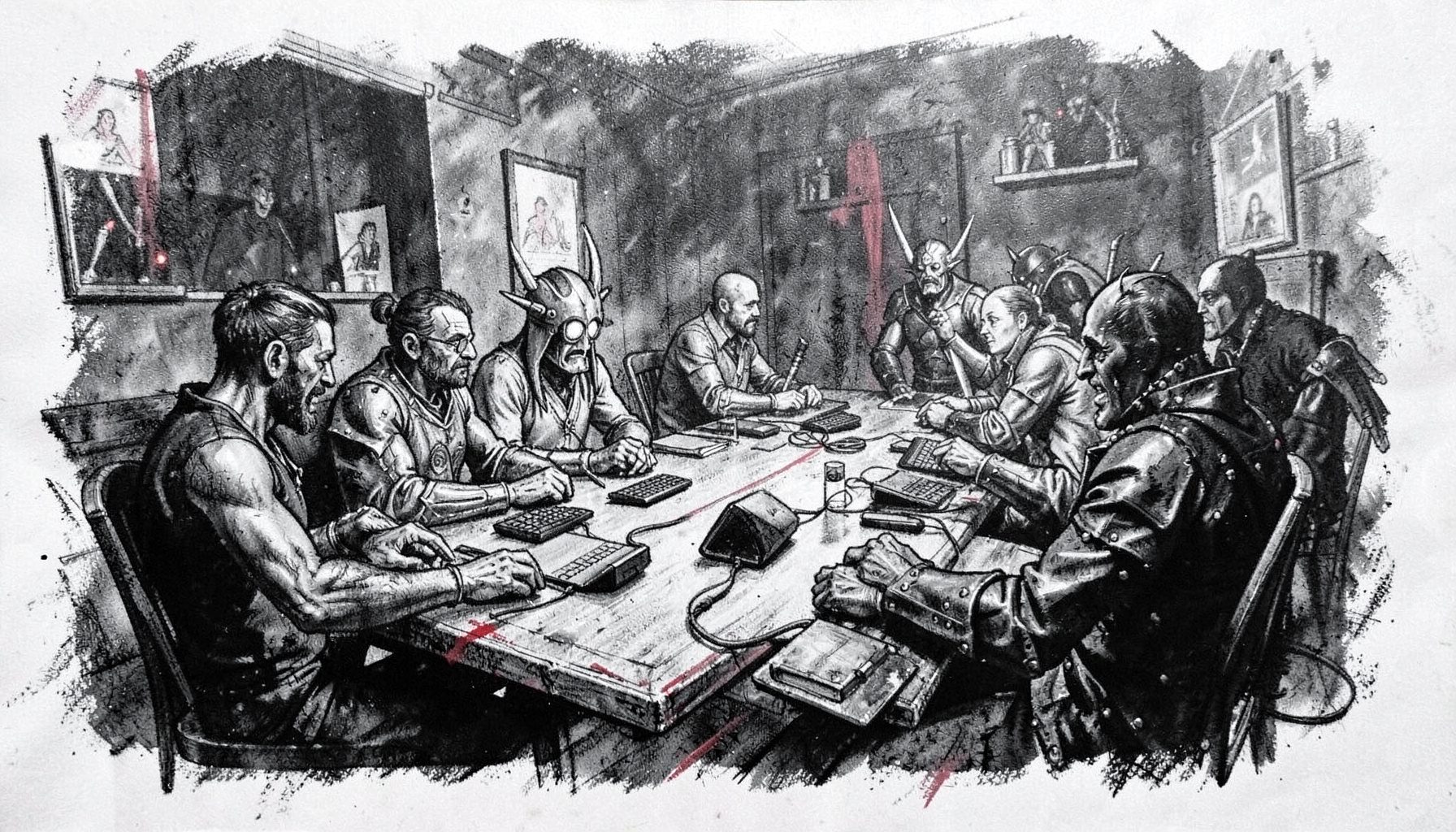
Building a collaborative story with strangers in one session
A one-session game has one chance to turn a room of unfamiliar people into a temporary ensemble. The strongest examples create momentum before anyone feels experienced: a shared mystery appears, each person receives a reason to care, and decisions belong to the group. The result is collaborative storytelling rather than a campaign carried over several weekends, but it still needs visible cause, consequence and closure.
That compactness is useful at conventions, game shops, libraries and community halls, where the cast may meet for the first time at the door. A story built collectively with strangers works best when the facilitator controls the boundaries rather than every plot detail. Clear roles, simple rules and quick prompts let participants contribute without demanding stagecraft, writing talent or intimate role-play.
Start with a promise and clear boundaries
Begin with a promise: three hours, one central question and an ending everyone helped create. Give the session a small number of fixed facts, such as why a train stopped or why a message arrived in code, but leave the motives and methods for negotiation. This lets players influence the direction without wandering outside the prepared story.
Set content and participation boundaries before play. Explain the themes, physical demands, lighting effects and level of personal disclosure involved. A short form can flag violence, horror, romance or strong language, while a visible pause system lets anyone leave an exchange without explaining. Nobody should be pressured to reveal personal history, speak in character at all times or accept physical touch.
Use confidence as a design constraint. Offer low-pressure roles for observers, map holders, equipment specialists and timekeepers, then let anyone move into a speaking role. Shared goals matter more than winning: two parties who need each other create reasons to listen, while rotating narrative authority keeps one confident player from carrying the whole story.
Shape a world players can enter quickly
Drop players into motion rather than delivering a history lesson. Open with an event, an urgent message or a problem visible in the room. Three locations, four recurring characters and three artefacts are usually enough to create a coherent world. Give each artefact a clear function, such as evidence, leverage or a missing piece, so choices have tangible consequences.
Make onboarding part of the mystery. Hand out role cards in plain language, then allow ten minutes for quiet reading and pair exchange before questions begin. Avoid long speeches and fictional biographies; useful details include what each character wants, what they know and whom they trust. Players who cannot act can still solve clues, manage resources or interpret rules.
Preparation improves play when the event timetable changes the available time. The archived programme schedule can help facilitators identify suitable panels, workshops or game breaks and leave enough space between them for arrival and decompression. If the story must fit a fixed slot, decide which scenes are essential and which can become narrated summaries.
Compare the main session formats
The right format depends on how the group wants to spend its attention. Some stories move through talk and deduction, others through movement and presence. Matching the format to the group prevents an energetic premise from becoming a series of speeches, or a cerebral mystery from becoming a series of shouted commands.
| Format | Best fit | One-session rhythm | Main risk |
|---|---|---|---|
| Guided tabletop | Groups that prefer discussion, systems and shared references | Scene prompts, clue rounds and a final group decision | Discussion stalls when roles are too broad |
| Live-action role-play | Groups comfortable with movement, voice and improvisation | Briefing, paired play, location changes and a shared climax | Performance pressure excludes quieter players |
| Hybrid | Mixed groups with different preferences | Rotation between brief scenes, clue work and shared planning | Scene transitions waste time without a clear host |
Choose one primary mode and borrow only a small feature from another. A live-action session with visible clues usually benefits from a map; a tabletop session can gain atmosphere from one artefact without becoming a full LARP. Test the combination with the same players, because a format that feels inclusive to one person may feel exposing to another.
Run the session like a live ensemble
Treat the facilitator as a stage manager for information, not the author of every decision. Establish clear trigger points: when a door opens, when reinforcements arrive or when evidence changes the stakes. Between those beats, let players negotiate, travel, investigate and decide. The prepared plot should create pressure while preserving meaningful uncertainty about how events unfold.
Physical space needs a simple flow and careful boundaries. The hotel ballroom LARP guide demonstrates how a large group can use a hotel venue, but a smaller session can apply the same discipline with clearer zones for public action, clue discovery and private discussion. Mark exits, keep pathways open and identify a quiet room.
Assign one person to time, one to safety and one to continuity, even in a modest group. Give facilitators coloured cards or message notes to reveal information consistently, and use tokens for shared resources so nothing disappears when a player leaves the table. In Australia, a packed function room may also need extra thought about hearing, step-free routes and nearby public transport, especially for interstate visitors.
Build the welcome around Australian realities
Local knowledge can shape the welcome without turning participants into stereotypes. Australian conversations are often direct, relaxed and lightly teasing; phrases such as “no worries”, “fair go” and “have a crack” may appear naturally, but forcing slang or mock accents quickly becomes awkward. Let people set their own register and judge tone by how the group responds, not by assumptions about nationality.
Venue expectations also vary. A game staged at the Melbourne Convention and Exhibition Centre, ICC Sydney or Brisbane Convention & Exhibition Centre must work around large-event movement, while a neighbourhood venue may rely on council-approved community rooms, local libraries or hotel function spaces. Organisers should publish the actual walking route, nearest station or bus stop, accessible entrance and finish time so interstate visitors can plan without calling for every detail.
The approach matches the participatory spirit of the 2018 High Level Games Convention at the Showboat Hotel in Atlantic City, New Jersey, where tabletop, live-action, art and publishing communities came together. The Australian market is shaped by volunteer-run conventions, independent game shops, local publishers and community-funded projects. Consumer prices commonly include 10% GST, while campaigns may use Australian platforms such as Pozible rather than relying entirely on overseas markets.
Remote participation needs another layer of care because mainland cities span several time zones. Perth stays on UTC+8 without daylight saving; Brisbane remains on UTC+10; Sydney and Melbourne shift with the southern seasonal clock. If anyone joins online, put the start time in Australian Eastern Time, repeat it in local time and avoid expecting overnight attendance to match a one-day event.
Use a reliable session blueprint
A session becomes dependable when its rules and resources are prepared before enthusiasm takes over. Keep the facilitator brief to one page: opening image, fixed facts, scene triggers, time limits, safety signals and ending condition. Put player-facing instructions on a separate sheet in large type, and provide digital and printable versions for different access needs.
Build the whole arc around decisions rather than a pile of disconnected puzzles. Every major clue should alter what the group can do, and each player role should create pressure toward a collective choice. Record unresolved threads as the ending forms, so even a partial resolution feels designed rather than abandoned.
- Fix the scope. Set a clear duration, one dramatic question and an ending that can be reached inside the booked slot.
- Brief with care. State themes, sensory effects, physical requirements, opt-out routes and content notes before the first scene.
- Give every role a job. Pair an objective, a useful skill and one connection to another character; avoid labels that amplify anxiety.
- Keep discoveries visible. Place clues, tokens and decisions in a shared area so quiet participation is as consequential as loud performance.
- Prepare the finish. Identify the final choice, the information required to make it and the sentence that will close the shared story.
The next concrete step is to reserve a three-hour room, appoint a facilitator and timekeeper, and publish a one-page session brief with the content and access details by 6 p.m. Australian Eastern Time.