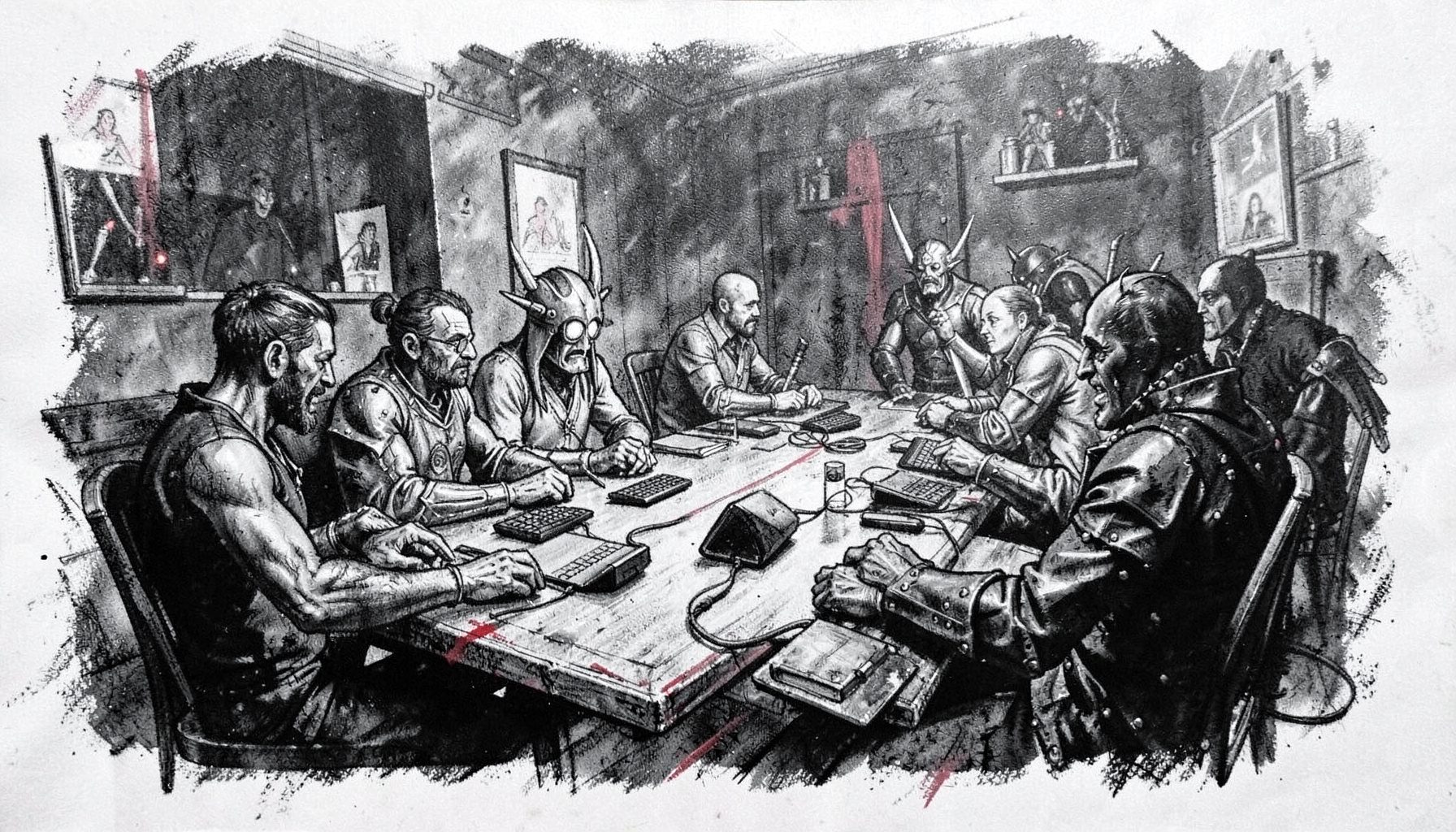
The thrill of collaborative worldbuilding at a gaming table
Worldbuilding becomes most vivid when it is shared. A campaign setting can begin with a map, a royal scandal or an old god, but it becomes memorable when players decide which rumours are true, who controls the harbour district and why the moon has begun to bleed. The pleasure lies in turning loose fragments into shared history, with every choice adding another layer to the myth.
At the 2018 High Level Games Convention at the Showboat Hotel in Atlantic City, New Jersey, that process had a physical home. Tabletop RPG players, live-action role-players, artists, designers, publishers and vendors mixed through sessions, panels, workshops, an exhibitor hall and escape rooms. The event’s emphasis on inclusive community participation made collaborative storytelling more than a game mechanic; it was a way for strangers to become temporary co-authors.
Shared sparks become a living setting
The official High Level Games Convention site shows the convention’s broad mix of play, performance, art and commerce. That variety matters because worldbuilding rarely stays inside a role-playing session. A map displayed in the exhibitor hall can inspire a dungeon, an illustrator’s costume can suggest a faction, and a conversation with a vendor can plant the seed of a game.
A setting can be inherited from a published adventure, improvised from a handful of prompts, or assembled through a campaign’s accumulated decisions. Each route leaves a different kind of ownership. Published lore offers polish and boundaries, while improvised lore offers speed and surprise. When players contribute to both, the result feels richer without becoming arbitrary.
Shared creation works best when a group agrees on what must remain stable and what can change. A magical system may be fixed while its local consequences remain open. The city may be permanent while its mayor, monsters and relationships are not. These boundaries let people take risks without arguing over every detail or erasing the work another person has invested in.
Dice, prompts and the courage to disagree
Rules are often treated as the engine of a game, but they are also a language for negotiating meaning. A roll can settle a risky choice, yet the reason for a rule often matters as much as its result. Does the group treat supernatural artefacts as common tools or feared relics? Is a failed negotiation a loss of status, a loss of information or simply a change of plan? The table becomes a laboratory for those answers.
Prompts help a group move beyond the first neat idea. A rumour about a vanished fleet, a locked tower or a diplomatic insult can be offered without deciding what it means. One player treats it as fact, another connects it to an old family feud, and a third spots a useful contradiction. Fiction advances through that exchange of confidence, suspicion and surprise.
Disagreement needs a structure that protects the story. Clear lines about physical contact, themes and player boundaries are especially important in live-action role-play, where improvisation can become intense. Once those agreements are in place, creative friction becomes safer. Participants can push the fiction, ask for a different perspective and recover from a dead end without treating another person’s discomfort as an obstacle to be ignored.
Australian gaming circles share that creative spark
Australian players bring the same table energy to well-known hubs in Sydney, Melbourne, Brisbane and Adelaide. Their communities range from regular role-playing groups in community halls to packed conventions such as Melbourne’s Freeplay and Brisbane’s Supanova. The local rhythm is recognisable: travel to a venue, meet people over dice, compare discoveries in a hallway and leave with several new campaigns competing for attention.
The Australian market also shapes how that creativity circulates. Local designers, illustrators, podcasters and small publishers release zines, solo games and campaign material through game stores, conventions and online communities, while hobby budgets are measured in Australian dollars. That mix of commercial support and maker-led enthusiasm gives player-created lore a practical home, even when it begins as an improvised rumour on a Saturday afternoon.
Customs matter too. Many community games meet in venues where bringing your own food and drink is normal, so a session may move from a quiet game room to a pub table without becoming two separate social experiences. Australia’s distances create another shared condition: party members in Perth, Hobart or regional towns may join remotely while the centre of the group meets in person. Shared maps, online notes and rotating facilitators become essential storytelling tools.
Visual artists make the lore impossible to ignore
The program guide artists featured at High Level Games Convention showed how visual design can act as a narrative guide. Their work did more than decorate names and spaces. Colour, costume and character detail gave players cues about alliances, eras and tone, allowing a shared setting to be sensed before the first rule was explained.
An illustration can settle a contradiction, open a mystery or turn a minor NPC into a future legend. A cracked badge on a guild enforcer suggests a long factional war; unfamiliar script marks a district with its own culture; an exaggerated portrait reveals where a respected merchant’s reputation has gone too far. These details work like sentences, communicating history without requiring a lore lecture.
This visual layer is particularly valuable in a collaborative campaign because it gives abstract choices a memorable shape. When an improvised villain receives a distinctive silhouette or a temporary alliance becomes a painted banner, participants remember what the group made. Australian illustrators and commission artists often build such assets through convention commissions, local fandoms and online portfolios, connecting the excitement of a live game to a durable creative community.
A good convention weekend gives stories room to grow
A practical Showboat gaming itinerary demonstrates how much a compact convention can offer. It is tempting to treat the programme like a checklist, filling every spare hour with another mechanic, miniatures game or panel. Collaborative storytelling benefits from a different rhythm: leave enough time for an idea introduced on Friday to mature into a shared campaign by Sunday.
Pacing also protects attention. A demanding tabletop session needs recovery time, while an LARP or escape room benefits from hearing the rules clearly before entering the action. Alternating noisy, physical play with quieter discussion allows the group to process what happened and decide which details belong in the continuing story. The strongest itineraries create options rather than obligations.
A clear starting prompt helps, but it should be simple enough for every participant to enter. “The lighthouse keeper has vanished” may be more useful than a fully explained conspiracy because it leaves room for local knowledge, character motive and accidental complications. Conventions are good at supplying the second half of worldbuilding: other players contribute the detail that the organiser could not have imagined alone.
The shared world is the real souvenir
The strongest outcome of a convention is not a souvenir badge but a group that remembers inventing the same place. Characters acquire histories, locations gain contradictions and a joke made at one table becomes part of a private campaign language. Returning home does not end the collaboration; it changes the group from attendees into authors carrying a shared version of events.
The practical differences between approaches can be seen when ownership, preparation and flexibility are placed side by side:
| Approach | Main source of ideas | Player agency | Best use | Common limitation |
|---|---|---|---|---|
| Solo worldbuilding | One creator | Low | A tightly controlled story | The group follows one vision |
| Published setting | A design team | Defined within fixed lore | Familiar worlds and prepared campaigns | Players may feel constrained by canon |
| Collaborative campaign | The whole group | High within agreed boundaries | Ongoing sagas and unexpected twists | Uneven participation can skew the result |
Across these approaches, the best results come from a shared agreement rather than equal invention from every person in every moment. Clear rules for consent, pacing and canon give bold ideas somewhere safe to land. The practical takeaway is to fix the story’s essential anchors, protect space for player contributions and let the group decide which improvised details deserve to become permanent history.