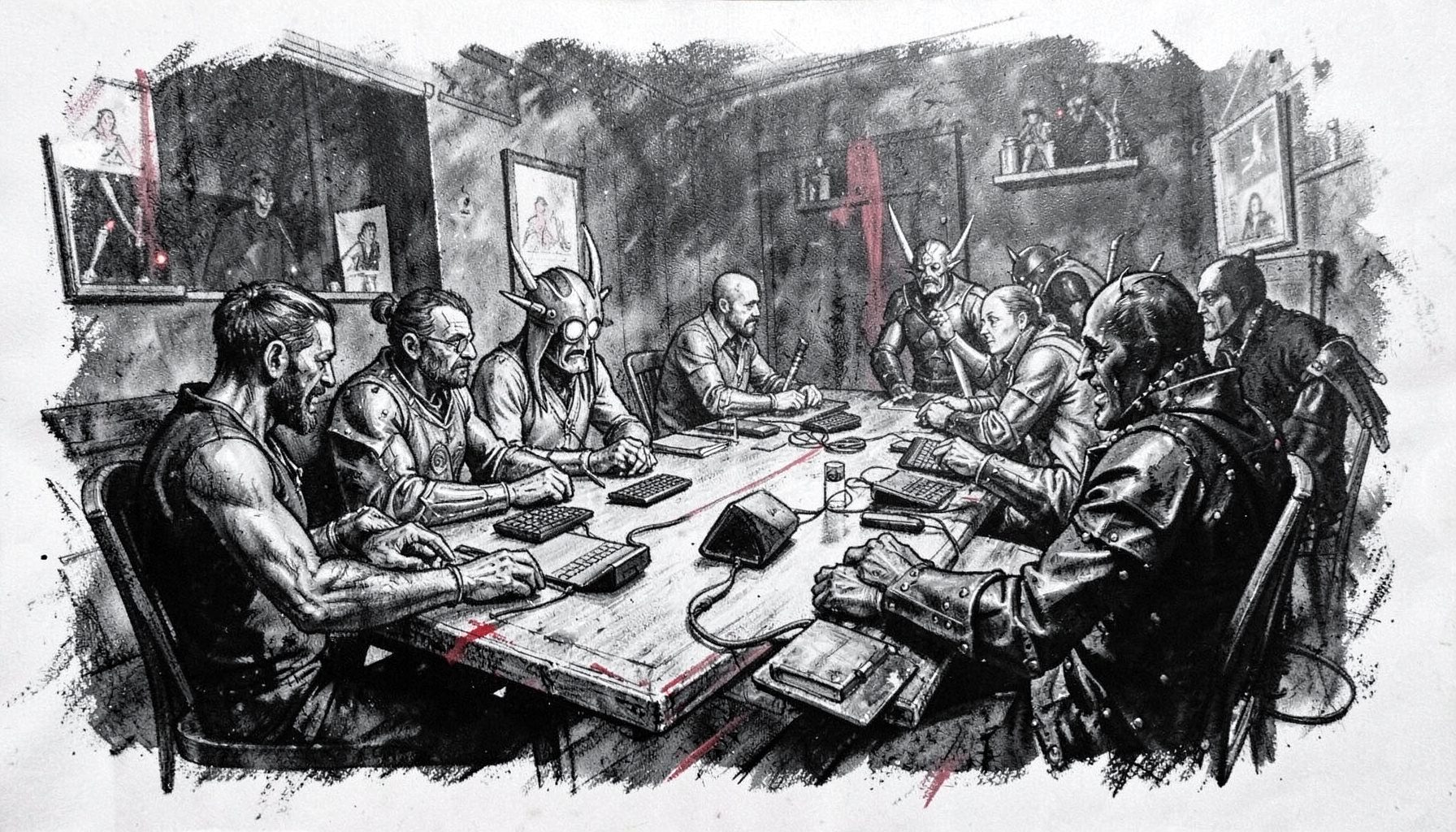
Exclusive interview: crafting the official HLGCon scenario
The official scenario at HLGCon 2018 represented months of coordinated effort by a small writing team determined to deliver something distinctive for the convention's tabletop and LARP participants. Situated within the Showboat Hotel in Atlantic City, the event brought together role-players, designers, and publishers from across the United States and beyond. Among the attractions, this flagship scenario became a touchstone for collaborative storytelling. It drew on classic investigation tropes while pushing toward modern narrative design. The interview below explores how the authors approached such a demanding creative brief.
Two writers and a lead designer composed the core team, though the project drew additional support from playtesters and editors scattered across multiple time zones. Each contributor brought distinct professional backgrounds, including academic fiction writing, indie game publishing, and community management for live events. The Australian tabletop community featured prominently in early discussions, with several Melbourne-based freelancers contributing cultural research and scenario stress-testing. The team's goal was not merely to entertain but to create a flexible experience adaptable to varied player counts and time constraints.
The scenario itself centred on a mystery set in a coastal city beset by strange occurrences, blending investigative mechanics with emotional character arcs. Unlike many convention one-shots, it offered branching conclusions and persistent NPC relationships that carried across sessions. Players could pursue multiple leads, and the authors built in optional rules for groups with mixed experience levels. The writing drew on techniques familiar to readers of literary fiction while remaining accessible to first-time role-players.
Below, the authors discuss their process, the challenges of writing for an inclusive audience, and what they learned from watching hundreds of players engage with their work. The conversation reveals how a convention scenario moves from blank page to finished module, and why the experience resonated beyond the event itself.
The origins of the scenario
The scenario began as a response to feedback collected after the previous year's convention, where attendees expressed interest in deeper narrative experiences. The authors met during a regional gaming summit and discovered shared dissatisfaction with the thin plots common in convention modules. They decided to pool their strengths and pitch a more ambitious design to the HLGCon organisers.
Early development took place over shared documents and late-night voice calls, with the Australian collaborators often joining from Melbourne cafes during their morning hours. This transcontinental workflow shaped the project's pacing, as the writers learned to accommodate asynchronous feedback and time-zone gaps. The no secrets style guide provided a framework for maintaining consistent tone across contributions.
The team faced an immediate constraint. The scenario needed to function for groups ranging from three to twelve players, with sessions as short as two hours or as long as six. Solving this required modular scene design and adjustable difficulty curves, principles the writers had absorbed from Australian convention culture, where flexible scheduling is common due to the country's vast distances and the tendency for players to travel between capital cities for major events.
Worldbuilding without overwhelming the table
One of the central design challenges involved creating a setting rich enough to reward exploration but streamlined enough to teach quickly. The authors opted for a fictional coastal city loosely inspired by Atlantic City itself, allowing local landmarks to ground the fiction without demanding geographical precision. Details such as the boardwalk, the salt-tinged air, and the constant hum of tourists became atmospheric shorthand.
To avoid info-dump exposition, the writers embedded setting details into dialogue and incidental documents players could discover during play. A restaurant menu hinted at local cuisine, while a discarded newspaper referenced ongoing city politics. These touches came partly from research conducted in Australian cities like Sydney and Brisbane, where similar techniques appear in locally published modules from outfits such as Spectrum Games and Mutant Meeples.
Character backgrounds were designed with similar restraint. Each pre-generated character came with two secrets, one personal goal, and one tie to the central mystery. This structure allowed players to make meaningful choices quickly, without requiring extensive system mastery. The approach reflected the team's belief that convention one-shots should lower barriers to entry rather than test character-building expertise, a philosophy that resonates strongly with Australian game runners who frequently host drop-in sessions at community centres and university clubs.
Mechanics that served the story
The scenario used a lightweight system that prioritised narrative momentum over complex calculation. Instead of granular combat rules, conflicts resolved through contested checks tied to character aspects. This kept the focus on decision-making and role-playing rather than tactical positioning.
The authors borrowed techniques from several Australian independent designers, including card-based initiative and collaborative world-mapping tools popular at Melbourne's quarterly Game Plus meetups. These mechanics encouraged table-wide engagement and prevented any single player from dominating the spotlight. The result was a system that felt closer to guided collaborative fiction than traditional dungeon-crawling, an approach that has gained traction in Australian hobby communities over the past decade.
Optional rules expanded the experience for groups wanting deeper mechanical engagement. A sanity track allowed gradual character evolution under stress, while a relationship web tracked NPC trust levels. These additions could be layered onto the base rules without disrupting the core flow. The authors stressed during playtesting that no rule should slow the narrative pace below a comfortable threshold for new players, a guideline informed by observations at Australian conventions like PAX Aus where mixed-experience tables are the norm.
Writing for inclusive, diverse audiences
Inclusivity shaped every stage of the scenario's development. The authors consulted sensitivity readers, ensured culturally respectful representation, and built content warnings directly into the scenario preamble. They also created characters with varied gender identities, abilities, and socioeconomic backgrounds, reflecting the diversity of the broader role-playing community.
Australian classification guidelines influenced how the team handled certain themes, particularly around horror and psychological tension. While the scenario operated within the bounds of general audiences, it did not water down emotional stakes. The writers drew inspiration from Australian independent films known for restrained but powerful storytelling, aiming to replicate that balance on the tabletop.
The team also addressed accessibility through physical materials. Large-print handouts, clear maps, and colour-coded clue cards helped players with different needs engage fully. These choices emerged from feedback gathered at Australian conventions, where accessibility initiatives have become standard practice. The authors hoped their work might encourage similar standards at future events worldwide.
Playtesting, data, and memorable moments
Playtesting occurred across multiple continents, with sessions run in Adelaide game stores, Sydney university clubs, and online groups connecting Australian and American players. Each session produced notes on pacing, clarity, and emotional impact. The team maintained a rolling document of revisions, updating scenes based on observed player behaviour rather than theoretical design alone.
| Design element | Traditional convention module | HLGCon scenario approach |
|---|---|---|
| Player count flexibility | Fixed party size of 4-5 | Adjustable from 3 to 12 |
| Session length | Typically 3-4 hours | Scalable 2-6 hours |
| Resolution system | Dice-heavy combat focus | Narrative contested checks |
| Character creation | Pre-gens or quick builds | Two secrets and one goal per character |
| Pacing tools | Linear plot beats | Modular scenes with branching |
This comparison highlighted how the team's approach diverged from convention norms. The table was distributed to organisers as part of the post-event documentation. It demonstrated that ambitious narrative design could coexist with the practical constraints of a busy convention schedule, a lesson relevant to Australian event organisers balancing tight venue hire costs with player expectations.
During the convention itself, certain sessions stood out. One group of six players from different backgrounds bonded over a shared revelation about a character's hidden past. Another group, consisting of three complete newcomers, navigated the mystery using only the materials provided, emerging satisfied and asking when the sequel would appear. Playtesters reported that the scenario's emotional beats landed consistently across different group compositions, validating the writers' commitment to structural flexibility.
Core design principles
The writing team operated according to a shared set of guidelines refined over months of collaboration. These guidelines emerged from late-night discussions, playtest debriefs, and feedback from early readers. They served as a touchstone whenever the writers faced difficult decisions about scope, tone, or mechanical complexity.
- Keep the core mystery solvable within two hours while allowing expansion for longer sessions
- Use setting details to create atmosphere without requiring memorisation
- Design characters that offer clear hooks rather than blank slates
- Build mechanics that reward cooperation over competition
- Maintain emotional stakes through consistent NPC behaviour
These principles evolved during development. The final version of the scenario guide included a philosophy section written collectively by the team. The document emphasised respect for player agency and trust in the group's collective storytelling instincts. The authors hoped other designers might borrow and adapt these guidelines for their own work, particularly those working in Australian community settings where resources can be limited but creativity runs high.
Reflections on the broader TTRPG landscape
The interview concluded with thoughts on where tabletop role-playing games are heading. The authors noted growing interest in shorter, more focused experiences suited to busy adult lives, a trend visible in Australian communities where weeknight sessions have become standard. They also pointed to increasing sophistication in narrative design, with designers blending literary techniques and game mechanics in new ways.
- Mystery scenarios remain popular, especially those with emotional weight
- Solo and small-group play is expanding, driven by time constraints
- Australian publishers are gaining international recognition for innovative mechanics
- Accessibility tools are moving from optional to expected
- Convention one-shots are becoming more narratively ambitious
They expressed cautious optimism about the medium's future. While commercial pressures sometimes push toward safer, more homogenised products, independent creators continue pushing boundaries. The success of experimental scenarios at conventions like HLGCon suggests audiences are hungry for fresh approaches.
For those curious about how popular systems compared during the event, the popular TTRPG systems review offers a statistical breakdown of attendance and play preferences. The data shows that mystery and horror genres remained strong draws across all systems tested, with Australian-designed engines performing particularly well in the narrative-focused categories.
The team announced plans for a follow-up module that builds on the original's setting while introducing new investigative mechanics. Early drafts suggest a colder climate and a focus on institutional corruption, themes the authors explored in their initial pitches but had to cut for length. They hope to run playtests in both American and Australian venues before final release.
Pick up a copy of the scenario, gather three to five friends, and run the opening scene this weekend to see how the mystery unfolds at your own table.