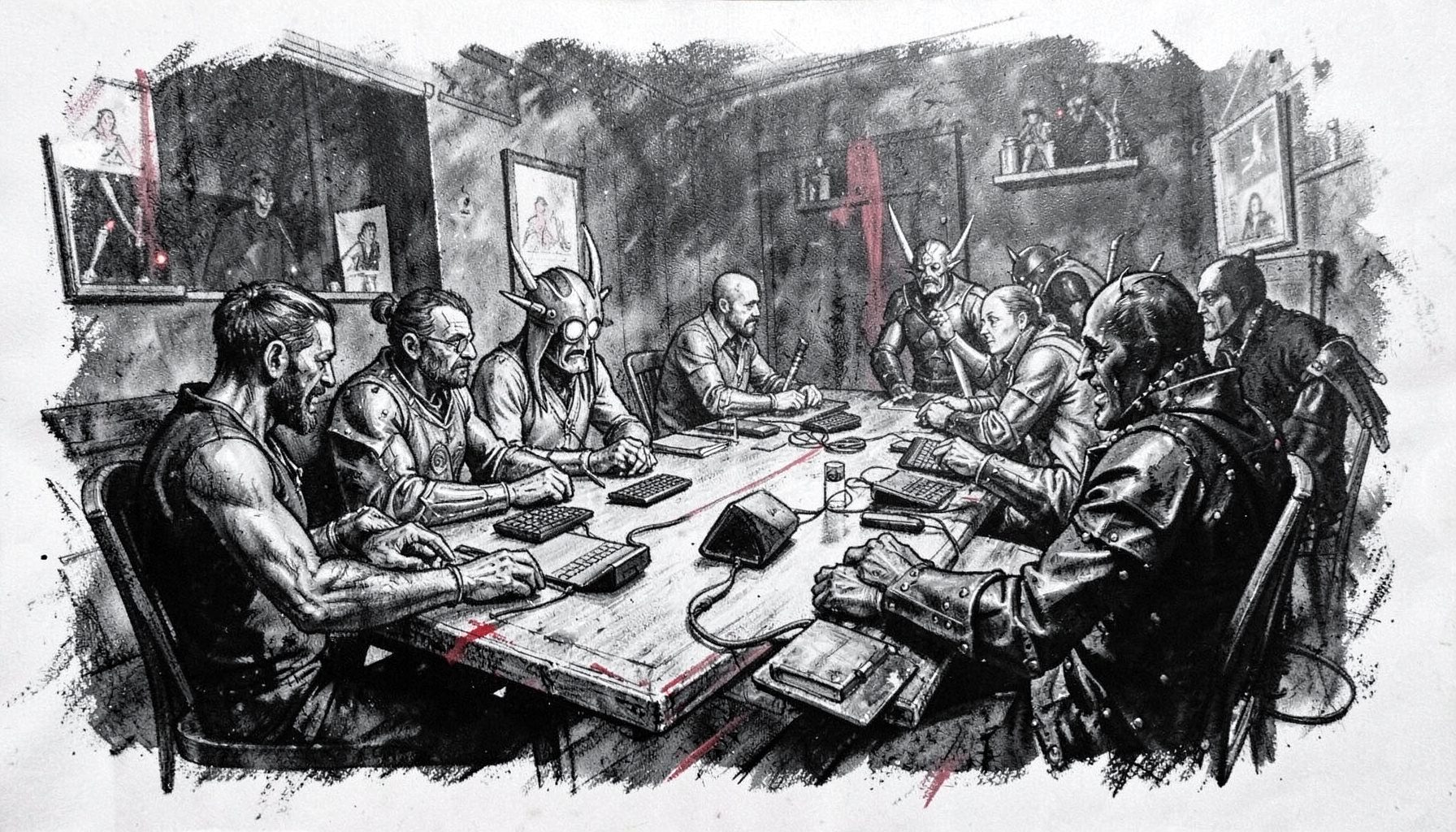
How HLGCon’s Escape Room Extended Its Shared Story
High Level Games Convention brought tabletop role-players, LARPers, designers, artists, publishers and vendors into the Showboat Hotel in Atlantic City in 2018. Its programme moved between scheduled games, workshops, panels, social spaces and an exhibitor hall, creating a convention where participation mattered as much as spectatorship.
An escape room fitted naturally into that environment. It gave visitors a contained story with a clear objective, but the experience still depended on communication, improvisation and collective problem-solving. Those are the same habits that make a tabletop campaign or live-action scenario work.
The format also helped connect different kinds of attendees. Someone familiar with Dungeons & Dragons could bring tactical thinking, while a LARP player might contribute character instincts, physical awareness and a willingness to improvise. A designer could notice the structure of the puzzles, and a first-time convention guest could simply follow the group’s discoveries.
The question of how HLGCon’s escape room tied into the convention’s overall theme is best answered through that shared responsibility. The room was more than a diversion between games. It turned collaborative storytelling into something immediate, social and playable within a single session.
| Escape room element | Wider HLGCon connection | What participants experienced |
|---|---|---|
| Shared clues and puzzles | Party-based tabletop play | Decisions shaped by group discussion |
| Time pressure | Convention scenarios and live events | Momentum, urgency and changing priorities |
| Themed setting | Immersive LARP and role-play | A stronger sense of place |
| Multiple approaches | Inclusive participation | Different skills could contribute |
| A finished scenario | One-shot gaming culture | A complete story within a limited visit |
A Physical Version Of Collaborative Storytelling
Tabletop role-playing normally asks a group to imagine a setting together. Players interpret clues, test theories and decide what their characters should do, while a game master or rules system provides structure. An escape room makes those processes physical: the clue is on the wall, the locked container is in the room, and the consequences of delay are visible.
That physicality suited a convention built around shared fiction. HLGCon included LARP experiences and immersive activities, so attendees were already prepared to treat a space as something more than a room with furniture. A themed escape challenge extended that attitude by asking players to inspect, interpret and act inside the environment.
It also created a useful bridge between audiences. Tabletop gamers could recognise the familiar rhythm of gathering information, proposing a plan and taking a risk. LARPers could enjoy the embodied side of searching and role-play. People who preferred panels or creative workshops could approach the challenge as a compact design exercise.
The result was a form of collaborative storytelling without a single storyteller controlling every beat. The organisers supplied the boundaries, atmosphere and puzzle logic, while the players generated the action through their choices.
Why The Format Matched The Convention
HLGCon’s wider identity centred on participation. A convention session was something people entered and shaped, whether it involved a campaign, a workshop, a panel discussion or a live-action scenario. The escape room followed the same principle by making every participant part of the solution rather than a passive audience member.
Its time limit was particularly effective in a convention setting. Visitors often move between activities, check the exhibitor hall, meet friends and discover an unexpected game. A self-contained puzzle adventure could deliver tension and a sense of achievement without requiring the long-term commitment of a multi-session campaign.
The structure also reflected the social reality of conventions. A group might include close friends, strangers who had just met, or players with very different levels of experience. The best escape-room design gives each person a useful entry point: observation, memory, pattern recognition, lateral thinking, physical searching or clear communication.
That accessibility was consistent with the event’s inclusive community focus. HLGCon’s convention policies provided the framework for respectful participation, while the escape room offered a practical setting where cooperation had to be demonstrated rather than simply discussed.
Skills That Moved Between Games
The activity rewarded familiar role-playing skills, even when no character sheet was involved. Participants had to decide who would search, who would keep track of information and who would test an uncertain idea. A confident player could lead briefly, but the group succeeded when attention moved between different contributors.
For Australian attendees, the social texture would have felt recognisable. At a convention in Melbourne, Sydney or Brisbane, a mixed group might quickly settle into a relaxed “give it a go” rhythm, with people swapping theories over a cuppa or making a joke when a clever solution turned out to be completely wrong. That informal style can lower the pressure on newcomers.
The transferable skills included:
- Listening carefully before committing the group to a theory
- Explaining an idea clearly when the room becomes noisy or hurried
- Sharing physical clues rather than keeping discoveries private
- Recognising when another player’s unusual suggestion deserves testing
- Staying flexible when the first solution proves incorrect
These behaviours are valuable in tabletop campaigns as well. A party that shares information, allows quieter players room to speak and treats failure as part of the fiction is usually more enjoyable than a group dominated by one voice. The escape room made those principles visible in a short, high-energy format.
It also showed why puzzle design and game mastering overlap. Both depend on pacing, readable information and the careful management of uncertainty. A challenge that is too obscure becomes frustrating; one that is too obvious loses its dramatic charge. That balance is central to memorable role-playing.
A Meeting Point For Different Gaming Communities
The escape room’s strongest thematic connection may have been its ability to sit between established categories. It was not exactly a tabletop session, a LARP, an educational workshop or a board-game demonstration, yet it borrowed useful qualities from each. That made it a natural meeting point within a convention with a broad programme.
It also reflected the practical shape of the Australian hobby market. Local players often move between community clubs, specialist game shops, pop-culture conventions and online groups because the audience for a particular role-playing system can be spread across a city. A flexible activity can help those communities overlap without requiring everyone to share the same rules background.
The wider role-playing programme mattered here. HLGCon’s TTRPG systems review points towards the range of systems and play styles represented at the event. An escape room could sit comfortably beside that variety because its core language—clues, choices, teamwork and consequences—does not belong to one game line.
The experience also suited people browsing rather than committing to a full campaign. In Australia, where travel between capital-city events can mean a flight, a long train journey or a costly weekend away, visitors often want activities that provide a complete experience within the convention schedule. A self-contained mystery offered exactly that kind of value.
What The Escape Room Added To The Event
The activity gave the convention a different tempo. A panel might centre on conversation, a tabletop game on extended decision-making, and the exhibitor hall on discovery and shopping. The escape room introduced movement, concentration and a shared countdown, making it a useful change of pace during a busy weekend.
It also created stories that could travel beyond the room. Players might later remember the unexpected clue, the failed theory or the moment someone noticed what everyone else had missed. Those small anecdotes become part of convention culture, just like a memorable critical roll, an improvised LARP scene or a designer’s comment during a workshop.
The community signals it reinforced included:
- Cooperation over individual performance
- Curiosity about unfamiliar game formats
- Respect for different problem-solving styles
- Permission to improvise when the planned approach failed
- A shared achievement that did not depend on winning a competition
That matters because immersive convention activities can turn strangers into temporary collaborators. Once a group has searched for the same hidden answer, it has an immediate point of connection. The experience can make the venue feel less like a collection of scheduled rooms and more like a temporary gaming community.
The organisers also demonstrated how an event can make room for varied creative ideas. HLGCon’s event submission form represented the broader process through which sessions and activities could contribute to the programme. An escape room showed that convention identity can be expressed through format as well as subject matter.
The Lasting Meaning Of A Shared Challenge
The escape room tied into HLGCon’s theme because it embodied the values the convention promoted. It required imagination without demanding a particular rules system, encouraged role-play without insisting on costumes, and created immersion without separating itself from the rest of the programme.
Its value was therefore broader than the puzzle outcome. Whether a group escaped quickly, needed hints or ran out of time, participants had practised the central habits of collaborative gaming: listen, interpret, experiment, communicate and build on another person’s idea. Those habits connected the Showboat activity to every other part of the convention.
For Australian players, that remains a useful model for local events, from a small games night in Adelaide to a large convention at the Melbourne Convention and Exhibition Centre. The lesson is straightforward: choose one activity that asks strangers to make something together, then place it where the wider programme can carry its energy forward.
The concrete next step is to map an escape-room-style group challenge into a convention schedule beside a tabletop session, a LARP activity and a design workshop.