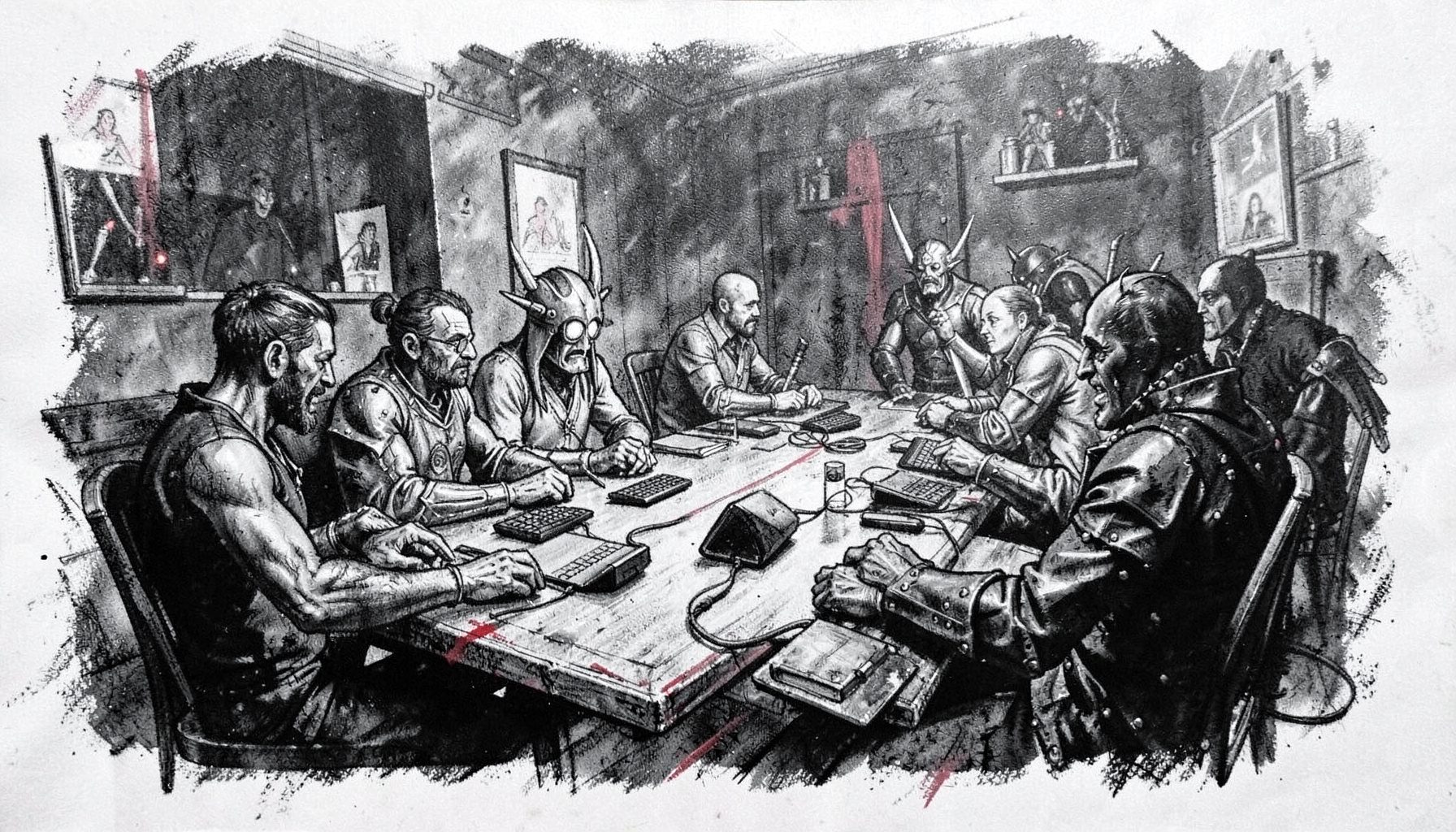
Why a well-placed pause changes the whole table
Every roleplaying table runs on two kinds of noise: the obvious kind, which is dice, chairs and arguments about rulings, and the other kind, the silence nobody schedules. A pause in tabletop roleplay — three seconds of held quiet while a player decides what their character does — is not a gap in the game. It is play with the volume turned down, and it is where much of the best collaborative storytelling happens.
Conventions built around shared tables teach that lesson quickly. At High Level Games Convention, held at the Showboat Hotel in Atlantic City, New Jersey in 2018, designers, live-action roleplayers, artists, publishers and vendors mixed panels, workshops, exhibitor halls and escape rooms in one building. Groups who could hold a silence without rushing to fill it kept their momentum, and groups that filled every gap played faster and lost more.
The craft travels well below the equator. Australian tables run on different fuel — board game cafés in Melbourne, pub trivia in Sydney, RSL club nights in Canberra and Brisbane, home campaigns that start after dinner — but the physics of a turn are identical. A pause works because attention has weight, and handing it to one player costs everyone else a moment of it.
The pause is a tool, not an awkward silence
A bad pause is hesitation: the game master hunting for a rule, a table filling dead air with chatter about work. A good pause is a beat, chosen on purpose, and it announces that something is about to matter. The difference is easy to feel and easy to name. One says nothing is happening. The other says wait.
Game masters who read this well use the pause before they reach for the rules. Ask a player what their character wants, then wait. Three seconds feels long when you are watching it and short when the player is living it, because the silence gives them room to answer in character instead of summarising their character's options aloud.
Conventions offer a laboratory for that skill. The panels, workshops and escape rooms listed in the event details page from that Atlantic City weekend all depend on the same timing, since a reveal lands because the room was quiet a moment earlier.
Turning silence into a spotlight
Every table has one voice that fills the gaps, and every table has three players who wait. A pause is the cheapest way to redistribute attention, because it hands the floor over without asking permission. A game master who notices the quietest player at the table and simply waits will get a different answer than one who points at them and demands it.
This is where inclusive play gets won quietly. Neurodivergent players, newer roleplayers and anyone running a second language often need a beat to build a response, and a table that pauses gives them one. Conventions built around collaborative storytelling tend to know this, and the same courtesy works just as well in a home campaign in Adelaide or a beginner group meeting in Perth.
Online tables make the point for you. For players in regional Australia, the half-second lag of voice chat and digital dice rollers is a built-in pause, and plenty of groups keep it because it stops the fastest talker steering every decision. Silence turns out to be easier to preserve when distance has already supplied some.
From dice to reason
A roll produces a result, while a pause produces a reason. When a character fails a lockpick and nobody speaks, the table has to decide together what that failure means, and the game moves from numbers into story. That is the practical heart of the thing: the quiet after the dice stop is an invitation to improvise, and the improvisation is what later becomes canon.
The same trick works on success, and most tables use it less often. A three-second hold after a character lands the impossible shot lets the player describe how it happened, turning a mechanical win into a memory the group will quote years later. Pauses cost nothing. Payloads of narrative are expensive.
Good pauses also handle the heavy moments. A death, a betrayal, a door opening onto something worse — each lands better when the game master lets the table sit with it before the next action. Australian tables know the value of a beat, and it is the same instinct as the silence between questions at a Friday night trivia session in a packed Sydney RSL club, where the MC counts to five and lets the room sweat.
The silence that punishes
Not every quiet room is a generous one. Tables have a second kind of silence, the silence that signals disapproval, and it usually follows a game master going quiet because a player derailed the plot or a rule argument stalled the scene. Players read that pause as a verdict on their choices, and the table learns to talk faster so nobody gets judged again.
The cure is naming the pause before it turns into punishment. A game master who says "let me sit with that for a second" or asks "does anyone want to add to this?" converts an accusation into an invitation. It is a small rewording, and it is the difference between a room that goes quiet out of respect and one that goes quiet out of fear.
Social pressure does the rest. At an Australian pub quiz, silence is normal and understood as thinking time, and players carry that expectation into the RPG session next door. At a convention in a crowded hall, silence gets swallowed by the noise around it, so the pause has to be made visible before it can be useful.
When silence gets loud in live action
Live-action play inverts the problem. At a table, the game master can pause because only the game master is talking. On a floor, in a warehouse, or inside an escape room, pausing means everyone stops, and stopping a group of moving bodies takes authority, a signal and practice. Experienced live-action groups build that signal into their rules so a freeze frame reads as part of the play rather than a breakdown.
Out-of-character pauses work the same way and matter more. Conventions put the safety tools — lines, veils, X-cards, a phrase that means stop — in front of everyone so a participant can break the fiction without embarrassment. Immersive scenarios such as the Detention Breakout experience leave players little room to improvise their way out, which makes the deliberate beat before a decision all the more necessary.
Australian live-action scenes have their own texture here, with regular games running through Melbourne, Canberra and Perth and conventions folding LARP into the wider hobby calendar, often in borrowed warehouses with characteristically Australian soundproofing problems. A pause that reads as elegant in a quiet room can vanish beside a busy road, and knowing when to drop the silence and narrate instead is worth naming out loud.
The people who make a pause land
Timing is a craft, and craft gets learned from people who have done it for a living. The guest roster published for High Level Games Convention is a useful reminder of the range involved: designers, artists, publishers and performers who all know how to hold a room's attention and let it go on purpose.
Game masters usually learn the value of restraint first. A player who says nothing may be playing silence, and a player who announces their character is thinking is not stalling, they are choosing a texture of play. Recognising those choices takes a game master who pauses instead of filling, and a table that trusts the silence enough to leave it alone.
That convention floor mattered for a plain reason too: it put hundreds of strangers around shared tables, which is the fastest way to discover whether your group can sit in the quiet together. Australian tables sit inside their own market and rules at the same time. Local game shops and online sellers handle the stock, and the Australian Consumer Law still applies when a boxed set turns up with a missing component. Venues carry their own limits, since liquor licences in New South Wales and Victoria set closing times that decide when a session must end, and state road rules treat fatigue as seriously as alcohol. A game master who knows how to close a scene cleanly is doing more than good pacing.
Habits and techniques that make pausing easier
Two lists sit below. The first covers the conditions worth building before the session starts, and the second covers the moves worth trying once people are around the table. Neither needs special rules, and both travel from a convention hall to a kitchen table without modification.
Conditions worth building beforehand
- Keep the rules talk short and save the lore dump for a moment when the dice have already landed.
- Write your character's want, their fear and one ugly secret before you arrive.
- Turn up early enough to settle in, since the first five minutes decide how easily a table goes quiet later.
- Use a visible turn tracker so nobody has to interrupt to ask whose scene it is.
- Keep two or three scene seeds to hand, so the pause has somewhere to go when it lands.
- Agree at the start that any player may pass once per scene and hand the beat to someone else.
Moves worth trying at the table
- Count to three before you answer a question at the table.
- Put the spotlight on the quietest player once a session and then wait.
- Hold a beat after a success as often as you do after a failure.
- End a scene on a question rather than a resolution.
- Ask what the character wants, not what the rules allow them to do.
- Name the silence for beginners who need it: the room holds its breath.
The quietest habit worth keeping is also the simplest. Pick the next session and place one deliberate pause in it: three seconds after the game master asks a question, five seconds before a character does something that cannot be undone, one full breath after a reveal. Nothing else about the night needs to change for that beat to work. That single pause will tell you more about your table than an hour of rules discussion, and the only thing it costs is attention you were going to spend anyway.