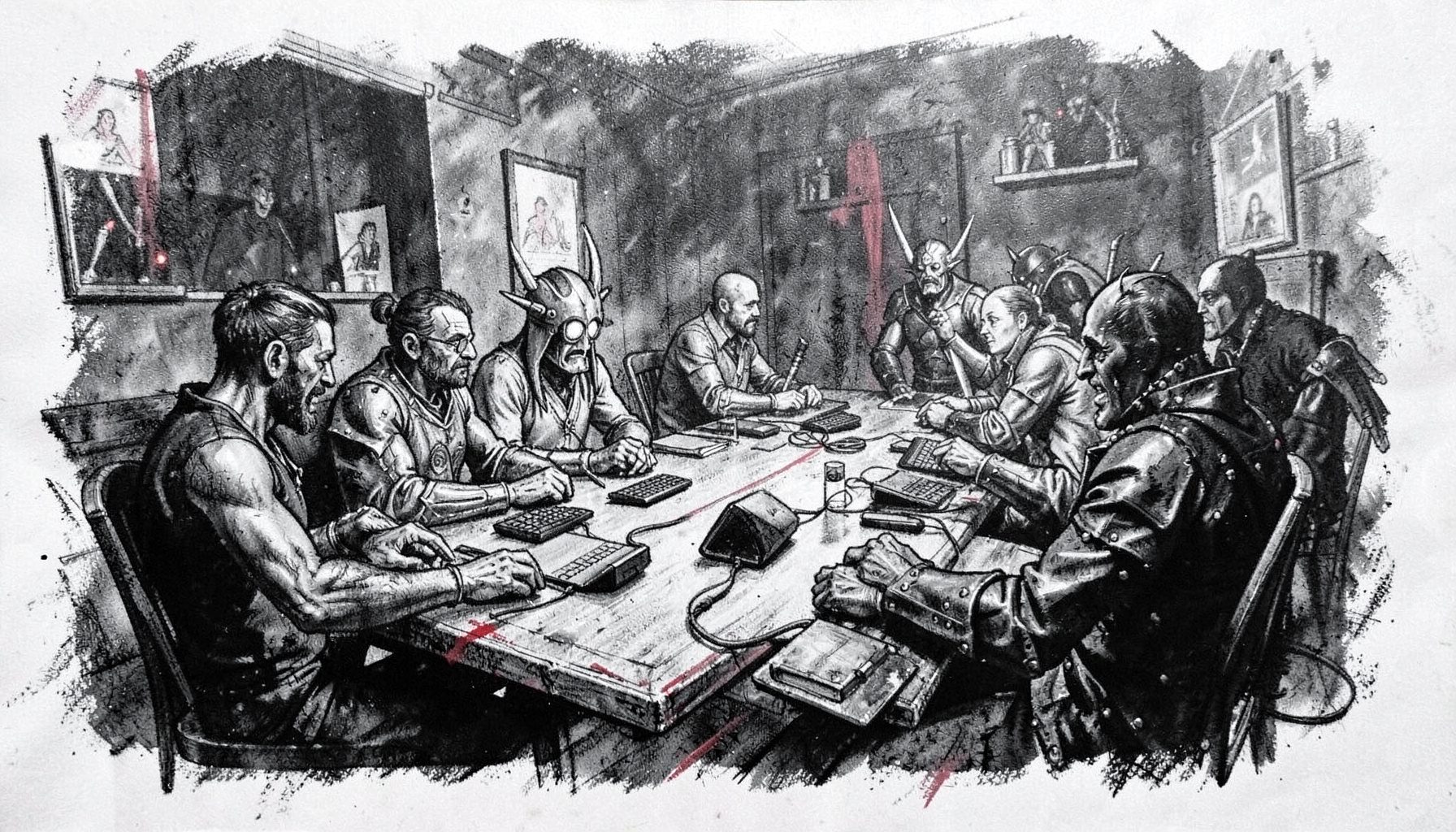
How to make your panel interactive without losing control
An interactive panel works best when participation is designed into the programme rather than offered as an improvised invitation to anyone with a microphone. Questions, short votes, paired discussion and audience tasks can shift energy without creating a free-for-all. The facilitator designs those moments, guides the exchange and returns the group to the session’s purpose.
At the 2018 convention at the Showboat Hotel in Atlantic City, New Jersey, the mix of tabletop role-players, LARP participants, designers, artists, publishers and vendors created a useful test: a panel can welcome different forms of participation without losing its central question. The event’s LARP experiences, workshops, exhibitor hall and escape rooms all depended on clear roles, shared rules and collaborative storytelling.
That lesson travels well to Australia. How to make your panel interactive without losing control is not about forcing every attendee into the spotlight; it is about creating low-risk ways to contribute and visible ways to move on. Melbourne’s smaller theatre-style rooms, Sydney’s larger convention stages and hybrid events connecting Perth with the east coast all require the same discipline: participation must have a beginning, a shape and an end.
Design participation before the room fills
Start by deciding where the audience will contribute. A useful panel might include an opening poll, a paired discussion midway through and a final story challenge. Give each activity a clear output, such as selecting one priority, identifying a shared obstacle or submitting a solution. This prevents participation from becoming disconnected chat while the speakers continue talking.
Prepare the prompts in advance and explain what will happen with each answer. A question that looks simple can produce a long debate if nobody knows whether the facilitator is collecting opinions, testing an assumption or asking for a vote. Printed cards, a digital poll or a show of hands can all work, but each should have a defined purpose and a time limit.
Build a rhythm that protects attention
Interactive does not mean constant activity. A strong forty-five-minute session might move between a short presentation, one audience contribution, panel responses and a summary. This gives the speakers room to develop an argument while ensuring that attendees are not passive for the entire session. It also reflects the brisk, team-based rhythm familiar from an Australian pub quiz.
Use cycles of roughly five to ten minutes rather than saving all participation for the end. An early question settles expectations, while a mid-session task restores energy before attention begins to drift. For a late-afternoon slot beginning at arvo time, a quick team exercise can also give people who have just travelled a purpose to focus on what follows.
Keep a visible queue for additional questions. A moderator can select items that relate to the panel’s theme and move the rest to a parking lot, either on a physical board or in a shared document. The audience should understand that their contribution has been recorded, even when every question cannot be discussed immediately.
Choose activities that suit the room
Choose participation methods that support the subject rather than borrowing them from a party game. A panel about narrative design might ask attendees to arrange story beats on cards, while one about inclusive play might use scenario voting. The activity should reveal an opinion, experience or priority that will help the discussion move forward.
Looking back at the 2018 event programme, the convention’s combination of panels, LARP experiences and immersive activities demonstrates several compatible approaches. LARP participants already use physical gestures and character perspectives, tabletop players understand rules and turn order, and workshop groups are accustomed to producing something together. The facilitator can borrow that clarity without turning a panel into a role-playing exercise.
Tools should also fit the venue and audience. Provide printed options for anyone uncomfortable with a digital platform, and avoid relying on a live poll when conference Wi-Fi is uncertain. If presenters are joining remotely from Perth, schedule a short technical check around the time difference and assign one host to monitor the connection. Rewards can remain modest: an A$20 voucher from an independent Australian games shop is enough to encourage participation without creating an awkward incentive to volunteer.
Set participation boundaries with care
Participation requires boundaries because some questions invite personal disclosure while others encourage general disagreement. A public code of conduct should make the expected behaviour clear before the session begins, and the moderator should reinforce it without treating every mistake as a crisis. People need permission to pass, enough room to disagree and a way to ask for help.
Invite contribution without assuming that silence means consent. Offer alternatives such as writing a response, speaking to a neighbour or submitting an anonymous card. Do not require physical contact, role-play or the sharing of a difficult personal experience. These safeguards create the trust required for lively discussion and help the panel remain accessible to people with different comfort levels.
Australian panel culture can be direct and informal, but informality should not become pressure to perform. Humour can ease the room, while personal jabs and forced self-disclosure can exclude it. Correct mistakes about pronunciation or place names without turning the exchange into a spectacle, and give the panel a clear path back to the topic whenever discussion becomes personal.
Keep control through visible facilitation
Moderation becomes easier when the process is visible. Tell attendees how questions will be selected, explain why some will be moved aside and name the person responsible for watching the clock. This removes the impression that panelists are protecting their territory and makes it easier for the audience to follow the discussion.
A practical facilitation checklist can include:
- Begin with a low-risk response that everyone can give quickly.
- Keep questions focused on the stated subject and audience needs.
- Move tangential questions into a visible parking area.
- Assign one panelist to summarise and another to monitor time.
- Prepare a neutral phrase for redirecting discussion without embarrassing anyone.
Control should come from structure, not authority. When the rules are clear, the moderator can act as a guide rather than a gatekeeper. If one answer starts dominating the session, invite the panel to compare it with another perspective rather than simply cutting the speaker off.
Rehearse the close and the next step
A controlled ending needs as much rehearsal as the opening. Decide who closes each audience activity, how the speakers will summarise the responses and which single point the panel will leave unresolved. This prevents the final discussion from dissolving into disconnected comments after an engaging but busy session.
Run the full timing with colleagues, including the reset phrases and transitions between speakers. Include possible interruptions, technical delays and questions that arrive late. The goal is not to script every answer; it is to ensure that the panel can recover its direction whenever the audience takes an unexpected turn.
For the next rehearsal, the concrete task is to draft a ten-minute opening script on one page, mark each audience action and test the reset wording with a colleague.