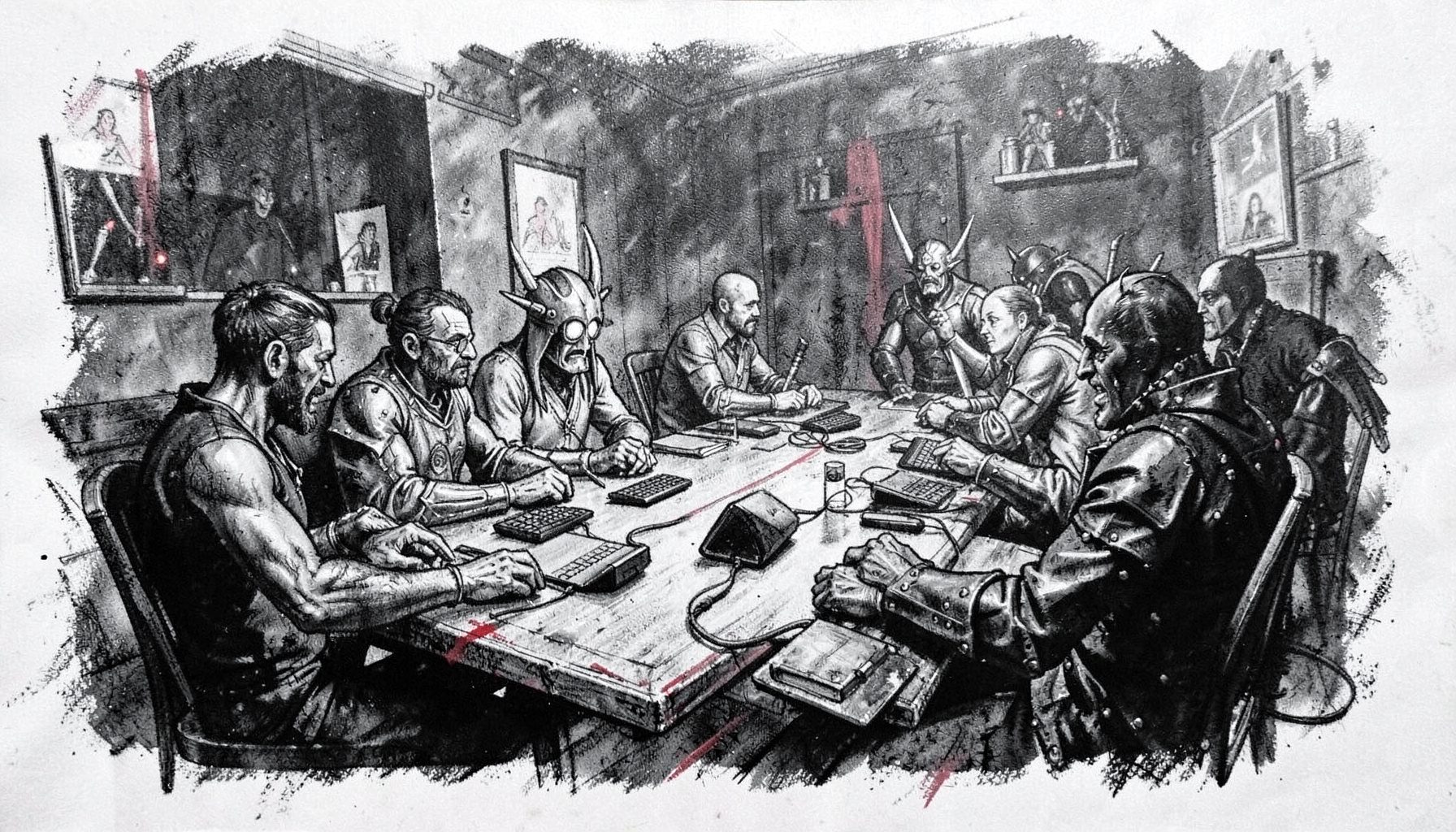
Hotel Furniture as the Heart of an Escapist LARP
The most creative use of hotel furniture in an escapist LARP scene begins with a simple reversal: a guest room is not a backdrop but the machine driving the story. A luggage bench can be a breached security portal, the wardrobe can hide a rebel archive, and the desk can become the concierge’s command console. Players do not merely admire the set; they open, move, decode and reinterpret it.
That approach suits live-action role-play because every object creates a shared cause. One player spots a code on the key sleeve, another turns a lamp into a signal, and a third uses the room plan to decide who acts next. The result feels more like an escape room with characters, history and consequences than a scavenger hunt placed inside a hotel.
From the convention floor to the guest room
In 2018, High Level Games Convention brought tabletop role-players, LARPers, designers, artists, publishers and vendors to the Showboat Hotel in Atlantic City, New Jersey. Its mix of live scenarios, gaming tables, panels, workshops, an exhibitor hall and immersive activities provided the right setting for testing how ordinary hotel spaces could support ambitious interactive fiction.
Convention furniture also had practical value. The exhibitor directory connected suppliers with designers and facilitators, while artists could adapt inexpensive room pieces into scenery without inventing an entire venue. A brass bell, chair, lamp or luggage rack could become the centre of a scene through paint, lighting, paper clues and a clear physical purpose.
For an Australian version, Melbourne’s laneway venues, Adelaide’s Fringe traffic and Sydney’s established convention calendar offer different ways to place the scene. Local tables are commonly volunteer-run, so a small team can test a scenario through community game stores, convention stalls and crowdfunding. Pricing in Australian dollars, freight on imported games and the need for clear insurance terms all shape that market.
Turning an ordinary room into a portal
The room needs a fiction that makes every piece of furniture necessary. In a workable scenario, a temporal storm strands six guests in a luxury suite at 11:40 pm. The hotel’s automated system has declared the building empty, while its concierge insists one guest must remain. Each object becomes evidence about where the guests came from, why the system lied and how they can leave before midnight.
Set dressing should separate the room into three readable zones: the desk and luggage bench operate as a disputed arrival point, the bed and wardrobe hold private memories, and the bathroom mirror carries the storm’s signal. Light can turn the bathroom blue during each phase, leaving the rest of the suite in warm hotel amber. Players then infer that the architecture itself is a navigation device rather than a static maze.
Physical interaction gives the LARP momentum. A bed tray slides between competing factions, a wheeled chair marks the suspect’s last known position and a movable lamp reveals a shadow-coded message. These actions should feel reversible and easy to reset, so a failed puzzle changes the narration instead of ending the experience.
Building a clue chain from the furniture
A strong chain alternates discovery, interpretation and choice. The key-card sleeve yields a timestamp; the timestamp selects a line on the room-service menu; the menu identifies which chair was moved; the chair hides a drawer containing half a cipher. No object needs elaborate lore if it changes what the players believe and gives them a decision to make.
Live-action role-playing adds social pressure to that chain. An NPC concierge can lie about the luggage bench, while another guest privately claims the wardrobe contains evidence. The facilitator releases information only after a group decision, turning character disagreement into a mechanic rather than a distraction. Tabletop-style state tracking can record alliances, suspects and altered rooms on a visible board.
Inclusive design works best when the puzzle has several routes. Sound, reading, sequencing and spatial reasoning can all contribute, while participants may speak in character or step out to clarify boundaries. A visible opt-out signal lets anyone pause physical play without breaking the fiction, and a short casting brief can redistribute narrative tasks so no role becomes essential to the solution.
Practical staging and Australian scene details
Before using real hotel furniture, obtain written permission and agree on what may be moved. Photographic evidence, cable-free effects and removable tape protect the room. Facilitators should inventory every object, test sightlines from the doorway and prepare a reset tray containing duplicate cards, markers and spare light bulbs.
Furniture transformations
- Turn the luggage bench into a transfer checkpoint with a pouch for exchanged evidence.
- Convert the desk into a concierge console, using a phone-shaped prop for automated instructions.
- Fit the wardrobe with hanging dossiers and a false panel operated from inside.
- Place the room-service trolley at the bed as a mobile map station.
- Angle the bedside chair toward the bathroom mirror to form a signal reflector.
Australian cues
- Put “arvo” and “no worries” into dialogue without turning the scenario into a caricature.
- Use a tea-bag tag as a ration chit and a eucalyptus air-freshener label as a coastal code.
- Name a fictional venue after a Melbourne laneway or an Adelaide Fringe space.
- Set the guest’s emergency contact in Sydney and hide a flight-reference clue.
- Price a fictional evidence auction in AUD, including the 10 per cent GST line.
These cues work best as clues and texture, not as a checklist of stereotypes. Characters can speak naturally with Australian rhythm, vendors can use local prices and shipping realities, and regional references can reward close observation. The room remains visually familiar while the story feels rooted in the people who play it.
Rehearsing the scene at convention scale
A convention rehearsal should test transitions, not just the final puzzle. Give each facilitator one zone, run the scene twice and time every reset. A post-convention indie RPG round-up is a useful companion when the live scenario borrows setting or character ideas, though the physical room still needs its own tested sequence.
At HLGCon-style events, LARP experiences can sit beside tabletop sessions without competing. Players leaving a live scenario can discuss its mechanics, while designers see which props carried useful information. The exhibitor hall can supply lightweight scenery, dice, handouts and safety tools, allowing the team to refine the scenario between panels and performances.
Public feedback should focus on clarity, participation and emotional payoff. If players cannot tell which object changed the story, simplify the chain; if they succeed through a single expert, open another route. Australian larpi scenes often move between intense character work and relaxed social chat, so the debrief should preserve that friendly atmosphere while still recording concrete revisions.
A scene blueprint ready for play
Begin with a twenty-minute arrival briefing and a thirty-minute live round, followed by fifteen minutes for the final decision and reveal. The facilitator opens with the hotel’s conflicting checkout messages. Players then recover room keys, assign companions and decide whether to trust the concierge, who becomes more credible each time an object contradicts the official timeline.
The reveal occurs when the correct five objects are aligned with the storm signal. Their shadows point to a compass rose hidden beneath the desk mat, identifying a service lift that appears on no guest floor plan. Success does not simply unlock an exit: it determines which character leaves, what reaches the public timeline and whether the group exposes the concierge’s manipulation.
For a first production, keep the room compact, assign one operator per furniture zone and duplicate every consequential clue. After a test run, tag pieces that were ignored, missed or physically confusing, then adjust placement rather than adding lore. The concrete next step is to book one mock guest room for two hours, label the five furniture stations and run a timed rehearsal with six players.