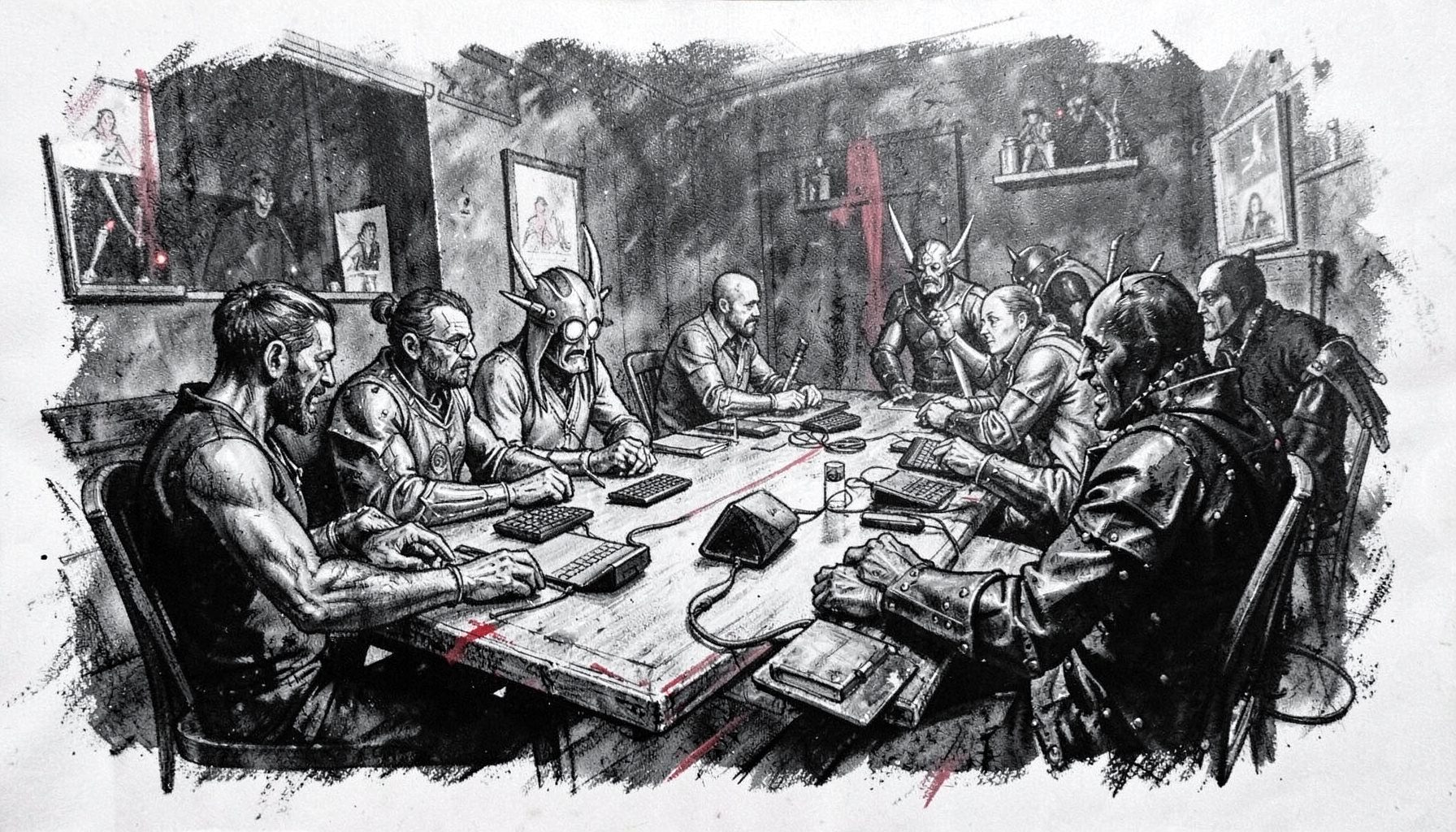
A Guide to Collaborative World-Building with Strangers
Creating a fictional setting with people you have just met can feel risky. Everyone arrives carrying different references, preferred genres and ideas about what makes a game exciting. One person may want political intrigue, another may be picturing a haunted bush town, while a third is ready to introduce dragons, robots and a talking magpie.
That variety is the strength of a shared world. At a convention, game night or online session, strangers can produce material that a familiar group might never consider. The key is to create enough structure for ideas to connect, while leaving room for surprise, negotiation and the occasional wonderfully weird suggestion.
Why Unfamiliar Groups Create Interesting Worlds
Friends often develop comfortable habits. They know who prefers fantasy, who always plays a rogue and who will veto horror before the snacks arrive. New collaborators interrupt those patterns. A stranger may bring experience from LARP, board games, historical research, fan fiction or theatre, adding a useful angle to the setting.
The goal is not to produce a perfectly consistent encyclopaedia in the first hour. A collaborative setting needs strong points of connection: a place, a problem, a few influential groups and a reason the characters must act. Once those elements exist, details can remain flexible.
Australian convention culture is well suited to this approach. At an event in Melbourne, Brisbane or Sydney, participants may have travelled from different states and gaming communities. The local scene is large enough to be inventive, yet small enough that independent designers, game-store regulars and convention volunteers often overlap. A short session can therefore become a meeting point between several creative traditions.
Start With A Shared Creative Contract
Before inventing names and histories, agree on the type of experience everyone wants. “Fantasy” can mean pastoral folklore, grim war drama, light-hearted adventure or something closer to a mythic western. A quick discussion of mood, age rating, themes and expected player agency prevents confusion later.
Keep the agreement short and practical. Decide whether the group is aiming for comedy, tension, discovery or tragedy. Clarify whether player characters can alter major institutions, whether the setting contains real-world parallels and how serious the table wants to be. “A bit spooky, generally hopeful, with room for silly ideas” is more useful than a page of abstract theory.
Use a visible phrase to anchor decisions. If the group chooses “a flooded city where memory is traded”, new contributions can be tested against that premise. A proposed sky pirate faction might fit immediately; an unrelated space opera may need adaptation. The phrase is a compass, not a fence.
Make Safety Part Of The Fictional Process
Collaborative creativity depends on people feeling able to contribute without being mocked, pressured or exposed to unwanted material. Establish boundaries before the setting becomes emotionally intense. Participants should be able to pass on a prompt, pause a scene or request a change without having to justify themselves.
Safety tools can be simple: lines and veils, an anonymous written check-in, a pause signal or a quick traffic-light system. Explain how each tool works, then use it consistently. The facilitator should model the behaviour by accepting changes calmly and moving the story forward.
Immersive activities offer useful lessons here. In an escape-room-style scenario such as the Detention Breakout experience, cooperation depends on clear objectives, shared attention and confidence that the group will respond constructively when someone gets stuck. World-building benefits from the same environment: challenge ideas, never the person offering them.
Build From Places, Pressures And People
A setting becomes playable when abstract ideas acquire physical and social form. Ask the group to define one location, one immediate pressure and one group with something to lose. These three ingredients create opportunities for action without requiring a complete history.
For example, begin with a coastal town that appears every decade when the tide retreats. Its pressure is a rapidly approaching storm, while its interested factions include local families, salvage crews and a research institute. Each contribution can now answer a useful question: who controls access, what do they fear and what would make them compromise?
Rotate the type of prompt. One person can name a landmark, another can describe a local custom, and another can invent a rumour that may or may not be true. This prevents the loudest participant from shaping every layer of the world. In an Australian group, a prompt about a dry riverbed, a remote roadhouse or a suburban community hall may produce a different texture from a standard medieval marketplace.
Turn Disagreement Into Setting Material
Conflicting suggestions do not have to be settled by choosing one winner. Often, the strongest result combines the disagreement into a social tension within the world. If one person imagines the city as carefully governed and another sees it as lawless, make both perceptions true: the central district may be controlled, while the outer settlements operate through informal alliances.
Ask what each proposal is trying to achieve. A player who introduces an all-powerful ancient order may be seeking mystery, while someone resisting it may be protecting character agency. Preserve the desired effect rather than the original wording. The order could be powerful but unable to act openly, or its authority could depend on a fragile public belief.
A written record helps keep negotiations visible. Use index cards, a shared document or a whiteboard divided into facts, rumours and unresolved questions. The group can then mark ideas as established, disputed or provisional. A useful no-secrets style guide can also encourage openness about creative expectations, especially when participants are deciding what information belongs with the whole group and what should remain a discovery.
Keep The World Open To Play
A setting becomes less useful when every mystery has already been solved. Leave deliberate gaps: an unnamed monarch, a map with missing roads, a festival whose origins have been forgotten or a faction whose public story does not match its private records. These spaces invite players to create meaning through action.
Distinguish between “unknown” and “not yet decided”. Unknown facts exist in the fiction but are hidden from the characters. Undecided facts remain available for collaborative invention. Telling the group which category applies prevents accidental contradictions and gives participants confidence to add material.
The Australian market also rewards adaptable formats. Independent tabletop designers often work with modest print runs, convention demos and digital releases rather than relying on a large publishing pipeline. A compact setting with reusable prompts is easier to test at a local games shop, a university club or a PAX Aus side event than a massive setting bible that requires expensive production and shipping.
Practices For A Strong Shared Setting
Use these recommendations when bringing unfamiliar players together for a one-shot, campaign launch, workshop or LARP planning session:
- Agree on tone, boundaries and the central premise before adding detailed lore.
- Give every participant a defined chance to contribute, including quieter people.
- Record facts separately from rumours, theories and unresolved possibilities.
- Treat contradictory ideas as potential conflicts inside the setting.
- Build locations around immediate pressures that invite characters to act.
- Leave several important questions unanswered so play can shape the world.
- End with a short recap of what is established and what remains open.
A facilitator can support this process without becoming the sole author. Their job is to notice repetition, connect promising ideas and prevent one contribution from closing down every alternative. They should also watch the clock. A group that spends an hour naming a royal family may have no time left to discover what the characters actually do.
The final recap is especially valuable when participants will continue separately. Share a one-page summary with the premise, key locations, factions, current tensions and open questions. If people use Australian spelling, local references or a mixture of online and in-person play, preserve those choices as part of the setting’s identity rather than sanding them into a generic fantasy style.
Let Collaboration Continue Through Play
The first session should create playable momentum, not settle the entire mythology. Give the group a situation that exposes the setting’s tensions: a ceremony interrupted by a missing witness, a disputed salvage claim or a message arriving from a place that official maps say does not exist. The world will gain depth as players make difficult choices.
Invite players to add consequences, not just background details. If someone establishes that a neighbourhood distrusts the council, ask what happens when the characters need its help. If a faction claims to protect an endangered species, ask what sacrifice its protection demands. Consequences convert attractive lore into a living environment.
There will be practical differences between a late-night session in a Sydney flat, a weekend event in Adelaide and a regional gathering where people have driven several hours to attend. Keep materials portable, allow breaks and avoid assuming everyone can return next week. A setting can survive distance when its core ideas are clear and its unfinished questions are easy to pick up again.
The most memorable shared worlds are rarely the ones with the longest histories. They are the ones where strangers made room for one another, transformed disagreement into possibility and left enough space for play to change the truth. What the reader should remember is simple: give people a common direction, protect their ability to participate and let the world remain unfinished.