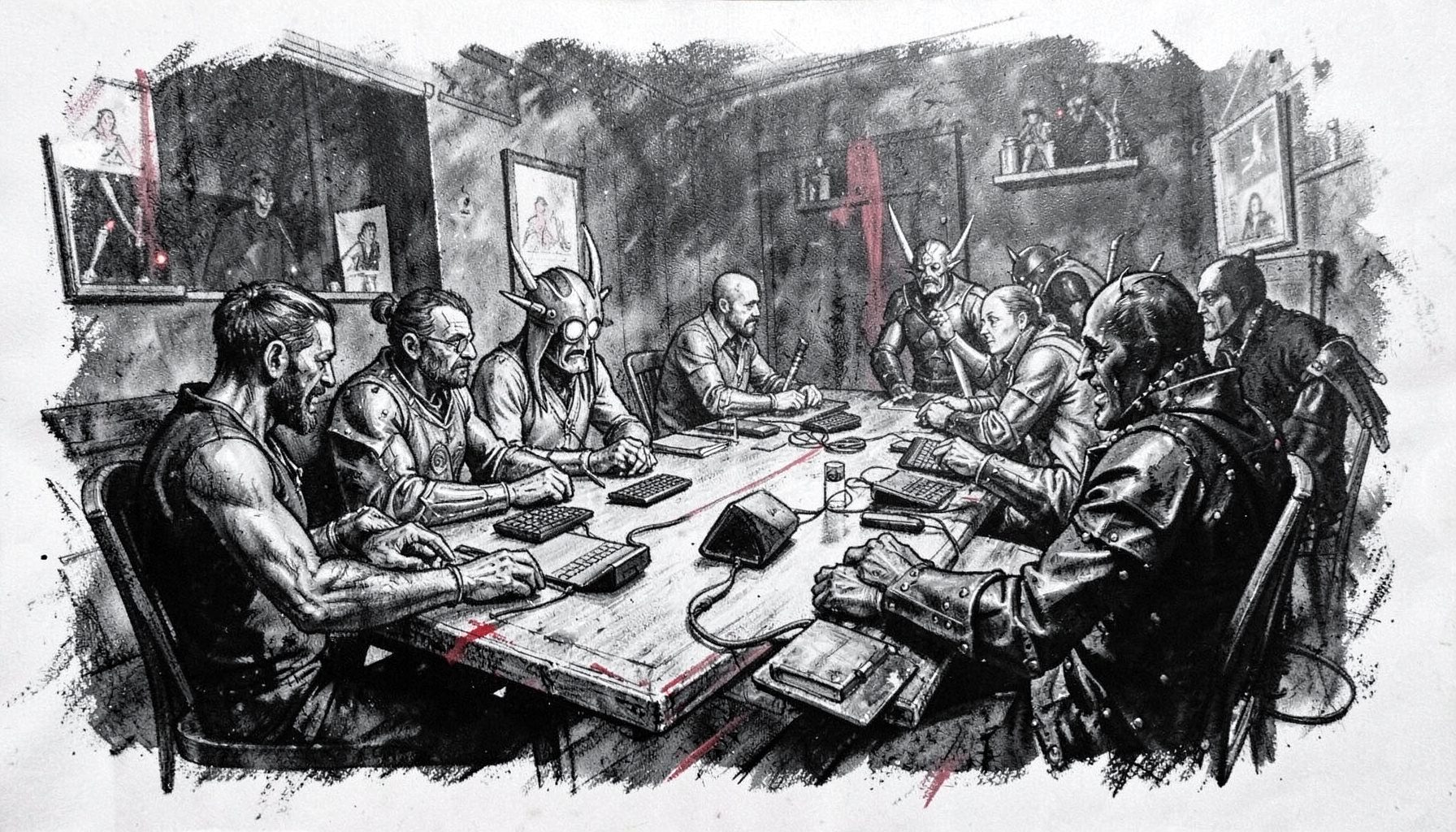
How immersive theater is reshaping the craft of LARP
The walls between a stage and a game table have been thinning for years, and recent productions are tearing them down altogether. Audiences who once sat politely in the dark are now handed a lantern, a character sheet, and a reason to run. Practitioners who used to think in terms of scripts now think in mechanics, and designers who used to worry about hit points are now worrying about blocking, lighting, and emotional pacing. This is the territory where immersive theater and live-action role-play meet, and it is where some of the most exciting design work in the hobby is happening right now.
In Australia, the conversation has gathered particular momentum. Melbourne's laneways have hosted wandering role-play events for over a decade, and the Adelaide Fringe regularly programs pieces that blur the line between installation art and game. Sydney Theatre Company's more experimental productions have introduced mainstream audiences to participatory storytelling, while Perth and Brisbane communities run seasonal LARP calendars that pull in newcomers every year. Designers working in these cities are quietly building a vocabulary that draws equally from contemporary stage work, fringe festivals, and the indie tabletop scene.
The 2018 High Level Games Convention in Atlantic City gave that conversation a stage of its own. Its panels on collaborative storytelling, its LARP tracks, and its escape-room partnerships all pointed toward a future where games are not played so much as inhabited. For designers heading home from the show floor, the question was less whether immersive theater would influence LARP, and more how to harness it without losing what makes a game a game.
What immersive theater actually offers a game designer
Strip away the spectacle, and immersive theater is built on a few simple promises: the audience is inside the world, the world responds to their choices, and the experience cannot be repeated in exactly the same way twice. Each of those promises has a direct parallel in LARP design. Player agency, environmental storytelling, and one-shot narratives have always been part of the form, but immersive productions tend to treat them as load-bearing walls rather than optional features.
Productions like Sleep No More and the smaller independent works that have followed in its wake have shown designers how to use space as a mechanic. A character discovered in one room can reappear in another with new information, and a corridor can carry weight simply because it is narrow, dark, and lined with mirrors. LARP writers are increasingly borrowing these techniques, designing physical layouts where geography itself drives drama, rather than treating location as a backdrop for conversations.
Borrowing from the stage without losing the game
The trick is translation, not imitation. A stage direction on a page becomes a trigger on a character sheet. A whisper from a stage manager becomes a private message from a game runner. Designers experimenting at events like High Level Games have started writing encounters that read more like scenes than combat tables, with objectives written in emotional language and success measured in changed relationships rather than reduced hit points.
This is where the no secrets style guide becomes unexpectedly relevant. The principle of keeping critical information out of player hands until the right dramatic moment has always been a cornerstone of fair LARP design, and it maps almost perfectly onto the immersive theater convention of revealing backstory through discovery rather than exposition. A letter found in a drawer, a confession overheard through a wall, a memory unlocked by a specific object — these moments work in both forms because they respect the participant as a co-author.
Game systems are also evolving. Designers working in Melbourne and Sydney are testing mechanics where players roll not to attack but to commit, where resources track emotional bandwidth rather than ammunition, and where failure pushes a scene forward instead of stalling it. The results feel less like traditional role-playing games and more like guided improvisation, a form that immersive theater practitioners have been refining for decades.
Safety, consent, and the architecture of trust
Few areas of crossover feel as urgent as the safety culture pioneered in immersive theater. Techniques such as the calibrated no, the open-door policy, and the careful separation of player from character were not invented by LARP organisers, but they have been embraced by them with unusual speed. Workshops at conventions increasingly treat consent mechanics as part of the design document rather than an afterthought stapled to the end of a rulebook.
This matters in the Australian context, where community-run events often rely on a small pool of trusted organisers to welcome a growing audience. Adelaide's fringe-style LARP nights, the quarterly gatherings in Brisbane's Fortitude Valley, and the long-running campaigns in suburban Melbourne all depend on participants feeling safe enough to take emotional risks. Borrowing the safety scaffolding from professional immersive work has allowed these communities to expand without losing the intimacy that makes them worth attending.
The shift is also visible in event marketing. Flyers used to promise danger, betrayal, and high stakes. Today's posters are just as likely to advertise accessibility options, content warnings, and dedicated quiet spaces. That tonal change reflects a broader understanding: an immersive experience that excludes some players is not immersive, it is merely exclusive.
Australian voices shaping the global conversation
Australian designers have been quietly contributing to the international discussion for years. Small-press publications out of Melbourne have released rule sets that read like play scripts, and several Perth-based creators have toured their work to festivals in Edinburgh and New York. The country's blend of scrappy DIY culture and rigorous academic theatre training programs has produced a generation of designers who treat LARP and immersive theater as a single continuum.
Local conventions have picked up the thread. Tabletop gatherings in Sydney and role-play focused weekends in regional Victoria increasingly program panels that pair immersive theater practitioners with game designers, sometimes in the same room. These conversations rarely produce a unified manifesto, but they consistently surface the same insight: a strong experience is built on choices that matter, characters worth caring about, and a world that feels like it exists whether or not the player is watching.
The 2018 High Level Games Convention, with its mix of LARP, escape rooms, and workshop tracks, reflected that same instinct to put different forms of play in conversation. For Australians reading about the event from the other side of the world, it served as a useful mirror — a chance to see how designers in another community were tackling problems that felt very familiar.
Building the next wave of live experiences
The practical work of designing for this overlap is rarely glamorous. It involves testing props until they stop breaking, rehearsing scenes until they stop feeling scripted, and revising safety language until it stops feeling clinical. The designers who do it well tend to treat their games as soft openings that can be tuned after every session.
For anyone wanting to push further, the path usually starts small: a one-room LARP for twelve friends, an immersive dinner party with character prompts, a public installation in a local library. From there, partnerships grow. Some Australian designers have begun collaborating with theatre companies, others with escape-room operators, and a few with municipal arts councils looking for new ways to bring stories into public spaces. Producers interested in supporting this kind of cross-pollination can find more information on the event partner page, where convention organisers lay out how exhibitors and collaborators fit into the broader program.
Recommendations for designers stepping into immersive territory
- Start with a single scene and let it breathe before adding complexity. A short, well-paced experience teaches more than a sprawling one.
- Write safety tools into the rulebook, not the appendix. Calibrated refusal, lines and veils, and an after-care plan should be visible from the first page.
- Treat the venue as a character. Lighting, sound, and the route between rooms shape emotion as powerfully as any line of dialogue.
- Borrow mechanics selectively. A touch of theatrical staging can elevate a LARP, but over-scripting can strip out the player agency that makes the form worth playing.
- Playtest with outsiders as well as veterans. A newcomer will surface assumptions that experienced players have stopped noticing.
- Document everything. The Australian tradition of indie publishing means that sharing what works helps the whole community level up.
The throughline across all of this is straightforward: immersive theater has reminded LARP designers that a game is also a performance, and a performance is also a relationship between people sharing a space. When that relationship is treated with care — with clear consent, evocative design, and respect for the player's imagination — the result feels less like entertainment and more like a temporary life. That feeling is what keeps participants returning to the next event, the next city, and the next unfamiliar room. Hold onto it, and the rest of the design decisions tend to fall into place.